Roof Repairs
Chimney Stack Repointing and Roof Repair Checks for Dublin and Wicklow Homes
A practical guide to loose chimney mortar, cracked bricks, flaunching, flashing, roof junctions, damp clues, and safe repair planning for Dublin and Wicklow homeowners.
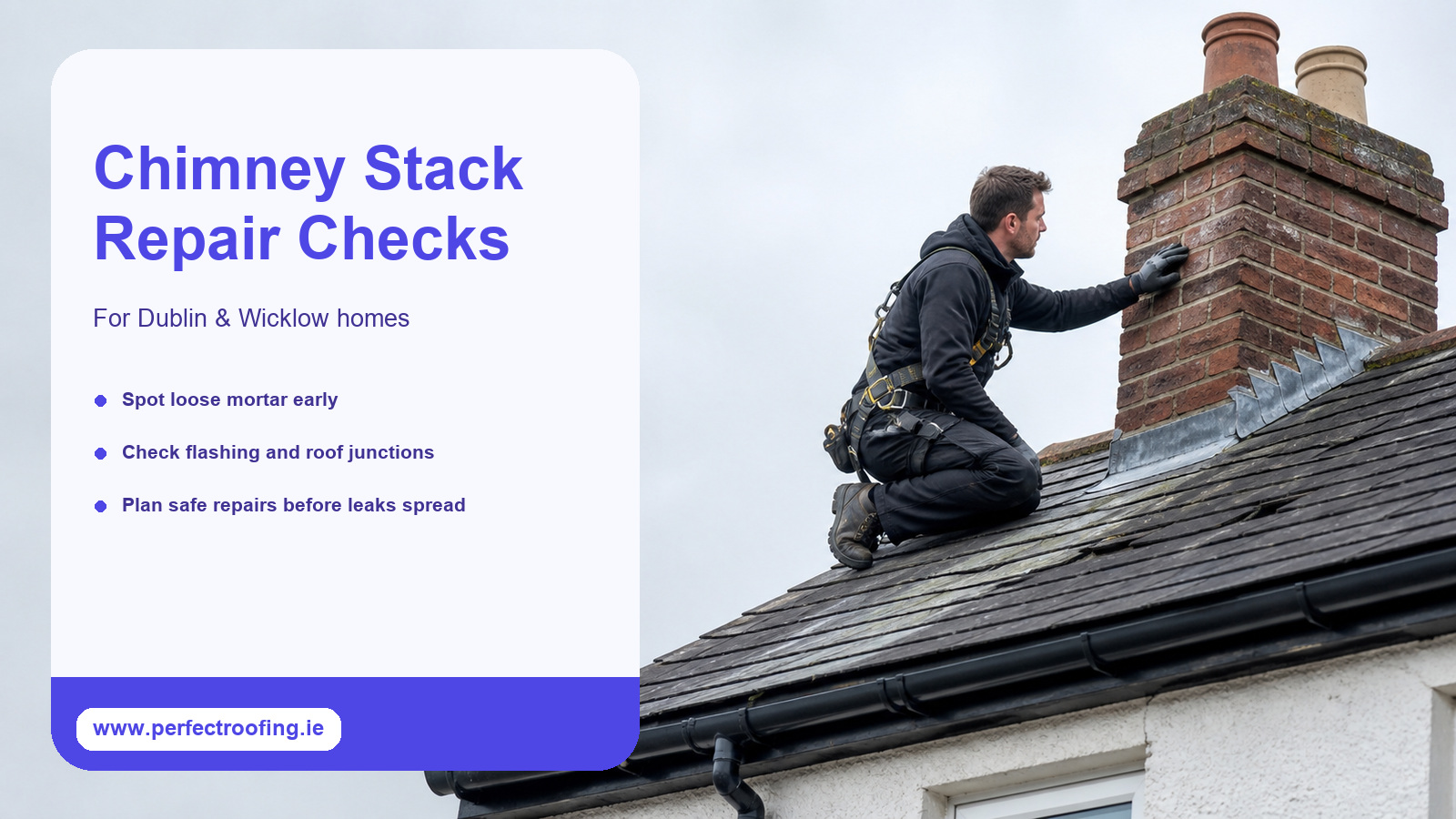
A chimney stack has to deal with rain, wind, temperature changes, and water running across the roof around it. When the mortar starts to loosen, bricks crack, or flashing opens at the roof junction, a small defect can become a stubborn source of damp.
For homeowners in Dublin City, North Dublin, South Dublin, Lucan, Bray, Wicklow, Naas, and nearby areas, chimney trouble does not always announce itself with a visible leak. It may begin as a few loose mortar joints, staining around the fireplace, damp in the attic, a cracked render finish, or a small ceiling mark after heavy rain.
This guide explains what to look for safely from ground level or inside the house, what chimney repointing can and cannot solve, and when to arrange a professional roof inspection.
Why chimney stacks need regular attention
Unlike much of the roof, a chimney stands above the roofline and is exposed on every side. Water can enter through failing mortar, damaged brickwork, a cracked chimney crown, open flashing, loose roof coverings, or defects where the chimney meets the roof.
On older Dublin terraces and period homes, the chimney may have had several repairs over the years. A newer patch of mortar can sit beside older, weathered joints. In Bray and Wicklow, more exposed wind-driven rain can make weak details show up sooner. The visible problem is not always the whole story.
Common chimney-related issues include:
- Mortar joints that are cracked, recessed, soft, or missing
- Loose, spalled, or cracked bricks
- Cracked render or open joints around the stack
- Damaged flaunching around chimney pots
- Loose, split, or poorly dressed lead flashing
- Slipped slates or tiles beside the chimney
- Moss and debris holding moisture at roof junctions
- Damp marks on chimney breast walls, ceilings, or attic timbers
- A chimney pot, cowl, or cap that appears loose or damaged
These signs do not all need the same repair. A sound diagnosis matters because repointing, flashing work, roof-covering repairs, and chimney-top repairs deal with different water paths.
What does chimney repointing involve?
Repointing means carefully removing failed mortar from between sound bricks and renewing the joints with an appropriate mortar. The aim is to restore the weatherproof face of the masonry without damaging the surrounding brickwork.
It can be suitable when the bricks themselves are largely sound but the mortar joints have become open, crumbly, or deeply recessed. It is not simply a case of smearing new mortar over the face of old joints. Surface-only patches can crack or detach if the loose material below has not been addressed.
For some older homes, the mortar choice needs particular care. The age and condition of the brickwork, previous repairs, exposure, and the rest of the chimney construction all affect the right approach. A roofer should assess the stack before recommending a quick cosmetic patch.
Safe checks you can make from ground level
Do not climb onto the roof, lean a ladder against a gutter, or try to reach a chimney from an upstairs window. Chimney work needs suitable access and safety equipment.
You can still gather useful clues safely. From the ground, a garden, or a clear upstairs window, look for:
- Dark gaps or deep shadows between bricks where mortar appears to be missing
- Bricks that look cracked, flaking, misaligned, or loose
- A chimney top that looks uneven or broken around the pots
- Lead flashing that appears lifted, split, or pulled away from the wall
- Slates or tiles beside the stack that are slipped, cracked, or unusually mossy
- Staining on the chimney breast after rain
- Damp in the attic close to the chimney, especially around the roof junction
- Debris in gutters below the stack, such as mortar fragments or pieces of tile
Take clear photos from a safe position if possible. A wide photo that shows the whole chimney and roof slope, plus a closer photo of the visible concern, can help Perfect Roofing plan an inspection.
Repointing is not the same as flashing repair
A chimney stack and its roof junction are closely connected, but they are not the same element. Repointing repairs mortar joints in the chimney masonry. Flashing directs water away where the roof meets the chimney.
| If the main issue is... | The inspection may need to focus on... |
|---|---|
| Open or crumbling joints between otherwise sound bricks | Chimney repointing and the condition of adjacent brickwork |
| Water marks just below the roofline or around the chimney breast | Lead flashing, soakers, slates or tiles, and the roof junction |
| Loose or cracked material around chimney pots | Flaunching, pots, caps, cowls, and the top of the stack |
| Damp in an attic near the chimney | Roof underlay, flashing, adjoining roof covering, and ventilation as well as the stack |
| Water overflowing near the chimney area | Valleys, gutters, back gutters, outlets, and debris routes as well as chimney details |
Sometimes several repairs are needed together. For example, a stack may need targeted repointing while the adjoining flashing and a slipped slate are repaired at the same visit. In other cases, the mortar can look tired but the active leak is actually coming from a roof detail above or beside the chimney.
Clues that the roof junction needs attention too
Water naturally collects and changes direction where a chimney interrupts a roof slope. This is why the leadwork and roof covering around the stack should be assessed with the masonry.
Ask for the inspection to check:
- Step flashing, cover flashing, and soakers where applicable
- The condition and overlap of nearby slates or tiles
- Back gutters or saddle details on the uphill side of the chimney
- Valleys, roof-wall junctions, and outlets that direct water toward the stack
- Underlay and battens if there are signs of water entering the roof space
- Mortar, render, brickwork, pots, cowls, and flaunching at the top of the chimney
- Gutters and downpipes below, especially if debris from the stack has collected there
This joined-up check helps avoid paying for a chimney repair while a separate roof-junction problem remains untreated.
When a local repair may be enough
A targeted repair can make sense when the defect is clearly localised and the surrounding stack and roof junction are in good condition. Examples include a few failed mortar joints, a small flashing defect, a loose cowl, or one or two damaged slates beside the chimney.
The right scope still depends on access and the condition of the surrounding work. If a stack has widespread open joints, repeated damp marks, cracked bricks, and ageing flashing, repeated spot patches may not be the most sensible long-term plan.
An inspection should explain:
- Where water is likely entering
- Which parts of the stack and roof junction are affected
- Whether the repair is local or more widespread
- What access is needed to complete the work safely
- Which nearby details should be monitored after repair
Avoid these common mistakes
Chimney defects can look simple from the ground, but rushed repairs often miss the route water is taking.
- Do not climb onto the roof or chimney without proper safety equipment and access.
- Do not seal visible cracks with a generic surface product and assume the leak path is fixed.
- Do not ignore loose mortar falling into gutters or onto paths.
- Do not replace a cowl or cap without checking the condition of the chimney top and its fixing.
- Do not assume a ceiling stain directly below a chimney means the masonry alone is at fault.
- Do not delay an inspection if brickwork, pots, or flashing look loose after bad weather.
Chimney repairs across Dublin and nearby areas
Perfect Roofing carries out practical chimney and roof repair assessments for homes across Dublin City, North Dublin, South Dublin, Lucan, Bray, Wicklow, Naas, and nearby areas. Older terraces may need careful work around shared rooflines and restricted access. Semi-detached homes can have a mix of original chimney details and newer extensions. More exposed properties around Bray and Wicklow may need especially careful attention to weather-facing masonry and flashing.
The aim is the same in every area: identify the actual water route, explain the repair scope clearly, and make sure the chimney, roof covering, flashing, gutters, and surrounding junctions are considered together.
Ask Perfect Roofing to check your chimney stack
If you have noticed loose mortar, cracked bricks, damp around a chimney breast, staining in the attic, failed flashing, or a chimney pot that does not look secure, contact Perfect Roofing by WhatsApp, phone, or email.
We can inspect the chimney stack and the surrounding roof safely, explain whether repointing, flashing repair, roof-covering work, or a combined repair is most appropriate, and recommend a plan that suits your roof, access, weather exposure, budget, and long-term plans.
Need a roofer to take a look?
Send a few photos on WhatsApp, email us, or tap the number to call. We cover Dublin City, North Dublin, South Dublin, Lucan, Bray, Wicklow, Naas, and nearby locations.