Roof Inspections
Drone Roof Inspection vs Close Inspection for Dublin Homes
Compare drone roof photos with close and attic inspections, understand their limits, and ask the right questions before booking a roof assessment in Dublin.
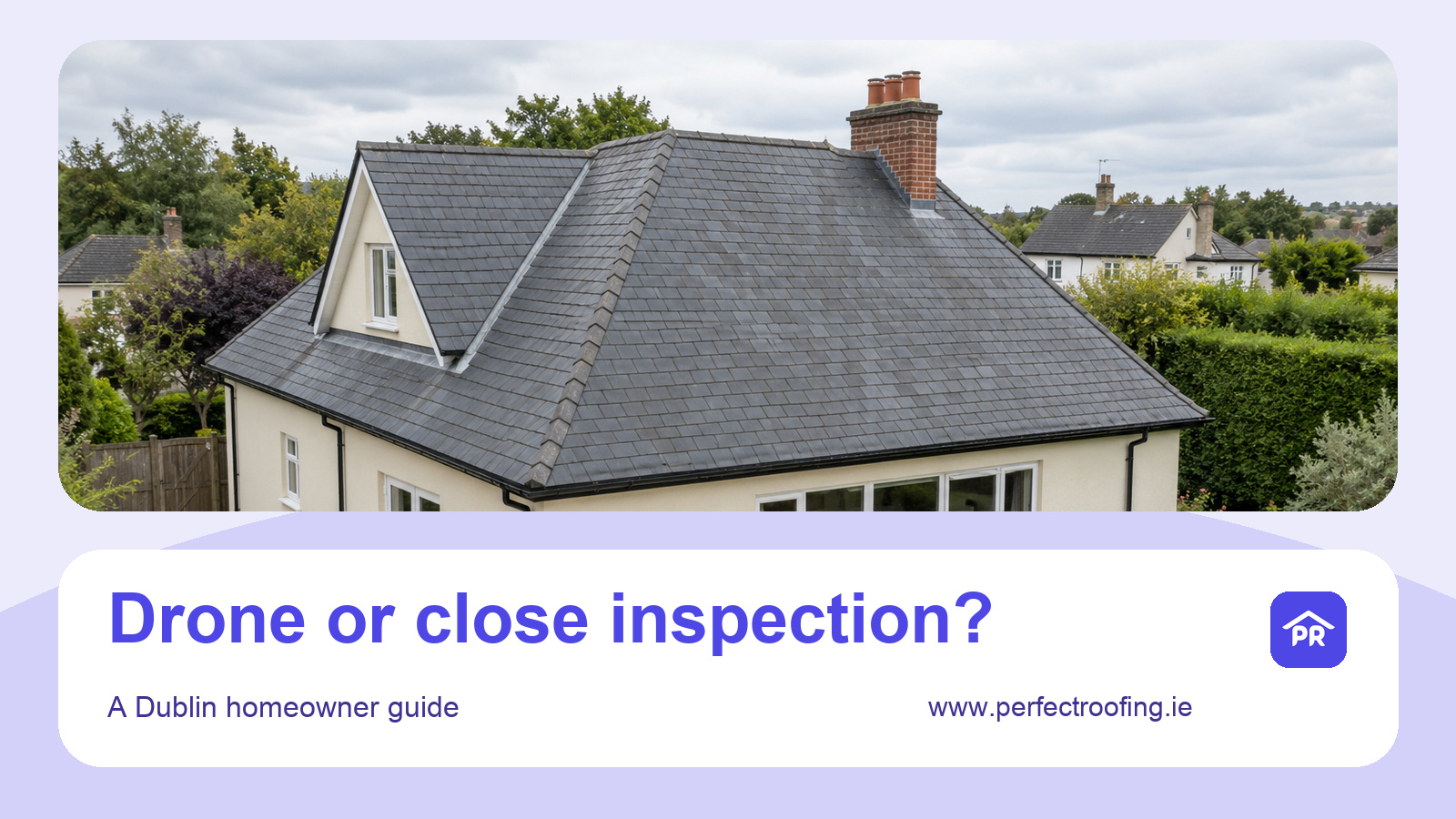
A clear aerial photograph can reveal a roof slope that you cannot see from the garden. But a drone roof inspection and a close inspection answer different questions. Neither method automatically explains everything happening beneath the roof covering.
For Dublin homeowners comparing inspection options, the best starting point is the problem you need assessed. Are you looking for a record of visible condition, investigating a recurring leak, or deciding the scope of future work? That purpose should shape the inspection and the information you receive afterwards.
What can drone roof photographs show?
Where a flight is appropriate and the images are sufficiently detailed, aerial photography can help document visible parts of a roof that are difficult to view from ground level.
Useful subjects may include:
- Displaced or visibly broken slates and tiles.
- The visible condition of ridge and hip coverings.
- Exposed chimney surfaces and surrounding roof junctions.
- Debris in visible gutters or valleys.
- The overall layout of roof slopes, extensions, and roof windows.
The advantage is a broader external view without someone needing to reach every photographed area physically. The limitation is that image quality, viewing angle, obstructions, and the person interpreting the photographs all affect what can be concluded.
A folder of photographs is useful evidence, but ask whether the service includes an explanation of findings and recommended next steps.
What cannot an external aerial image confirm?
An ordinary roof photograph cannot see through slates, tiles, or a waterproof covering. It cannot establish the condition of concealed battens, underlay, fixings, or timber simply because the surface looks tidy.
It also cannot, on its own, prove that an apparent gap is the source of an indoor leak. The position of a ceiling stain and the visible external defect need to be considered together with the roof construction and the history of water entry.
RICS explains why drone imagery needs professional interpretation, including how external observations may need an internal roof-space inspection to establish the cause of a defect.
Treat statements such as “the roof looks fine” cautiously if significant areas were hidden or the concern involves materials below the surface. Ask what was checked and what remains unknown.
How does a close roof inspection differ?
A close inspection uses suitable access to examine selected details at shorter range. Depending on the agreed scope, it may help assess a suspect junction, the condition of a component, or whether further investigation is needed.
Close access does not automatically include lifting roof coverings or opening up concealed areas. Those are separate decisions that should be agreed in advance, including how the area will be protected and made good.
| Inspection approach | Where it can help | Main limitation |
|---|---|---|
| Ground-level observation | Initial overview and visible external symptoms | Some slopes and details may be out of sight |
| Drone photography | External views of otherwise difficult-to-see roof areas | Shows visible surfaces; interpretation and image quality matter |
| Close inspection with suitable access | Focused examination of suspect details | Access and the agreed scope may restrict what can be checked |
| Roof-space inspection | Visible underside, staining, and accessible internal roof details | Insulation, boarding, finishes, and unsafe access can hide areas |
| Agreed opening-up investigation | Selected concealed details that need checking | Requires a specific plan, protection, and making good |
These methods can complement each other. An external overview may identify where a closer examination would be useful, while an attic assessment may provide context for an apparent surface defect.
Which approach suits your Dublin home?
The useful choice depends on the roof and the question, rather than the appeal of a particular camera or access method.
For a Dublin City terrace, a rear slope or chimney junction may be difficult to see from the street. Ask how the inspection will cover those areas and identify anything left unseen.
For a North Dublin semi-detached home, an external overview might be enough to record an obvious displaced tile, but a recurring leak could still require a targeted investigation. A South Dublin house with an extension may need several roof junctions considered together.
Before choosing an inspection, explain:
- Whether there is active water entry or only a visible concern.
- Which room or roof area is involved.
- When the symptoms started and whether previous work changed them.
- Whether earlier inspection photographs or repair records exist.
- What access is available to the garden and roof space.
If you are buying a property, discuss the roof findings with your surveyor as well. Our pre-purchase roof inspection checklist can help you prepare questions.
What should you ask before booking?
Compare the scope and outcome of each proposal. Do not assume two services described as a “roof survey” include the same work.
Ask the provider:
- Which roof areas will be examined, and using which methods?
- Who will interpret the photographs and explain the findings?
- Is an internal roof-space assessment included where appropriate?
- Will inaccessible areas and inspection limitations be recorded?
- Are photographs, written findings, and repair recommendations included?
- Is any opening-up work excluded or separately quoted?
- What happens if conditions prevent the planned inspection?
Ask about any proposed drone flight separately, including whether it is suitable for the site and who will arrange it. Confirm availability with the provider before booking.
Keep inspection access safe
Do not climb onto a roof without proper access, safety equipment, and competence, or step onto a flat roof because it appears solid. Avoid entering an attic where safe footing and access have not been established.
The RICS inspection safety checklist highlights the need to assess safe access and explain inspection restrictions. A limited inspection should lead to clearly stated limitations and a plan for any further checks needed.
You can help by sharing existing paperwork and taking photographs from indoors or ground level where it is safe to do so.
Ask Perfect Roofing about the right assessment
If you have aerial photographs, a survey finding, or a roof concern, contact Perfect Roofing to discuss the next assessment. Tell us your location, what you have noticed, and which areas have already been inspected.
We help homeowners in Dublin City, North Dublin, South Dublin, Lucan, and nearby areas with roof inspections, maintenance planning, and repair advice. We can discuss an appropriate next step based on your roof, weather exposure, access, budget, and long-term plans.
Message us on WhatsApp, call 083 066 3462, or email hi@perfectroofing.ie to arrange a discussion about your roof.
Need a roofer to take a look?
Send a few photos on WhatsApp, email us, or tap the number to call. We cover Dublin City, North Dublin, South Dublin, Lucan, Bray, Wicklow, Naas, and nearby locations.