Roof Repairs
Fascia, Soffit, and Verge Repair Checks for Lucan and North Dublin Homes
A practical roofline guide for spotting fascia, soffit, gutter-edge, and verge problems around homes in Lucan, North Dublin, Dublin City, Bray, Wicklow, Naas, and nearby areas.
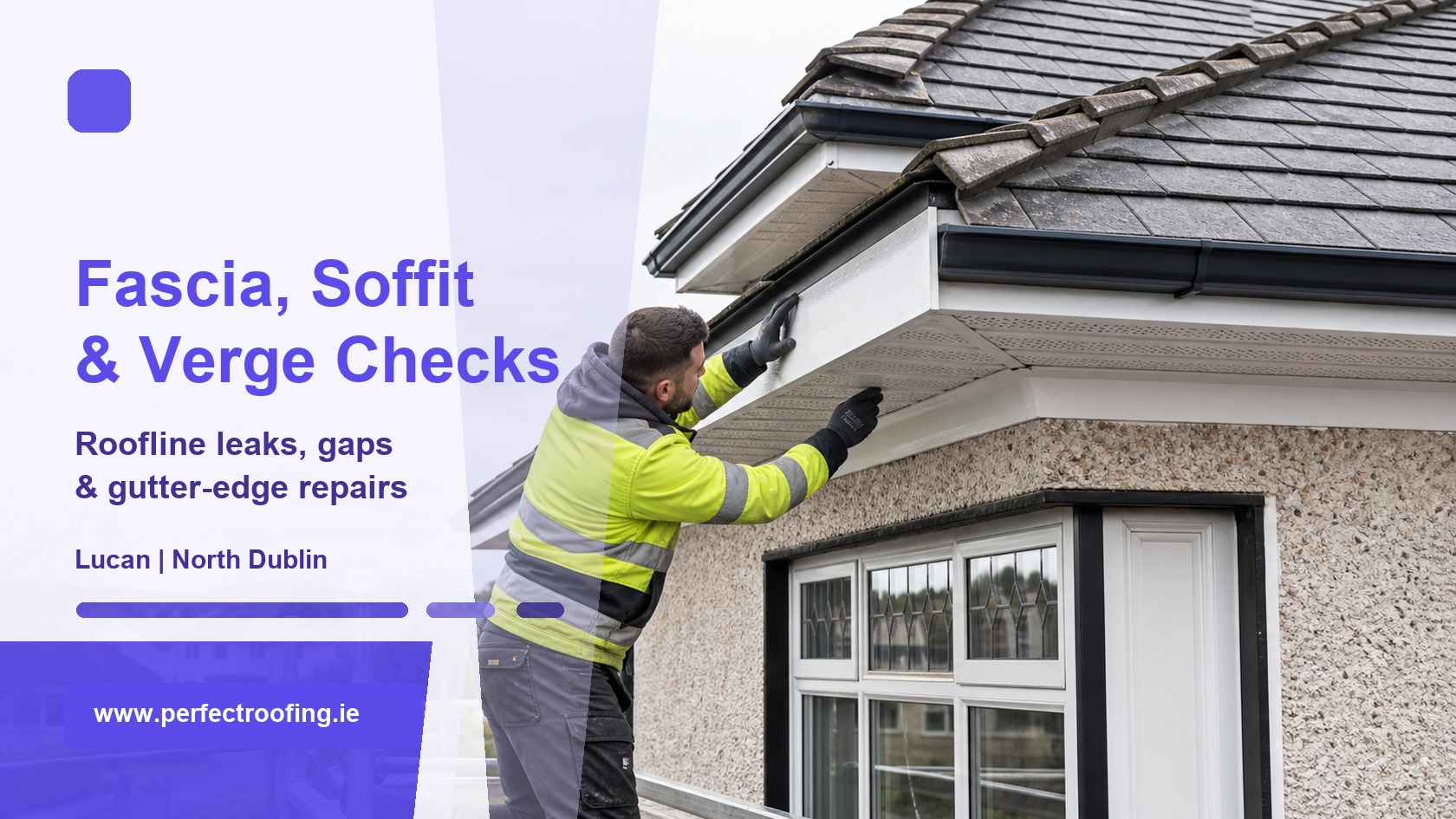
Fascia, soffit, gutters, and verge details sit at the edges of the roof, so they are easy to overlook until something starts moving, staining, overflowing, or letting water behind the roofline. These parts do not just tidy up the roof edge. They help protect the rafters, support gutter runs, close gaps at the eaves, and finish the roof where slates or tiles meet the side of the house.
For homeowners in Lucan, North Dublin, Dublin City, South Dublin, Bray, Wicklow, Naas, and nearby areas, roofline problems often show up gradually. A small gap beside a verge tile, a loose gutter bracket, peeling fascia paint, or a damp patch near an upstairs corner can be an early warning that the edge of the roof needs attention.
This guide explains what you can check safely from the ground, why fascia and soffit problems happen, and when to ask Perfect Roofing to inspect the roofline properly.
What fascia, soffit, and verge details do
The roofline is the collection of parts around the outer edge of the roof. On many homes, it includes:
- Fascia boards: the vertical boards along the lower roof edge, often supporting gutters.
- Soffits: the boards or panels underneath the eaves, sometimes with ventilation openings.
- Verges: the sloping side edges of a pitched roof, where tiles or slates finish against the gable.
- Gutters and downpipes: the rainwater system that should carry water away from the roof and walls.
- Eaves ventilation: openings or vents that help air move into the attic space where the roof design needs it.
When these details work together, rainwater leaves the roof cleanly and the timber edge of the roof stays protected. When one part moves or fails, water can track into places that are harder to see from outside.
Safe signs to look for from the ground
Do not climb a ladder or walk on a roof to inspect fascia, soffits, or verges unless you have proper access equipment and training. Many useful warning signs can be spotted from the garden, driveway, street, attic, or an upstairs window.
Look for:
- Gutters pulling away from the fascia or dipping between brackets
- Water spilling behind the gutter instead of into it
- Dark stains, green algae, or peeling paint on fascia boards
- Cracked, loose, bowed, or missing soffit panels
- Birds, insects, or debris entering gaps at the eaves
- Gaps at the verge where mortar, dry verge units, slates, or tiles have moved
- Damp marks on internal ceilings near external walls
- Rotten-looking timber, soft patches, or visible splits at the roof edge
- Downpipes that rattle, leak at joints, or discharge too close to the wall
Take wide photos from a safe position if you are contacting a roofer. A close-up of one loose section helps, but a wider photo showing the gutter run, roof edge, wall, and nearby roof details is often more useful.
Why roofline problems happen
Roof edges face wind, rain, movement, moss, blocked gutters, and repeated maintenance work over the years. The problem is not always one dramatic failure. More often, several small issues combine.
Common causes include:
- Old timber fascia boards losing their protective finish
- Gutter brackets fixed into weak, wet, or split timber
- Blocked gutters holding water against the fascia
- Downpipes blocked by leaves, moss, grit, or broken roof material
- Verge mortar cracking or falling away on exposed gable ends
- Dry verge or edge units moving because fixings or surrounding tiles have failed
- Soffit ventilation blocked by paint, debris, insulation, or past repairs
- Previous patch repairs that did not deal with the source of water entry
Homes in Lucan and North Dublin often have extensions, dormers, bay roofs, and mixed rooflines where old and new details meet. Dublin City terraces can have tight eaves and awkward access. Bray and Wicklow properties may also have more exposed roof edges depending on location and orientation.
Fascia and gutter problems often arrive together
A gutter may look like the main issue because overflowing water is easy to see. Sometimes cleaning the gutter is enough. Other times, the gutter is only showing a deeper roofline problem.
The fascia may need closer inspection when:
- The gutter keeps sagging soon after being refixed
- Brackets no longer hold firmly
- Water is running behind the gutter onto the wall
- The fascia board looks swollen, cracked, or rotten
- There are stains on the soffit below the gutter
- A downpipe leak keeps wetting the same section of roofline
Replacing a gutter without checking the fascia can leave the same weak fixing points in place. A proper roofline repair should look at the gutter fall, outlet positions, downpipe flow, fascia condition, and the roof covering above.
Soffit issues can affect ventilation and damp
Soffits are easy to ignore because they sit underneath the roof edge, but they can be important for ventilation and weather protection. Some homes have vented soffits that allow air into the roof space. Others use different roof ventilation details, so the right repair depends on the roof design.
Soffit problems are worth checking when you notice:
- Cracked or missing panels under the eaves
- Paint peeling or timber staining near the roof edge
- Gaps where birds or insects can enter
- Damp insulation near the eaves inside the attic
- Musty attic air or condensation signs near the roof edge
- Previous repairs that have blocked ventilation openings
Do not seal every gap at the eaves without understanding whether it is meant to provide airflow. Blocking ventilation can make attic moisture problems worse, while leaving a weather gap open can let rain, debris, or pests enter. The roofline needs the right balance for the house.
Verge details need attention on exposed gable ends
The verge is the side edge of a pitched roof. On a gable end, it may be finished with mortar, tiles, slates, undercloak, dry verge units, or a combination of details from different repair periods.
Verge problems can lead to:
- Wind lifting edge tiles or slates
- Rain being driven under the roof covering
- Mortar falling onto paths, driveways, or lower roofs
- Damp patches near the inside of a gable wall
- Repeated small leaks after windy rain
- A ragged roof edge that keeps losing pieces after each repair
A verge repair should not be judged only by how neat it looks from the ground. The roofer should check the nearby slates or tiles, battens, underlay, fixings, roof pitch, exposure, and how the edge is finished.
When a small repair is enough
Some roofline jobs are local and straightforward. A small repair may be enough when:
- One gutter joint or bracket has failed but the fascia is sound
- A short section of soffit has cracked but the surrounding roofline is dry
- A limited verge section has moved and the nearby roof covering is secure
- The problem is clearly linked to a blocked outlet or downpipe
- There are no repeat damp marks inside the home
Even then, it is worth checking what caused the fault. A loose bracket may be simple. A loose bracket fixed into soft timber is a different repair.
When wider roofline work may be better
Wider repair or replacement planning may make more sense when several roof edge details are failing at once. This is especially true if access equipment is already needed.
Consider a fuller inspection when:
- Gutters, fascia, soffits, and downpipes all show age or movement
- Several verge sections have cracked or opened up
- Damp has reached rafters, eaves, or attic insulation
- The roofline has been patched repeatedly
- A roof replacement, flat roof repair, Velux installation, or gutter replacement is being planned nearby
- Safe access will be a large part of the job cost
The aim is not to replace parts unnecessarily. It is to avoid paying for repeated access and small repairs when the roof edge needs a more joined-up fix.
What Perfect Roofing checks during a roofline inspection
When Perfect Roofing inspects fascia, soffit, gutter, or verge problems, we look at the edge of the roof as one system rather than one isolated board or joint.
A practical inspection may include:
- Gutter alignment, bracket spacing, joints, outlets, and downpipes
- Fascia board condition and whether fixings are holding properly
- Soffit panels, eaves gaps, and ventilation openings
- Verge mortar, dry verge units, edge tiles, slates, and undercloak details
- Nearby ridges, hips, valleys, chimneys, dormers, and flat roof edges
- Signs of water tracking behind the gutter or into the attic
- Whether a local repair, partial replacement, or wider roofline upgrade is the sensible option
This matters because water does not respect neat labels. A stain near a soffit may start at a gutter. A gutter overflow may be fed by moss from the roof. A verge leak may be linked to loose tiles further up the slope.
Roofline checks for Lucan, North Dublin, and nearby homes
Different areas bring different roofline details. Lucan homes often have extensions, porch roofs, and mixed gutter runs. North Dublin properties can have long exposed roof edges, older fascia boards, and weathered gable ends. Dublin City homes may have tight access, parapets, and shared terrace details. Bray and Wicklow houses can be more exposed to wind-driven rain depending on their position.
That local context matters, but the inspection principle is the same: check how water leaves the roof, how the roof edge is protected, and whether the visible symptom is part of a bigger roofing issue.
Perfect Roofing helps homeowners with fascia and soffit repairs, gutter repairs and replacements, verge repairs, roof inspections, roof repairs, flat roofing, Velux windows, skylights, roof ventilation, and roof replacement planning across Dublin City, North Dublin, South Dublin, Lucan, Bray, Wicklow, Naas, and nearby areas.
Ask Perfect Roofing before the roofline gets worse
If you can see sagging gutters, stained fascia, loose soffits, cracked verge details, or damp near an external wall, do not climb onto the roof to investigate it yourself. Take photos from a safe place and note when the problem appears, especially after rain or wind.
Contact Perfect Roofing by WhatsApp, phone, or email for practical advice, a roofline inspection, or a repair quotation. We can help decide whether the issue is a small gutter or fascia repair, a soffit ventilation concern, a verge repair, or part of a wider roof repair plan.
Need a roofer to take a look?
Send a few photos on WhatsApp, email us, or tap the number to call. We cover Dublin City, North Dublin, South Dublin, Lucan, Bray, Wicklow, Naas, and nearby locations.