Roof Windows
Old Roof Window: Repair or Replace? A Dublin City and Wicklow Guide
Learn when an older roof window may need a focused repair, new flashing, or full replacement, plus what Dublin City and Wicklow homeowners should ask before work starts.
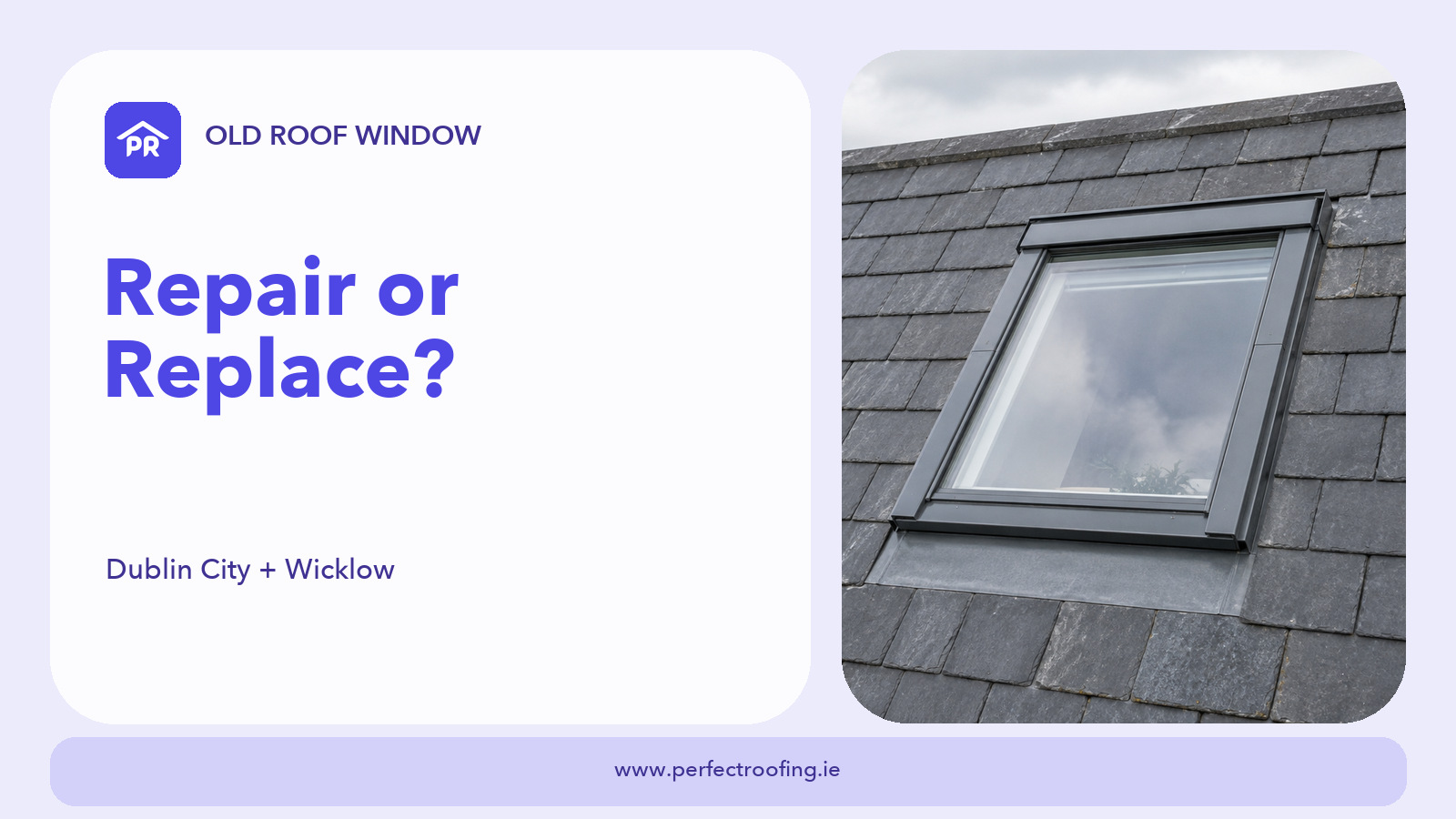
An older roof window can become stiff, draughty, stained, or difficult to close without the whole unit necessarily being beyond repair. In other cases, repeated patching around the frame only delays a replacement that would deal with the window, flashing, insulation, and surrounding roof covering together.
For homeowners in Dublin City, Wicklow, and nearby areas, the useful first step is to separate a roof-window fault from a problem in the roof around it. This guide explains the signs to record, when a focused repair may be sensible, when replacement deserves serious consideration, and what a clear quotation should include.
Is the window failing, or is water arriving from elsewhere?
A damp mark beside a VELUX window, skylight, or other pitched roof window does not prove that the frame or glazing is leaking. Water can enter higher up the roof and travel along underlay, battens, rafters, or internal linings before appearing beside the opening.
Possible sources include:
- A slipped slate or cracked tile above the window
- Damaged, poorly fitted, or debris-filled flashing around the frame
- A roof valley, chimney, ridge, or wall junction further up the slope
- Torn or badly lapped underlay around the opening
- Moss, leaves, or grit slowing drainage beside the window
- Condensation on cold glazing, frames, fixings, or poorly insulated reveals
- A sash, seal, hinge, handle, or closing mechanism that no longer works properly
Note when the problem appears. Staining that follows wind-driven rain suggests a different investigation from moisture that forms on cold mornings or after showers. A professional inspection should follow the evidence rather than assume every mark needs a new window.
Signs a focused repair may be enough
A repair may be practical when the roof window is otherwise sound and the defect is limited. Depending on the findings, the work might involve the window mechanism, local flashing, nearby roof coverings, drainage channels, or internal finishing.
A focused repair is more likely to suit when:
- The frame and sash remain firm and close evenly
- The glass is intact and there is no moisture trapped between panes
- One hinge, handle, seal, or operating part needs attention
- Debris is obstructing an external drainage path
- One flashing section has moved or been installed poorly
- A small number of surrounding slates or tiles are damaged
- The leak can be traced to a separate roof defect above the window
- There is no long history of failed patch repairs around the opening
The repair should address the cause, not only cover the visible gap with sealant. Ask how water is meant to move around the window and how the proposed work restores that route.
Signs replacement may be the better long-term option
Replacement becomes more attractive when several parts are ageing together or the unit no longer performs reliably in everyday use.
It may be worth comparing replacement options when:
- The timber frame is soft, swollen, split, or badly deteriorated
- The sash is warped, repeatedly sticks, or will not close securely
- Moisture or misting is trapped inside the glazing unit
- Draughts remain after basic adjustments and seal checks
- The window has been patched several times without solving the problem
- Flashing and surrounding roof details need extensive correction
- Replacement parts cannot be matched confidently to the existing unit
- The roof covering, underlay, battens, or insulation around the opening also need work
- The room would benefit from a different opening style, operation method, or window size
Age alone does not decide the issue. A well-fitted older unit may still be serviceable, while a newer window can cause trouble if the flashing or surrounding roof build-up is wrong.
What should be checked before specifying a replacement?
Replacing a roof window is not simply a matter of measuring the visible glass. The installer needs to understand the existing opening and the roof around it.
Important checks include:
- Window identification: Look for the model and size plate from inside if it is safely accessible. A clear photograph can help with early planning.
- Roof covering: Slate, tile, profile, thickness, and condition affect the flashing and reinstatement work.
- Roof pitch and exposure: The proposed window and flashing arrangement must suit the actual roof slope and weather exposure.
- Opening size: A like-for-like replacement may reduce internal alteration, while a larger or differently positioned unit can involve more structural and finishing work.
- Underlay and battens: These should connect neatly around the opening so water is directed outside.
- Insulation and internal lining: Cold gaps and poorly shaped reveals can contribute to draughts and condensation.
- Access: Scaffolding or another safe access system may be needed, particularly on tall Dublin City terraces or exposed Wicklow roofs.
- Operation: Manual, electric, or solar operation should suit the window height, room use, wiring possibilities, and future maintenance.
Do not order a unit from the visible pane dimensions alone. The full frame size, roof opening, flashing type, and surrounding construction need to be confirmed.
Should the roof window be replaced during wider roof work?
Roof repairs and roof-window work often overlap. If scaffolding is already being arranged for slate repairs, chimney work, a roof replacement, or gutter and fascia work, it may be sensible to inspect an ageing window at the same time.
Combining the work can make particular sense when:
- The roof covering around the window is already being lifted
- Old underlay or battens need renewal
- Previous flashing patches will be disturbed by the roof work
- The internal room is due to be redecorated
- More than one roof window needs inspection
- Ventilation, insulation, or condensation problems need a joined-up solution
That does not mean every roof project requires new windows. A sound unit may be carefully retained and re-flashed where the system and condition allow. The quotation should explain what will stay, what will change, and how the weatherproof layers will connect.
Repair, re-flash, or replace: a quick comparison
| Option | May suit | Ask about |
|---|---|---|
| Focused repair | A sound frame with one local mechanism, seal, slate, tile, or drainage issue | The confirmed cause, compatible parts, access, and how the repair will be tested |
| Re-flashing and local roof work | A serviceable window with defective flashing or surrounding roof details | Matching the roof covering, underlay laps, drainage above the frame, and internal making-good |
| Full replacement | A deteriorated, repeatedly troublesome, or unsuitable unit | Frame size, glazing, opening style, flashing kit, insulation, lining, access, and waste removal |
The best route depends on the complete opening. A cheap local patch can be poor value if the frame is already failing, while full replacement is unnecessary when the window is sound and the water is coming from one slipped slate above it.
What should a roof-window quotation include?
Before approving work, ask for a clear description of the scope. Useful questions include:
- What evidence points to the window, flashing, surrounding roof, or condensation?
- Can the existing model and size be identified?
- Is the proposed job a repair, re-flash, or complete replacement?
- Which slates, tiles, battens, underlay, and internal finishes will be disturbed?
- How will insulation and air gaps around the frame be handled?
- Are the roof pitch and covering suitable for the proposed window and flashing?
- Is scaffolding or other access included?
- Will blinds, controls, cables, or internal trim need separate work?
- How will debris be removed and the room protected?
- Are nearby gutters, valleys, chimneys, or roof junctions part of the inspection?
A useful quotation should also explain any uncertainty. Hidden damage around an old opening may only become visible after roof coverings or internal trim are removed, so the process for agreeing additional work should be clear.
Local considerations in Dublin City and Wicklow
Dublin City homes can have tall terraces, tight rear access, older slate roofs, shared rooflines, and attic conversions completed at different times. Safe access and careful matching of surrounding roof materials may shape the repair plan as much as the window itself.
Wicklow properties range from town homes to more exposed rural and coastal roofs. Wind-driven rain, roof orientation, nearby trees, moss, and longer access routes can all affect inspection and detailing. Homes in Bray, South Dublin, North Dublin, Lucan, and Naas may have their own mix of extensions, dormers, pitched roofs, and flat-roof skylights.
Perfect Roofing can assess the roof window together with its flashing, underlay, roof covering, insulation, internal evidence, and nearby drainage details. That wider view helps avoid replacing the window when the real problem sits elsewhere.
Ask Perfect Roofing whether to repair or replace
If an old roof window is stiff, draughty, misted, stained, or repeatedly leaking, take photographs from inside and note whether the symptoms follow rain, cold weather, or room use. If the identification plate is easy to reach from a stable floor, photograph that too. Do not climb onto the roof, lean out of the opening, or attempt high-level repairs without suitable safety equipment.
Contact Perfect Roofing by WhatsApp, phone, or email. We can inspect the window and surrounding roof, explain whether a focused repair, re-flashing, or replacement is appropriate, and recommend an option based on the roof, room, weather exposure, access, budget, and long-term plans.
Need a roofer to take a look?
Send a few photos on WhatsApp, email us, or tap the number to call. We cover Dublin City, North Dublin, South Dublin, Lucan, Bray, Wicklow, Naas, and nearby locations.