Roof Inspections
Why Is My Roof Noisy in Wind? Checks for Dublin and Bray Homes
A practical guide to rattling, tapping, whistling, and flapping roof noises, including safe checks and when to arrange a roof inspection.
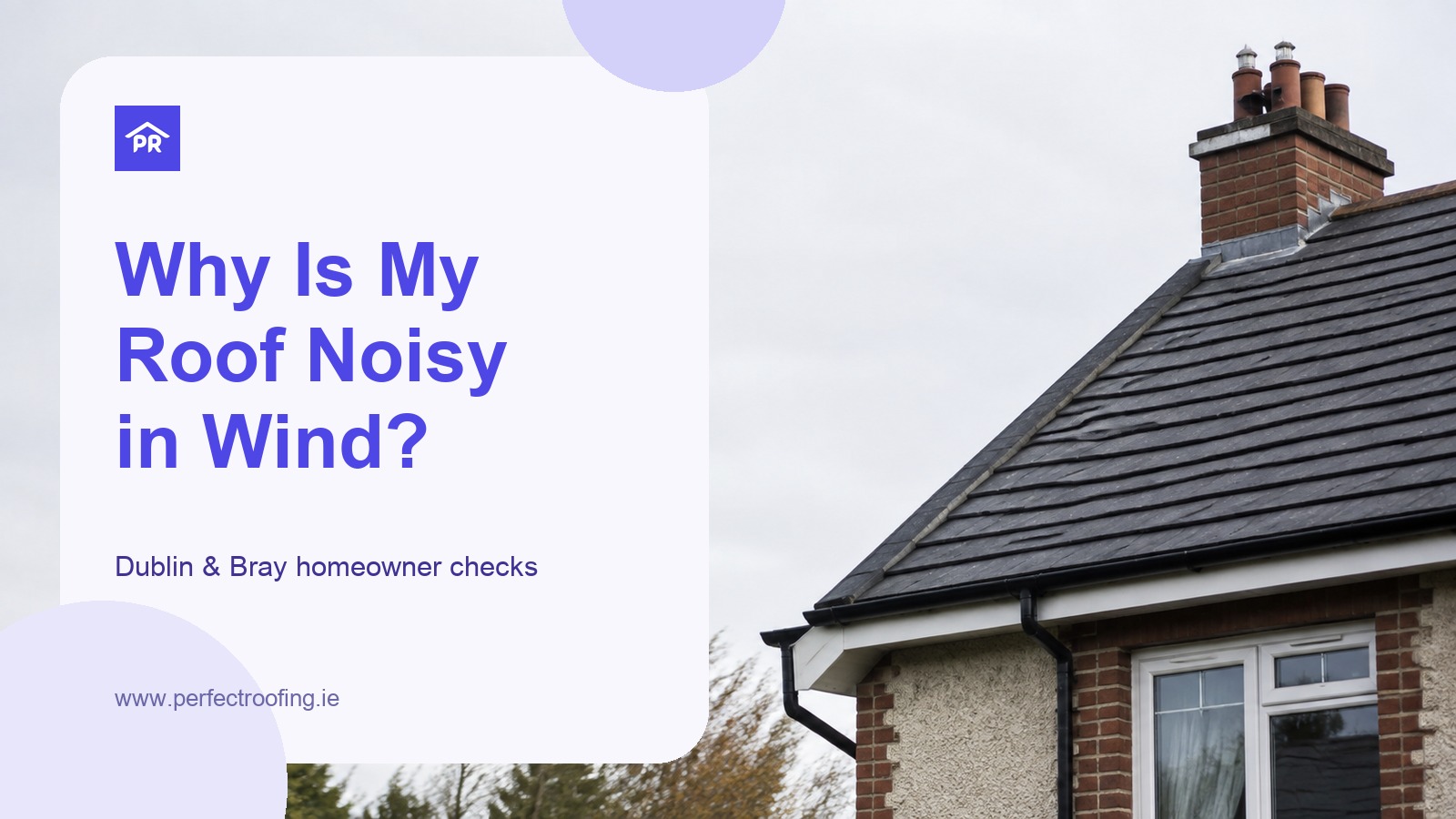
A roof that suddenly rattles, taps, whistles, or flaps in windy weather can be difficult to diagnose from inside the house. The sound may come from a loose roof component, but it can also travel through timber, pipework, gutters, vents, cables, or an attic space and seem to come from somewhere else.
For homeowners in Dublin, Bray, Wicklow, and nearby areas, the useful first step is to record the pattern rather than climb onto the roof. Note the type of sound, where it is loudest, which wind direction seems to trigger it, and whether anything has changed at the property recently. Those clues can make a professional inspection more focused.
What different roof noises may suggest
The sound alone cannot confirm a defect, but it can help narrow the inspection.
| Noise | Possible areas to check |
|---|---|
| Repeated tapping | Cable, aerial fitting, branch, loose trim, vent cover, gutter part, or flashing edge |
| Rattling or clattering | Slate, tile, ridge or verge detail, gutter bracket, cowl, flashing, or another loose fitting |
| Flapping | Underlay at an exposed edge, loose membrane, felt, temporary covering, fascia trim, or roofline component |
| Whistling | Small gap around a roof window, vent, flashing, eaves detail, soffit, or poorly sealed opening |
| Creaking | Timber movement, roof structure, ceiling components, tanks or pipework, especially as wind pressure changes |
| Scraping | Branches, cables, aerial parts, or another object making contact with the roof or gutter |
Several causes can create similar sounds. A tapping noise near a chimney might be loose leadwork, a cable against brickwork, or a cowl moving above the roofline. A whistle near a Velux window might relate to the window seal, surrounding lining, flashing, ventilation path, or a different opening nearby.
Start with safe observations indoors
You can collect useful information without going onto the roof. During the next windy spell, listen from different rooms and note whether the sound is strongest at the eaves, ridge, chimney, roof window, dormer, attic hatch, or an extension junction.
If the attic has a properly boarded, safely accessible area, look from inside without stepping between joists or disturbing insulation. Use a torch and stay well away from electrical equipment, stored items, and fragile ceiling areas.
Useful observations include:
- Whether the sound is louder in the attic than in the room below
- Whether any daylight is visible through an unexpected gap
- Whether underlay appears loose, torn, or moving
- Whether timber, water tanks, pipes, ducts, or cables move or vibrate
- Whether there are fresh damp marks, drips, debris, or daylight around a penetration
- Whether the noise occurs only from one wind direction
- Whether it continues after the wind has eased
Do not pull, press, or cut any roof component to test the sound. A small movement can worsen a gap or disturb an electrical cable, duct, or weatherproofing detail.
Check the roofline from ground level
Stand well back in a safe place and compare both sides of the roof. Binoculars or a camera zoom can help, but avoid leaning from an upper window or using a ladder.
Look for visible changes such as:
- A slate or tile sitting higher or lower than its neighbours
- A ridge or hip tile that appears out of line
- A loose verge, fascia, soffit, gutter, or downpipe section
- Lead flashing with an edge that appears lifted
- A chimney pot, cowl, cap, or aerial fitting that seems to move
- A branch, cable, or satellite lead touching the roof
- A roof vent or terminal that looks tilted or incomplete
- Debris in the garden or gutter after windy weather
Take one wide photograph showing the whole elevation and several closer photographs from the same safe position. Wide views help a roofer understand how the chimney, roof slope, extension, gutters, and adjoining property relate to the noisy area.
Loose slates, tiles, ridges, and verges
Roof coverings and their edge details receive direct wind pressure. A slate or tile may look almost normal from the ground but move enough to create an intermittent click or rattle. Ridge, hip, and verge details can also become noisy if a fixing, clip, mortar section, or dry-fix component is no longer secure.
The location matters. A sound near a gable may point toward the verge, fascia, soffit, or roof covering at the edge. Noise near the top of the roof may lead the inspection toward ridge details, vents, aerial fittings, or chimney components. On an extension or porch, the noise may come from a small edge trim or junction rather than the main roof.
Do not try to push a slate, tile, or ridge component back into place from a ladder. Roof coverings can be loose, brittle, or slippery, and a visible piece may not be the only defect.
Flashing, chimneys, vents, and roof windows
Thin metal edges and small roof fittings can transmit noise surprisingly well. Lead or metal flashing around a chimney, parapet, wall junction, pipe, or roof window may tap or vibrate if an edge has lifted or a fixing has failed. Cowls, caps, vents, and aerial components can also create a regular rattle as the wind changes direction.
Around a Velux window or skylight, an inspection may need to consider:
- The sash and seals
- External flashing and surrounding roof covering
- Internal lining and insulation gaps
- Ventilation openings
- Blinds, handles, trim, and room fittings that can imitate an external noise
Close and secure the window normally, then listen again. Do not force a stiff handle or dismantle a vent. If the sound changes when the window is closed, tell the roofer, but do not assume the window itself is necessarily at fault.
Gutters, fascia, soffits, and downpipes
Roofline components can knock, vibrate, or whistle during gusts. A loose gutter bracket may allow a section to move. A downpipe can tap against the wall. A soffit panel or fascia trim may lift slightly. Water, leaves, and small debris can also move through the system and create sounds that resemble a roof defect.
From the ground, check whether:
- A gutter run looks uneven or has pulled away from the fascia
- A downpipe bracket is loose or a pipe is touching another surface
- Soffit or fascia sections have a visible gap
- Overflow marks appear below a gutter joint or outlet
- A cable is rubbing against the gutter or roof edge
A simple roofline fault may be repairable without wider roof work, but the fixing surface also needs checking. Reattaching a bracket will not solve the problem if the fascia behind it is soft or damaged.
Why wind direction is a useful clue
A noise that appears only when wind reaches one side of the house can help identify the exposed elevation. This is particularly useful on semi-detached and terraced homes, where sounds can travel across shared roof timbers, party walls, gutters, and chimney structures.
Write down whether the sound is strongest at the front, rear, or gable side and whether it starts with light wind or only stronger gusts. If safe, record a short audio or video from inside. Include a spoken note with the room, time, and approximate wind direction. The recording may not capture the exact source, but it can document the rhythm and intensity.
Homes in coastal or elevated parts of Bray and Wicklow can have different exposure from sheltered Dublin streets. Even neighbouring houses can behave differently because of roof shape, extensions, trees, nearby buildings, and previous alterations. The repair should therefore follow an inspection of the actual property rather than a guess based on sound alone.
When a noisy roof needs prompt attention
Arrange an inspection promptly if the noise is new, getting worse, or accompanied by a visible change. Treat the situation as more urgent if you notice:
- A displaced slate, tile, ridge, flashing, or roofline component
- Pieces of roofing material in the garden or on a lower roof
- Fresh water entry, ceiling staining, or damp insulation
- A chimney pot, cowl, aerial, or vent that appears unstable
- A gutter, fascia, soffit, or downpipe section pulling away
- Noise after recent roof, solar, aerial, chimney, or roof-window work
- An opening where wind or rain can enter the roof build-up
Keep people, pets, and vehicles away from the area below any visibly loose component. Do not stand beneath the roof edge to watch it during strong wind, and do not climb onto the roof without proper access and safety equipment.
What a professional inspection may cover
A roof-noise inspection should follow the clues while checking connected details. Depending on the house and safe access, that may include:
- Slates, tiles, ridges, hips, verges, and eaves
- Chimney pots, cowls, caps, flaunching, and flashings
- Roof windows, skylights, vents, ducts, and pipe penetrations
- Gutters, brackets, fascia, soffits, outlets, and downpipes
- Aerials, cables, satellite fittings, and nearby branches
- Underlay, battens, timbers, tanks, and pipework visible from the attic
- Junctions with dormers, extensions, porches, parapets, and adjoining roofs
The aim is to identify the moving component and understand why it moved. Repairing only the sound without checking the fixing, surrounding material, and water path can leave the underlying issue unresolved.
Ask Perfect Roofing to investigate the noise
Perfect Roofing helps homeowners with roof inspections, roof repairs, emergency roof repairs, gutters, roof ventilation, flat roofing, Velux windows, skylights, and roof replacement planning across Dublin City, North Dublin, South Dublin, Lucan, Bray, Wicklow, Naas, and nearby areas.
If your roof rattles, taps, whistles, scrapes, or flaps in windy weather, contact Perfect Roofing by WhatsApp, phone, or email. Share safe ground-level photos, a short recording if available, the room where the noise is loudest, and the wind direction that seems to trigger it. We can inspect the likely source and recommend a practical next step based on the roof, exposure, access, condition, budget, and long-term plans.
Need a roofer to take a look?
Send a few photos on WhatsApp, email us, or tap the number to call. We cover Dublin City, North Dublin, South Dublin, Lucan, Bray, Wicklow, Naas, and nearby locations.