Roof Repairs
Roof Underlay and Felt Leak Checks for North Dublin and Wicklow Homes
A practical guide to spotting roof underlay and old sarking felt problems around tiled and slated roofs in North Dublin, Wicklow, Bray, Lucan, Naas, and nearby areas.
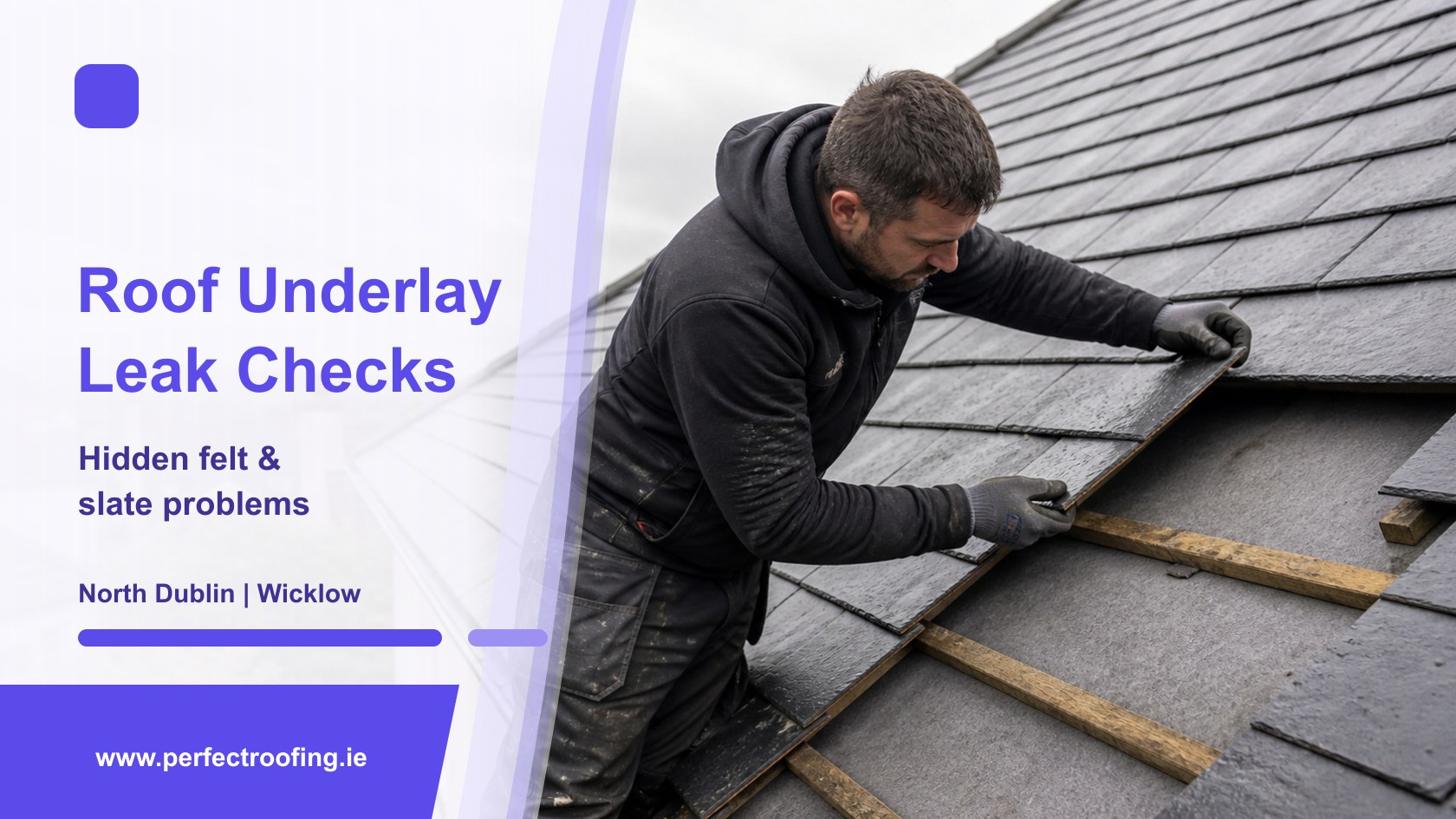
Roof underlay sits below the visible slates or tiles, so most homeowners never see it until a leak starts showing indoors. When it is working properly, it helps guide wind-driven rain, condensation, and small amounts of water safely down toward the gutter area. When it tears, sags, perishes, or is exposed by slipped roof coverings, water can reach timber, insulation, ceilings, and walls.
For homes in North Dublin, Wicklow, Bray, Lucan, Naas, Dublin City, South Dublin, and nearby areas, underlay problems are often found on older roofs, extension junctions, exposed roof slopes, and roofs that have had several small repairs over the years.
This guide explains the safe signs to check, why roof felt or underlay fails, and when Perfect Roofing may recommend a local repair, a more detailed inspection, or wider roof replacement planning.
What roof underlay does
Roof underlay is the layer installed beneath slates or tiles and above the rafters or roof deck. Depending on the age and design of the roof, people may call it roofing felt, sarking felt, membrane, breathable membrane, or underlay.
Its job is not to replace the roof covering. Slates, tiles, flashings, ridges, hips, valleys, gutters, and roof windows still need to shed rain correctly. Underlay is a backup layer that helps manage moisture that gets past the outer covering.
On many pitched roofs, underlay helps with:
- Wind-driven rain that gets under tiles or slates
- Water tracking from a cracked tile, slipped slate, or loose ridge detail
- Condensation that forms beneath the roof covering
- Small gaps around roof edges, valleys, and junctions
- Temporary protection while repairs are being planned
If the outer roof covering is failing badly, underlay alone will not keep the home dry for long. It should be treated as one part of the roof system, not a permanent waterproof layer by itself.
Safe signs to check from inside the home
Do not climb into awkward roof spaces, walk on rafters, or go onto the roof to inspect underlay. You can still gather useful clues safely from rooms, ceilings, attic access points, and outside ground level.
Inside the home, look for:
- Brown or yellow damp marks after rain
- Staining near ceiling edges, attic hatches, roof slopes, or chimney breasts
- Wet insulation or a musty smell in the attic
- Drips that appear after windy rain rather than every shower
- Daylight showing through small roof gaps when viewed safely from the attic hatch
- Flaking paint or bubbling plaster below an upstairs ceiling
- Damp patches that move or spread after heavy rain
- Repeated staining even after a small tile or slate repair
Take photos when the problem is visible and note the weather conditions. A leak that appears after wind from one direction may point toward an exposed slope, verge, ridge, valley, or roof junction rather than the spot directly above the stain.
What may be visible from ground level
Underlay is usually hidden, but problems with the roof covering above it can be visible from a safe place outside.
Useful signs include:
- Slipped, cracked, lifted, or missing slates or tiles
- Ragged felt visible at the eaves or under a slipped slate
- Broken ridge or hip tiles close to the leak area
- Gaps at a verge, valley, chimney, dormer, or roof-to-wall junction
- Moss, leaves, or debris holding water against roof details
- Gutters overflowing where underlay should discharge toward the eaves
- Previous patch repairs that no longer sit neatly
- Roof sections that look uneven, bowed, or patched compared with the rest
Wide photos are more helpful than tight close-ups. Try to include the roof slope, gutter, chimney, valleys, roof windows, and nearby walls so the roofer can understand how water may be travelling.
Why old roof felt and underlay fail
Underlay can fail slowly. A roof may look acceptable from the ground while the hidden layer beneath has become brittle, torn, unsupported, or poorly lapped.
Common causes include:
- Age-related brittleness in older roofing felt
- Slates or tiles moving and exposing the layer beneath
- Tears caused by past repairs, foot traffic, or loose fixings
- Sagging between rafters or battens where water can collect
- Poor overlaps around valleys, hips, dormers, chimneys, or extensions
- Blocked gutters or eaves details holding water where it should drain away
- Condensation problems linked with poor attic ventilation
- Repeated small leaks that have weakened the surrounding roof area
North Dublin homes may have long roof runs, extensions, and older estates with roofs repaired in stages. Wicklow and Bray properties can have more exposed slopes depending on their position. The inspection should match the roof age, pitch, exposure, and repair history.
Underlay leaks can be hard to trace
A damp patch does not always sit directly below the entry point. Water can travel along underlay, battens, rafters, insulation, plasterboard, or a wall before it appears inside.
That means an underlay problem may be confused with:
- A chimney flashing leak
- A valley leak higher up the roof
- A slipped slate or cracked tile
- A leaking Velux window or skylight surround
- A blocked gutter spilling back toward the eaves
- Condensation in the attic
- A flat roof outlet or extension junction issue
- Damp from damaged render, pointing, or wall details
A proper roof leak inspection should look at the surrounding roof area, not only the stain inside. The visible damp mark is a clue, not a complete diagnosis.
When a local repair may be enough
A local repair may be sensible when the roof covering is generally sound and the problem is limited to one area.
Examples include:
- Replacing a small number of slipped or cracked slates or tiles
- Repairing a torn patch of underlay around a local defect
- Correcting a gutter, verge, ridge, or valley issue that is feeding the leak
- Refitting loose roof coverings after wind movement
- Tidying a previous repair where the surrounding roof is still in good condition
The key is to fix the cause, not only cover the symptom. If a slate has slipped because fixings or battens have failed, simply pushing it back into place may not solve the problem for long.
When wider roof work may be better
Sometimes an underlay problem is a sign that the roof has reached a point where repeated local repairs no longer make sense.
Ask for a wider inspection if:
- Several areas of the roof have slipped or cracked slates
- Felt or underlay looks brittle, torn, sagging, or widely exposed
- Leaks keep returning in different rooms
- The attic has damp insulation, staining, or musty air
- Valleys, ridges, verges, gutters, and flashings all show age
- A roof replacement, attic conversion, solar installation, or Velux installation is being planned
- Access costs would be high for repeated small visits
This does not automatically mean the whole roof needs replacing. It means the inspection should compare the likely cost, access, disruption, and long-term value of local repair versus planned roof renewal.
What Perfect Roofing checks
When Perfect Roofing inspects a suspected roof underlay or sarking felt problem, we look at the roof as a complete weathering system.
A practical inspection may include:
- Slates, tiles, ridges, hips, verges, and valleys
- Chimneys, flashings, dormers, roof windows, and roof-to-wall junctions
- Gutter alignment, outlets, downpipes, and eaves details
- Visible attic staining, insulation condition, and safe ventilation clues
- The likely age and condition of the underlay where visible
- Whether water is entering from above, tracking sideways, or spilling back at the eaves
- Whether a local repair, planned maintenance, or roof replacement discussion is more sensible
This joined-up approach matters because underlay rarely fails in isolation. A hidden membrane tear may be connected to a slipped slate, blocked gutter, cracked valley, loose ridge, or long-standing ventilation issue.
Roof underlay checks for North Dublin, Wicklow, and nearby homes
Perfect Roofing helps homeowners with roof leak tracing, roof repairs, roof inspections, roof replacements, gutter repairs, flat roofing, Velux windows, skylights, roof ventilation, and roof maintenance across North Dublin, Wicklow, Bray, Lucan, Naas, Dublin City, South Dublin, and nearby locations.
Local roof details vary. North Dublin houses may have older pitched roofs, long gutter runs, and extensions added over time. Wicklow and Bray homes can be exposed to wind-driven rain depending on location and orientation. Lucan and Naas properties often include porches, garages, and mixed roof sections where underlay, gutters, and flashing details need to work together.
The useful question is not simply whether the felt has failed. It is why water is reaching that layer, whether the surrounding roof is still sound, and which repair gives the homeowner the best long-term result.
Ask Perfect Roofing before a hidden roof leak spreads
If you can see damp marks, suspect old roof felt has failed, or notice slipped tiles or slates above a leak, do not climb onto the roof to investigate it yourself. Take clear photos from a safe place and note when the leak appears.
Contact Perfect Roofing by WhatsApp, phone, or email for practical advice, a roof inspection, or a repair quotation. We can help decide whether the issue is a local underlay repair, slipped roof covering, gutter problem, flashing leak, ventilation concern, or a wider roof replacement plan.
Need a roofer to take a look?
Send a few photos on WhatsApp, email us, or tap the number to call. We cover Dublin City, North Dublin, South Dublin, Lucan, Bray, Wicklow, Naas, and nearby locations.