Roof Repairs
Roof Valley Leak Checks for Dublin, Bray, and Naas Homes
A practical guide to spotting roof valley leaks, blocked channels, damaged slates, and hidden damp problems around homes in Dublin, Bray, Naas, and nearby areas.
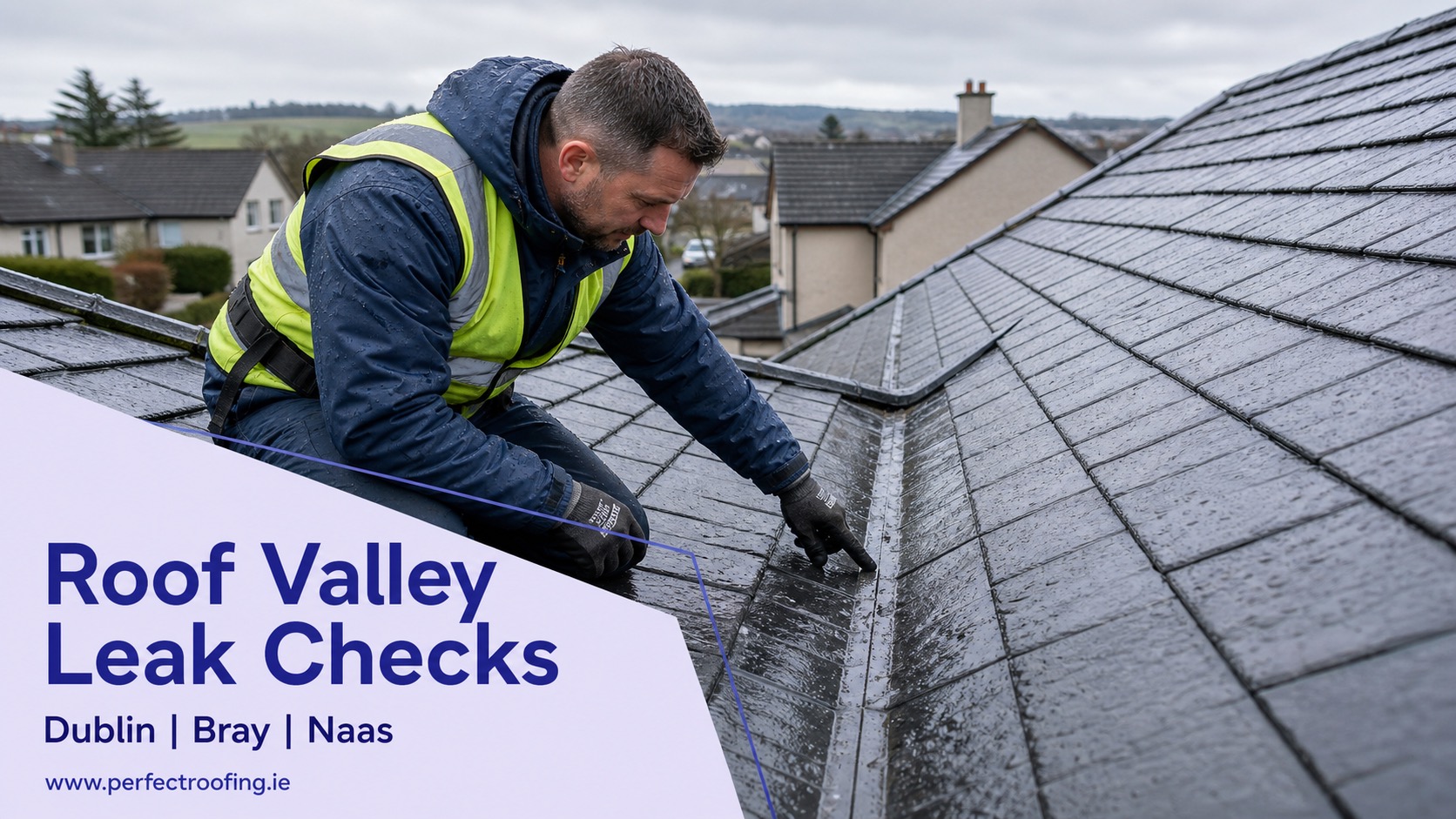
Roof valleys carry a lot of water. Where two pitched roof slopes meet, rain is channelled down one narrow line, so even a small blockage, cracked tile, loose slate, or poor repair can turn into a leak inside the house.
For homeowners in Dublin, Bray, Naas, and nearby areas, valley problems often show up after repeated wet weather or wind-driven showers. This guide explains the safe signs to look for, what can go wrong in a roof valley, and when to ask Perfect Roofing to inspect the area properly.
Why Roof Valleys Need Extra Attention
A roof valley is designed to move water quickly from higher roof slopes into the gutter or onto a lower roof section. Because it handles more water than most parts of the roof, it needs clear drainage, secure roof covering, and sound junction details.
Valley leaks can be caused by:
- Leaves, moss, grit, or broken mortar collecting in the channel
- Slates or tiles slipping beside the valley
- Cracked valley tiles or damaged cut edges
- Split, worn, or poorly supported leadwork
- Damaged underlay beneath the valley
- Previous patch repairs that have lifted or separated
- Poor detailing where an extension roof meets the original house
- Gutters below the valley overflowing and backing water up at the eaves
The leak may not appear directly below the valley. Water can track along battens, rafters, underlay, plasterboard, or masonry before it becomes visible indoors.
Safe Signs to Check Indoors
Do not climb onto a roof or lean out of a window to inspect a valley. Without proper access equipment and fall protection, roof work is not safe for homeowners.
You can still check for useful clues from inside:
- Brown or yellow staining on a sloped ceiling
- Damp patches close to an internal corner or roof junction
- Peeling paint, bubbling plaster, or softened lining paper
- A musty smell in an attic after heavy rain
- Drips that only appear during prolonged rain
- Staining that spreads from a ceiling line rather than a flat wall
- Marks that return after repainting
Take photos before the area dries out. If the leak appears only when rain comes from a certain direction, make a note of that too. The timing of the stain can help narrow down whether the issue is the valley, guttering, a chimney, a roof window, or another nearby junction.
What You May Spot From Ground Level
From the garden, driveway, street, or a safe upstairs window, you may be able to see whether the valley area looks blocked or disturbed. Keep enough distance to see the wider roof, not just the suspected problem area.
Look for:
- Moss or leaf build-up sitting in the valley line
- A darker wet strip that remains long after the rest of the roof has dried
- Slipped or uneven slates beside the channel
- Cracked tiles near the valley cut
- Daylight gaps or lifted edges where roof covering meets the valley
- Sagging or damaged guttering below the valley outlet
- Staining on fascia, soffit, brickwork, or render below the eaves
- Temporary-looking sealant patches around the junction
Clear photos taken safely can be very useful when you contact a roofer. Avoid climbing onto a ladder to get a closer picture.
Why Valley Leaks Are Often Misdiagnosed
A valley leak can look like another roof problem from inside the house. Water may enter at the valley, then travel to a ceiling light, chimney breast, dormer cheek, or top-floor wall before showing up.
It can be mistaken for:
- A chimney flashing leak
- A Velux or skylight leak
- A gutter overflow issue
- Condensation in an attic space
- A flat roof junction problem
- A cracked ridge or hip detail
- A leak from an extension roof abutment
This is why a proper inspection should consider the whole roof slope around the valley. In Dublin terraces, Bray homes near exposed coastal weather, and Naas houses with extensions or mixed rooflines, the visible damp mark may only be the final point where water appears.
Common Valley Repair Options
The right repair depends on the roof type, the age of the materials, and the condition of the surrounding slates, tiles, battens, and underlay. A valley should not be repaired by guesswork.
Possible solutions include:
- Clearing moss, leaves, silt, and loose debris from the valley
- Replacing cracked or slipped slates and tiles beside the channel
- Refitting poorly cut or poorly fixed roof covering
- Repairing or replacing damaged leadwork
- Correcting failed previous patch repairs
- Reworking the junction where an extension roof meets the main roof
- Checking the gutter outlet below the valley for overflow
- Replacing damaged underlay or timber where water has tracked in
Some valley repairs are local. Others are better handled as part of wider roof repair or roof replacement planning, especially if the nearby roof covering is brittle, heavily patched, or repeatedly leaking.
Preventing Repeat Valley Problems
Valleys should be kept clear enough for water to drain freely. That does not mean homeowners should get onto the roof to clean them. It means including valleys in routine roof inspections and asking a roofer to check them when other roofline work is being done.
Practical prevention steps include:
- Check attic spaces after prolonged rain when it is safe to access them
- Watch for stains near roof junctions, ceiling corners, and sloped ceilings
- Keep gutters maintained so valley water can discharge properly
- Trim overhanging branches where they regularly drop leaves onto the roof
- Ask for valley areas to be inspected during roof maintenance
- Deal with slipped slates, cracked tiles, and loose ridge details promptly
- Avoid relying on repeated surface sealant as a long-term repair
If you notice damp near electrics, ceiling lights, or a visibly sagging ceiling, keep the area safe and arrange professional help quickly.
Local Help With Roof Valley Leaks
Perfect Roofing helps homeowners with roof leak tracing, valley repairs, slate and tile repairs, leadwork, gutters, flat roofing, Velux windows, skylights, roof ventilation, and roof inspections across Dublin City, North Dublin, South Dublin, Lucan, Bray, Wicklow, Naas, and nearby areas.
Need a Roof Valley Checked?
If you can see debris in a valley, staining below a roof junction, slipped slates, damp patches after rain, or signs of water entering near an extension, do not climb onto the roof to investigate it yourself.
Contact Perfect Roofing by WhatsApp, phone, or email for practical advice, a roof inspection, or a repair quotation. Clear photos taken safely from inside the room, attic, garden, driveway, or an upstairs window can help us understand whether the problem looks like a roof valley issue, gutter overflow, damaged roof covering, or a wider roof repair.
Need a roofer to take a look?
Send a few photos on WhatsApp, email us, or tap the number to call. We cover Dublin City, North Dublin, South Dublin, Lucan, Bray, Wicklow, Naas, and nearby locations.