Flat Roofing
Warm Roof vs Cold Roof: Flat Roof Insulation for Dublin Extensions
Replacing an extension roof in Dublin or Lucan? Compare warm and cold flat roof insulation, ventilation, moisture risks, roof height, and questions to ask before agreeing a quote.
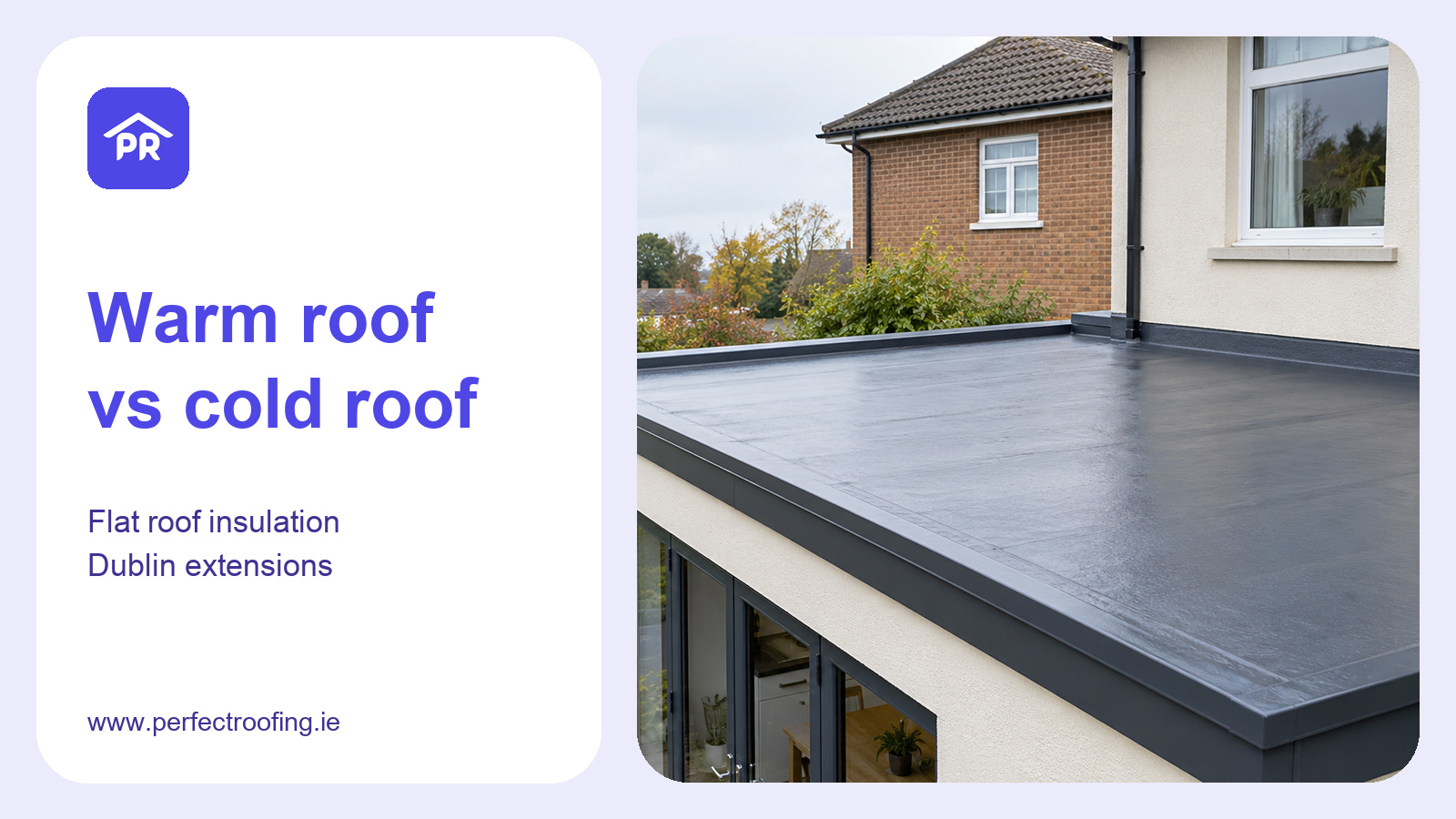
If your kitchen extension feels cold, or its flat roof needs replacing, the conversation should include what sits beneath the waterproof covering. A quote for a new membrane tells you only part of the story. Ask where the insulation will go and how the complete roof will manage moisture.
For homeowners in Dublin and Lucan, understanding the terms warm roof and cold roof makes that discussion easier. They describe the position of the insulation, rather than the colour of the roof or a particular waterproofing brand.
What is the difference between a warm and cold flat roof?
In a conventional warm flat roof, the principal insulation sits above the structural deck and below the outer waterproof covering. The deck is kept on the warmer side of the insulation. A cold flat roof has its principal insulation below the deck, usually within the ceiling or joist zone, leaving the deck colder.
Recticel's flat roof explanation describes these arrangements and the vapour control layer normally included beneath warm-roof insulation. These are general construction principles; a UK manufacturer's guidance does not establish the Irish requirements for your project.
| Question | Warm flat roof | Cold flat roof |
|---|---|---|
| Where is the main insulation? | Above the deck | Below the deck |
| What needs particular attention? | Vapour control, continuity, and external junctions | Ventilation, vapour control, and the colder void |
| What should be checked before a retrofit? | Available height above the deck | Whether the existing void can be ventilated effectively |
| What should the quote explain? | The complete proposed roof system | The complete system and its ventilation strategy |
This guide concerns domestic flat roofs. Pitched roofs, attic conversions, and inverted roofs use different arrangements, so do not transfer a detail from one roof type to another.
Why does ventilation matter in a cold flat roof?
Irish retrofit guidance published through SEAI says a cold flat roof should not be used where cross ventilation cannot be provided, and a warm deck should be considered instead.
That makes the actual air route an important inspection question. A visible vent at one edge does not prove air can travel through every part of the roof void. Do not fill gaps or block openings because the room below feels draughty.
Ask the contractor:
- How will the existing insulation position be confirmed?
- Can the proposed ventilation route work across the whole roof?
- Will internal partitions or roof junctions affect that route?
- Is the proposal retaining a cold roof or changing the construction?
The roof void's ventilation and the room's ventilation serve different purposes. Keep both in the discussion when a kitchen or bathroom sits below the roof.
When should you discuss a warm roof upgrade?
A planned replacement is a useful point to ask for an insulation assessment. Request an explanation of whether a warm roof is suitable, rather than assuming the new covering will address a cold room.
The practical attraction is that the main insulation goes above the deck. The trade-off is the space needed there: the finished height must be checked against the surrounding building. On a South Dublin extension, for example, an upstairs window sill or a roof-window kerb may constrain the proposal.
Before agreeing the work, ask about:
- Wall junctions and the height available for weatherproofing details.
- Rooflight kerbs, door thresholds, and nearby window sills.
- Perimeter trims, gutters, outlets, and the drainage route.
- Whether existing ceilings will need opening or making good.
- The proposed treatment of insulation already below the deck.
Bauder's insulation guidance explains that tapered insulation can form drainage falls and that insulation continuity at perimeters matters. Neither feature is automatic: ask whether it forms part of your particular specification.
Can you leave the old insulation in place?
Do not assume that insulation above and below the deck simply provides extra benefit. Bauder's roof design guidance identifies increased condensation risk in hybrid refurbishment arrangements and calls for a risk assessment before finalising the design.
Ask the contractor or roof designer to explain what will remain, what will be removed, and how the proposed arrangement has been assessed. A warm roof also needs appropriate air and vapour control; its name does not guarantee a moisture-free roof.
If inspection finds wet materials or questionable decking, request a clear plan for further assessment and replacement where needed. Avoid agreeing to cover those discoveries without understanding the revised scope.
Compare complete quotes, including the limitations
Warm and cold roofs are construction choices, not price tiers. Request site-specific quotes rather than assuming one arrangement is always cheaper or suitable for every extension.
A useful written proposal should identify:
- The existing construction and the proposed insulation position.
- The insulation specification and the basis for its thickness.
- The air and vapour control approach, plus ventilation where needed.
- The waterproofing system and its compatibility with the proposed build-up.
- Junctions, drainage, access, waste removal, and internal making good.
- How hidden defects and any extra work will be discussed before proceeding.
Ask who is responsible for the design and confirming applicable Irish requirements. Do not select a board thickness from an online example. Our roof quote comparison guide can help you check the wider scope.
Talk to Perfect Roofing about your extension roof
Perfect Roofing can assess flat roof repair and replacement work in Dublin, Lucan, Naas, and nearby areas, including Bray and Wicklow. Tell us whether your priority is a leak, a cold extension, a planned replacement, or a combination of concerns.
Send your location, any previous roofing specification, and photos taken from the ground or a safe indoor position. Do not climb onto a roof without proper safety equipment and competent assessment, or lift the covering to identify the layers yourself.
Contact us by WhatsApp, call 083 066 3462, or email hi@perfectroofing.ie. We can discuss the inspection and the next steps towards a recommendation based on your roof, budget, weather exposure, access, and long-term plans.
Need a roofer to take a look?
Send a few photos on WhatsApp, email us, or tap the number to call. We cover Dublin City, North Dublin, South Dublin, Lucan, Bray, Wicklow, Naas, and nearby locations.