Roof Repairs
Bats in Your Roof? What to Know Before Roof Repairs in Dublin and Wicklow
Bats and their roosts are protected in Ireland. How to spot signs of bats, when roof work can go ahead, and when to talk to NPWS before re-roofing in Dublin.
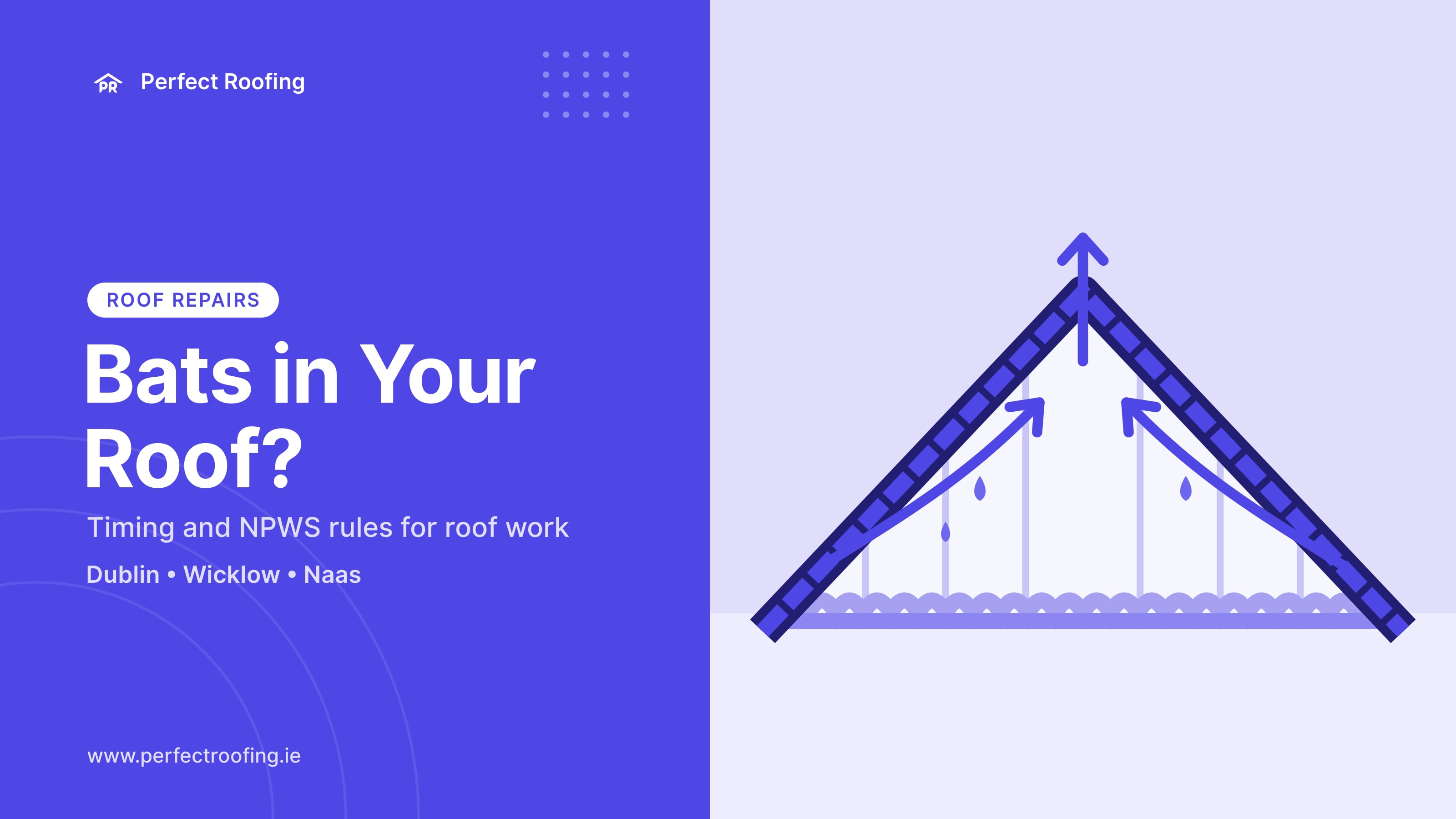
Every so often a homeowner mentions small droppings in the attic or a bat flitting out from under the eaves at dusk. Most people's first question is whether this stops them getting the roof fixed. Usually it doesn't, but it does change how and when the work is done.
All Irish bats are protected by law, and so are the places they roost. This guide explains what that means for ordinary roof repairs and re-roofing in Dublin City, North Dublin, South Dublin, Lucan, Bray, Wicklow and Naas, based on the National Parks and Wildlife Service (NPWS) Bat Mitigation Guidelines for Ireland v2 (Irish Wildlife Manuals No. 134, 2022).
We are roofers, not ecologists. Where a site needs a bat survey or a licence, that is a job for a qualified bat specialist and NPWS, and we will say so.
Why bats matter for roof work
According to the NPWS guidelines, Ireland has nine resident bat species, and all of them are protected under:
- the Wildlife Acts 1976 to 2021, which make it an offence to wilfully interfere with or destroy a bat's breeding or resting place; and
- the European Communities (Birds and Natural Habitats) Regulations 2011 (S.I. No. 477 of 2011), where Regulation 51 prohibits damaging or disturbing bats' breeding or resting sites.
Two points catch people out:
- A roost is protected even when the bats are away. The guidelines state that breeding and resting places are protected "whether bats are actually present in them at the time or not."
- Planning permission doesn't cover it. The Regulation 51 prohibition applies whatever other consents you hold.
Works that would damage or disturb a roost can only go ahead under a derogation licence issued under Regulation 54. NPWS publishes the derogation licence application details on its website.
Where bats roost in Irish houses
Bats don't build nests; they use gaps and spaces that already exist in the roof. The NPWS guidelines note that most species form maternity roosts in the roofs of buildings because the sun warms them, and that:
- common pipistrelles prefer tight spots such as soffit boxes, eaves and under hanging tiles;
- brown long-eared and lesser horseshoe bats are more often found in open roof voids they can fly in;
- in winter, bats of most species have been recorded hibernating in cavity walls, around window frames and under ridge tiles.
Those are exactly the areas a roofer works on: fascia and soffit, eaves, ridge, verges and the attic.
Signs that bats may be using your roof
You don't need to go anywhere near the roof to look for these. Check from the garden or from the attic hatch with a torch.
| Sign | Where to look |
|---|---|
| Small droppings, similar in size to mouse droppings | Attic floor, insulation, window sills, walls below the eaves |
| Bats leaving at dusk | Gaps at the eaves, soffit, fascia or ridge, seen from the garden on a mild summer evening |
| Dark, oily marks | Around small gaps at the eaves or roof timbers |
| Discarded moth wings or insect parts | Attic floor below the ridge |
| Bat sounds or a characteristic smell | Near the eaves, ridge or in the attic |
The NPWS guidelines list droppings, oily marks around access points, feeding remains such as moth wings, and a characteristic roost smell as signs surveyors look for. If you've seen any of these, mention it when you contact a roofer so the job can be planned properly.
Timing: when roof work can go ahead
The guidelines say the most common and effective way to avoid an offence is to do the work at the right time of year. Most roosts are used seasonally, so there is usually a period when bats aren't there. Their recommended windows (Table 5) are:
| How bats use the roof | Optimum period for works |
|---|---|
| Maternity roost | 1 October to 1 May |
| Summer roost (not a proven maternity site) | 1 September to 1 May |
| Hibernation site | 1 May to 1 October |
The guidelines add that maternity sites are generally occupied from May to September and hibernation sites from October to March, depending on the weather. Some species, notably brown long-eared bats, can stay in summer roosts well into autumn or even winter.
So November isn't automatically "safe". A roof void that held a summer colony may be empty now, but bats can hibernate under ridge tiles or in cavity walls through the winter. Which window applies depends on how the bats actually use your roof, and that is what a bat specialist establishes.
Do you need a licence?
Not always. The NPWS guidelines say no licence is needed if the work can be "timed, organised and carried out so as to avoid committing an offence". They give re-roofing as an example of work that may not need a licence if it is done while bats are not present and the access points and roosting area are not affected.
Works the guidelines say are likely to need a licence include significant alterations to roof voids known to be used by bats, and maintenance of heritage buildings used by bats.
In practice, for a homeowner it breaks down like this:
- No sign of bats, routine repair: go ahead as normal. A good roofer still watches for bats while stripping tiles or soffits.
- Signs of bats, small repair away from the roost: talk to your local NPWS Conservation Ranger first. Timing the work may be all that's needed.
- Known roost, re-roofing or changes to the attic, soffits or ridge: get a bat specialist involved early. They can advise on timing and a method statement, and on whether a derogation licence is needed.
NPWS lists its head office contacts in the guidelines (email natureconservation@housing.gov.ie, licensing enquiries wildlifelicence@housing.gov.ie), and the head office can put you in touch with the local ranger for Dublin, Wicklow or Kildare.
If bats turn up during the work
Bats sometimes appear when old slates or a soffit board come off. If that happens on one of our jobs, we stop work in that area, cover the roof temporarily to keep the house dry, and seek advice from NPWS before continuing. Don't try to handle a bat or move it on yourself.
That's one more reason to mention any signs of bats before the job starts: it is far easier to plan around them than to stop halfway through a re-roof in the middle of a wet week.
Roofing materials where bats roost
This is where re-roofing an older Dublin or Wicklow house with bats needs extra thought. Modern breathable roof membranes are the standard underlay on most new roofs, but the NPWS guidelines warn that fibrous "non-bitumen coated roofing membranes" have been shown to trap and ensnare bats, causing deaths.
The guidelines say:
- the use of these membranes should be carefully considered if bats are in the building;
- older linings such as mineral felt or rough timber should be used instead where possible;
- breathable membranes may be acceptable alongside older linings, on a bat specialist's advice, if bats only come into contact with the older lining.
Because ventilation and condensation still matter (see our guide to breathable membranes vs roofing felt), underlay and ventilation choices on a roof with a known roost should be agreed with the bat specialist before materials are ordered.
A quick checklist before booking roof work
- Look for droppings in the attic and below the eaves (from the ground or the hatch only)
- Note any bats seen leaving the roof at dusk in summer
- Tell your roofer about any signs when asking for a quote
- If bats are likely, contact NPWS or a bat specialist before fixing a start date
- Agree the timing, underlay and any roost access points before work begins
- Keep any method statement or licence conditions with your house paperwork
Planning roof repairs around bats?
We carry out roof repairs, re-roofing, fascia and soffit work and attic ventilation across Dublin City, North Dublin, South Dublin, Lucan, Bray, Wicklow and Naas. If you've seen signs of bats, tell us when you get in touch and we'll plan the inspection and timing with that in mind, working with your bat specialist where one is needed.
Contact us by WhatsApp, call 083 066 3462, or email hi@perfectroofing.ie.
Need a roofer to take a look?
Send a few photos on WhatsApp, email us, or tap the number to call. We cover Dublin City, North Dublin, South Dublin, Lucan, Bray, Wicklow, Naas, and nearby locations.