Roof Repairs
Bay Window Roof Leak Checks for Dublin City and Naas Homes
A practical guide to spotting bay window roof leaks, lead flashing problems, blocked gutters, and damp warning signs around homes in Dublin City, Naas, and nearby areas.
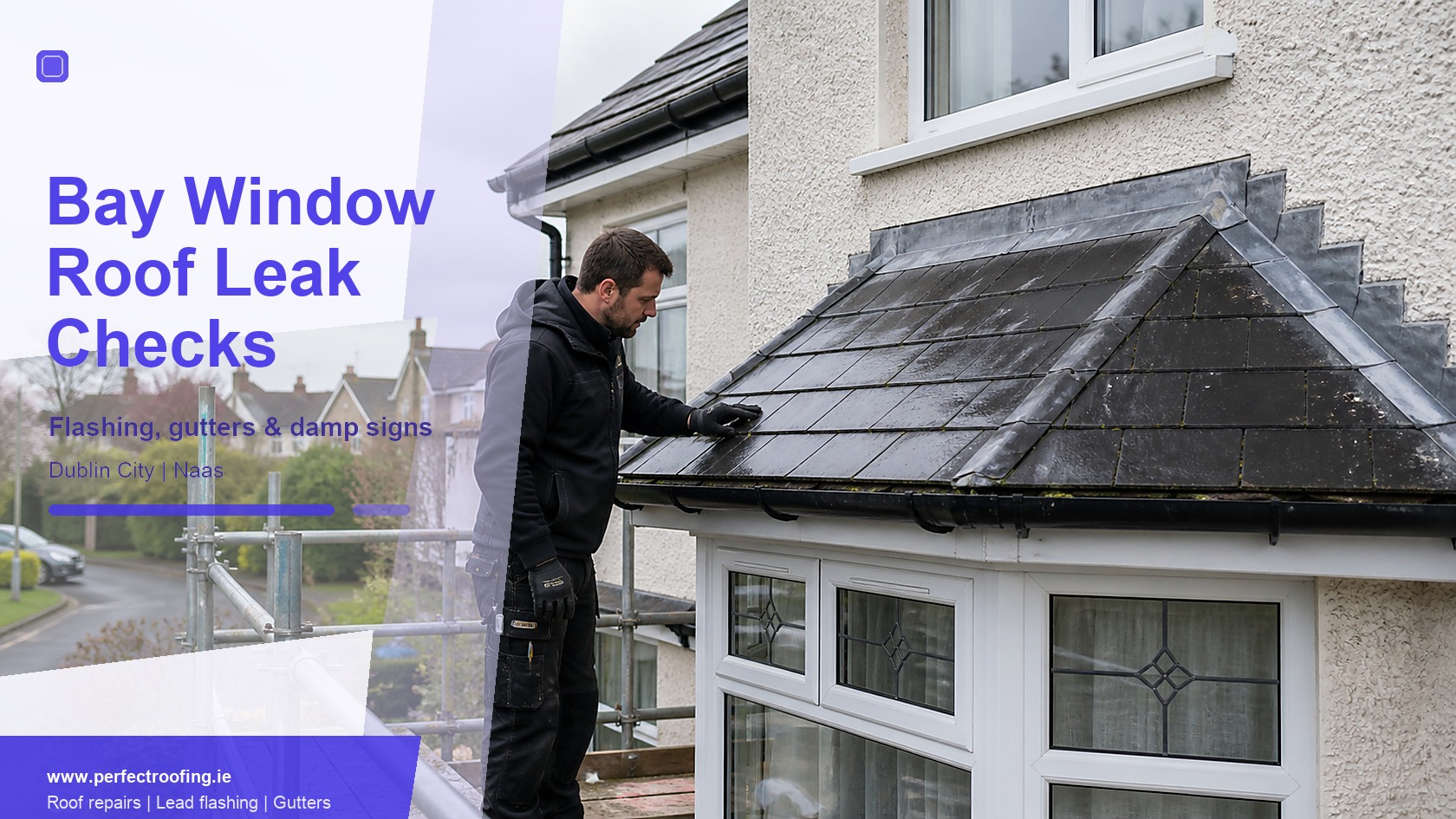
Bay window roofs are small, but they can cause frustrating leaks. Because they sit below the main roof and connect directly into the front wall, even a modest defect can leave damp marks around curtains, window heads, plasterboard, timber trim, or the ceiling beside the bay.
For homes in Dublin City, Naas, Lucan, South Dublin, North Dublin, Bray, Wicklow, and nearby areas, bay roof leaks are often linked with ageing leadwork, cracked tiles or slates, blocked small gutters, poor junctions, and older patch repairs that no longer shed water cleanly.
This guide explains what homeowners can check safely, why bay window roofs leak, and when Perfect Roofing may recommend a local repair, flashing work, gutter repair, or a wider inspection of the surrounding roof area.
Why bay window roofs leak
A bay window roof has several details packed into a small space. It may have slates, tiles, lead, felt, GRP, metal sheeting, gutters, fascia boards, valleys, hips, and wall flashing all within a few metres. The smaller the roof, the less room there is for water to be managed badly.
Common weak points include:
- Lead flashing where the bay roof meets the wall
- Slipped or cracked slates and tiles on small pitched bays
- Worn felt, metal, or flat roof coverings on shallow bays
- Blocked mini-gutters, outlets, or downpipes
- Loose ridge, hip, or apron details on decorative bay roofs
- Cracked render or pointing just above the flashing line
- Failed sealant around windows, trims, or side cheeks
- Previous repairs that trap water instead of directing it away
The leak may not come from the most obvious place. Water can enter at a side flashing, track behind the front face of the bay, and show up indoors at the window head or along one corner.
Safe signs to check indoors
Do not climb onto a bay roof, lean out of windows, or stand on a ladder without proper access and safety equipment. Bay roofs can be fragile, slippery, and awkward to inspect from above. You can still gather useful information from inside the home.
Look for:
- Brown or yellow staining above the bay window
- Damp plaster at the left or right corner of the bay
- Bubbling paint, peeling wallpaper, or swollen timber trim
- A musty smell around curtains, blinds, or window boards
- Damp marks that appear after wind-driven rain
- Drips from the top of the window frame during heavy showers
- Mould spots around the bay ceiling where air circulation is poor
- Repeated staining after a previous quick sealant repair
Take photos when the stain is fresh. Note whether the leak appears during heavy rain, after rain from one direction, or only after several wet days. That timing helps separate a flashing defect from a blocked gutter, cracked roof covering, condensation, or a problem with the wall above.
What may be visible from ground level
Useful roof clues are often visible from the footpath, driveway, garden, or an upstairs room across the street. Wide photos are usually better than close-ups because they show how the bay roof, wall, main roof, windows, and gutters connect.
From a safe position, look for:
- Slates or tiles that sit unevenly on the bay roof
- Cracks, missing corners, or lifted edges on small roof coverings
- Lead flashing that looks loose, split, pulled away, or heavily patched
- Moss and leaves collecting behind a small gutter or hip detail
- A downpipe that drips onto the bay roof below
- Staining on render above or beside the bay
- Gaps where the bay roof returns into the wall
- Old sealant lines that have cracked or peeled away
If you can safely photograph the whole front elevation, include the main roof, upper gutters, windows, chimney, and wall above the bay. Water sometimes starts higher up and only becomes visible at the bay because that is where it finally reaches the inside.
Lead flashing and wall junction problems
Many bay window roofs rely on lead flashing to keep water out where the small roof meets the house wall. Good flashing should be securely fixed, neatly dressed, and detailed so water is directed onto the roof covering, not behind it.
Flashing problems may include:
- Lead that has lifted away from the wall
- Cracks, splits, or fatigue in older leadwork
- Poorly formed corners or side returns
- Mortar joints that have opened above the flashing
- Patch repairs that rely too heavily on surface sealant
- Flashing that is too shallow for the roof pitch or exposure
- Water being driven behind the flashing during windy rain
Sealant alone is rarely a durable answer to a failed roof-to-wall junction. It may slow a leak for a short time, but it does not fix loose leadwork, cracked pointing, poor laps, or a roof covering that is sending water toward the wall.
Gutters and downpipes above the bay
Bay roof leaks are sometimes caused by drainage rather than the bay covering itself. A blocked upper gutter, leaking joint, or misaligned downpipe can drop water onto the small roof below. That extra water can overwhelm details that would otherwise cope with normal rainfall.
Check safely for:
- Water spilling from an upper gutter onto the bay
- A downpipe discharging too close to the wall junction
- Staining below a gutter joint directly above the bay
- Leaves, moss, or roof grit sitting in a small bay gutter
- A short gutter run that falls away from the outlet
- Drips continuing long after the rain has stopped
This is common on older Dublin City houses with compact front elevations and on Naas, Lucan, and South Dublin homes where extensions, porches, and bay windows have been added or altered over time. The repair should deal with the water route as well as the visible damp mark.
Pitched, flat, and metal bay roofs
Not every bay window roof is built the same way. The repair approach depends on the roof type.
| Bay roof type | Typical leak clues | What to check |
|---|---|---|
| Small pitched slate or tile bay | Slipped slates, cracked tiles, moss at hips, damp near corners | Roof covering, battens where visible, hips, valleys, flashing, and gutter edges |
| Shallow flat bay | Ponding water, lifted edges, blistered covering, damp across the bay ceiling | Falls, outlets, trims, upstands, wall junctions, and roof covering condition |
| Lead or metal bay | Cracks, splits, loose seams, staining below joints, noisy movement in wind | Laps, fixings, expansion movement, wall chase, and whether previous patches are failing |
| Decorative bay with hips or small ridges | Damp at one side, loose cappings, open mortar, awkward corners | Hip/ridge details, water channels, flashing returns, and small gutter sections |
A bay roof can also be affected by window and wall details. A roof inspection should consider the roof first, but it should not ignore cracked render, open pointing, failed window sealant, or water running down from above.
Local repair or wider roof inspection?
A local repair may be enough when the surrounding roof and wall are sound and the defect is clearly limited to one detail.
Local repair may suit:
- One slipped slate or cracked tile on the bay
- A small section of failed flashing
- A blocked bay gutter or short downpipe issue
- A loose trim or open joint at the roof edge
- A previous patch that can be removed and repaired properly
A wider inspection is usually better when:
- The same bay has leaked more than once
- There are damp marks in more than one room
- The main roof or upper gutter is discharging onto the bay
- Several slates, tiles, hips, or flashings look aged
- The wall above the bay has cracks, staining, or open joints
- Access costs would make repeated small repairs inefficient
- You are already planning roof replacement, new windows, gutters, or front elevation work
The useful question is not only "Where is the leak?" It is whether the repair will stop water reaching the same weak point again.
What Perfect Roofing checks
When Perfect Roofing inspects a bay window roof leak, we look at the full water path around the bay and the roof area above it.
A practical inspection may include:
- Bay roof covering, hips, ridges, valleys, and edge trims
- Lead flashing, side returns, wall chases, render, and pointing
- Upper gutters, downpipes, fascia, soffits, and nearby outlets
- Main roof slates or tiles above the bay
- Interior damp marks, window heads, trim, and ceiling corners
- Whether water is entering at the bay, tracking from above, or collecting at a blocked detail
- Whether a local repair, drainage correction, flashing repair, or wider roof maintenance plan is more sensible
This joined-up approach matters because a bay roof often receives water from more than one source. Fixing only the visible crack can leave the real cause untouched.
Bay roof leak checks across Dublin City, Naas, and nearby areas
Perfect Roofing helps homeowners with roof leak tracing, roof repairs, roof inspections, lead flashing, gutter repairs, flat roofing, Velux windows, skylights, roof ventilation, roof maintenance, and roof replacement planning across Dublin City, Naas, Lucan, North Dublin, South Dublin, Bray, Wicklow, and nearby locations.
Dublin City homes can have older front bays, shared walls, tight access, and upper gutters that are difficult to inspect from ground level. Naas and Lucan houses often include mixed roof sections, porches, garages, and bay windows where several drainage routes meet. Bray and Wicklow properties may have more exposed elevations depending on their position.
The right repair depends on the bay roof type, weather exposure, access, wall condition, and how water reaches the detail in the first place.
Ask Perfect Roofing before a bay roof leak spreads
If you notice damp above a bay window, staining at the corners, loose flashing, slipped slates, blocked gutters, or repeated patch repairs, do not climb onto the roof to investigate it yourself. Take clear photos from a safe place and note when the leak appears.
Contact Perfect Roofing by WhatsApp, phone, or email for practical advice, a roof inspection, or a repair quotation. We can help decide whether the problem is a bay roof covering defect, lead flashing issue, gutter overflow, wall junction leak, or part of a wider roof repair plan.
Need a roofer to take a look?
Send a few photos on WhatsApp, email us, or tap the number to call. We cover Dublin City, North Dublin, South Dublin, Lucan, Bray, Wicklow, Naas, and nearby locations.