Roof Repairs
Birds Under Roof Tiles: Eaves Guard and Repair Checks for Dublin Homes
Birds entering beneath your roof tiles? Learn what an eaves inspection should check, how bird combs differ from gutter guards, and why airflow and nesting checks matter.
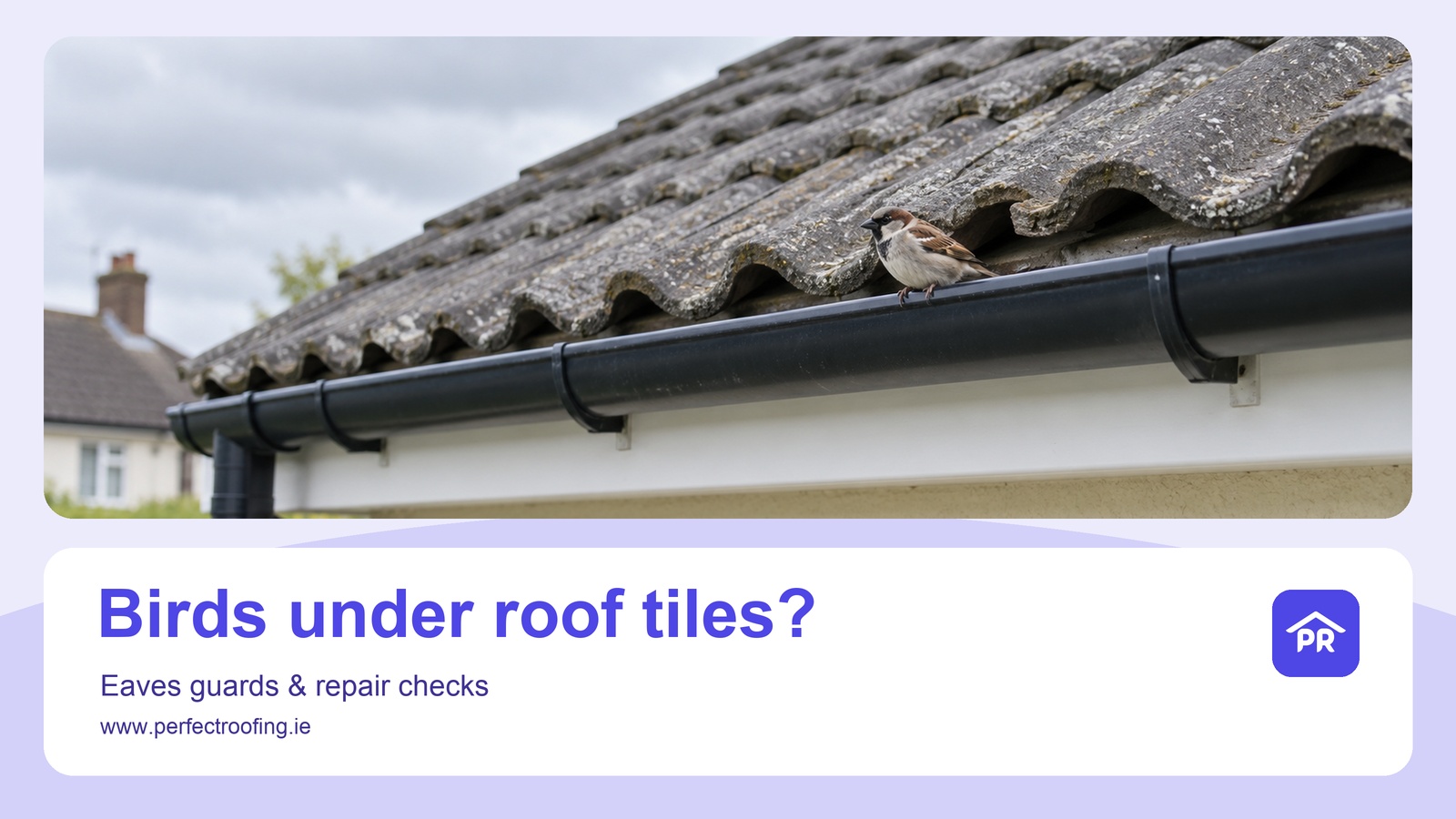
Birds repeatedly disappearing beneath the lowest row of roof tiles can leave homeowners wondering whether the roof is damaged. Sometimes they are using the open shape of a profiled tile; sometimes there is a broken tile, loose edge component, or another gap that needs attention. The right first step is to identify the entry point, check for nesting activity, and assess the roof detail before closing anything.
For homeowners in Dublin and Lucan, this is a roofing inspection question as well as a wildlife consideration. A suitable repair should protect the roof while keeping the ventilation and drainage paths it needs.
Are birds entering the roof or simply landing on it?
A bird sitting on a gutter does not establish that it is inside the roof. Watch from a safe ground-level position and note whether it repeatedly enters the same opening and emerges again. A short video taken without approaching the opening can help explain the location to a roofer.
Useful observations include:
- Which elevation and roof edge the birds use
- Whether the opening is beneath a tile, at a verge, or around a damaged soffit
- Whether a tile appears cracked, lifted, or out of line
- Whether you see material being carried into the opening
- Whether scratching or chirping seems concentrated near that part of the house
- Whether there are separate symptoms such as a new damp mark or gutter overflow
Noise alone cannot identify the cause. Roof fittings, branches, cables, and other animals can also create sounds. Our guide to roof noises in wind explains some other inspection clues.
Do not lean out of an upstairs window, climb a ladder to investigate, or put a hand or tool into the opening. Do not climb onto a roof without proper access and safety equipment.
Check for nesting before arranging exclusion work
If birds are carrying material or food into a roof opening, treat that as possible nesting activity and tell the contractor before work is planned. Do not block the entrance, pull out material, or attempt to relocate a nest yourself.
The National Parks and Wildlife Service's guidance explains that protections for wild birds, nests, eggs, and dependent young apply throughout the year. An autumn date alone is therefore not permission to close an opening or remove a nest.
Where nesting is suspected, pause work that could affect it and seek advice from NPWS or a suitably qualified wildlife professional. The appropriate timing and method need to be established for the actual situation. If the same area also leaks, explain both issues so that roof protection can be planned with wildlife advice rather than sealing the entrance as a quick fix.
What is an eaves bird comb?
The eaves are the lower edge of a pitched roof, usually above the gutter. Profiled tiles can leave shaped openings at that edge. An eaves bird comb, also called an eaves comb filler, is a purpose-made component intended to restrict entry through suitable tile-profile openings.
For example, Klober's current eaves comb page describes a comb for profiled tiles that restricts access to the batten cavity while allowing airflow there. This is a product example, not a recommendation for every roof: the actual tile profile, support arrangement, and installation instructions must be checked.
A comb does not repair a cracked tile, secure a loose verge, or replace a damaged soffit. It also does not establish that the whole roof has adequate ventilation. Those are separate parts of the inspection.
Bird comb, gutter guard, or roof repair?
These terms can sound interchangeable when discussing work, but they address different areas.
| Item | Where it belongs | What to establish before choosing it |
|---|---|---|
| Eaves bird comb | Beneath compatible tile profiles at the roof edge | Whether this is the entry route, the component suits the tiles, and nesting checks permit work |
| Gutter guard | At the gutter opening | Whether leaf and debris management is the actual problem and cleaning access is retained |
| Tile or verge repair | At a damaged roof covering or edge | Why the gap developed and what surrounding fixings or components need attention |
| Soffit repair or suitable closure | At the underside of the roof edge or another opening | Whether the opening is damage, a ventilation detail, or a wildlife access point |
A gutter guard does not normally address an opening beneath a roof tile. Likewise, fitting a comb along one section will not resolve access through a separate broken component. Ask the roofer to show you the specific entry route and proposed treatment.
Preserve the roof's airflow and water paths
An opening at the roof edge is not automatically a defect to fill solid. Roofs can have purpose-made ventilation at or near the eaves, and the underlay needs an appropriate route to discharge water towards the gutter.
BMI Ireland's eaves systems overview shows that eaves ventilation arrangements vary with roof construction and insulation position. The important question is how the proposed guard or repair fits the existing roof, rather than simply whether it makes the gap disappear.
Ask the contractor to explain:
- Which opening the birds are using and whether it is intended or damaged
- How the proposed component matches the tile profile and roof build-up
- Whether the underlay support and drainage detail remain effective
- How existing ventilation paths will be preserved
- Whether adjacent sections have missing or failed components
Avoid improvised foam, mortar, or tightly packed mesh placed into unidentified openings. A neat-looking filled gap can conceal an unresolved roof defect or interfere with a functional detail.
When local repairs may be enough
Bird activity does not by itself mean you need a replacement roof. Where the surrounding covering and support are sound, the proposal may involve a compatible eaves component or a local tile, verge, or soffit repair. Where several sections are damaged, the inspection may reveal a wider repair scope.
On North Dublin and Lucan homes, an extension or altered roof edge may have a different arrangement from the original roof. Ask for each affected section to be assessed rather than assuming that one component suits the whole property.
Arrange prompt assessment if you also notice fresh water entry, displaced tiles, a loose roof-edge component, or pieces falling into the garden. Keep people away from beneath visibly unstable material. These symptoms need attention independently of whether birds are present.
What should an eaves repair quote include?
A useful quote should describe the location and length of the affected work, the proposed component, and any repairs needed before it is fitted. Ask whether safe access, lifting and reinstating tiles, checking the underlay support, and photographs of completed work are included.
It should also explain how suspected nesting will affect the programme. Ask what happens if further damage or wildlife activity is found once access is available, and how any additional work will be agreed.
The cost depends on access, roof height, covering, the number of affected sections, and the condition of surrounding materials. A price for fitting a guard alone is difficult to compare with a proposal that includes repairing the entry point and restoring the eaves detail.
Ask Perfect Roofing to inspect the entry point
If birds appear to be entering beneath your tiles, send Perfect Roofing safe ground-level photos or a short video, your location, and a note about any noise, nesting activity, or water entry. We can assess the roofing detail and discuss repairs or suitable eaves protection, with wildlife advice sought where needed.
Perfect Roofing provides roof inspections and repairs in Dublin City, North Dublin, South Dublin, Lucan, and nearby areas, with wider roofing services across Bray, Wicklow, and Naas.
Contact us by WhatsApp, call 083 066 3462, or email hi@perfectroofing.ie. Ask for a recommendation based on your roof covering, the actual entry route, access, ventilation, weather exposure, budget, and long-term plans.
Need a roofer to take a look?
Send a few photos on WhatsApp, email us, or tap the number to call. We cover Dublin City, North Dublin, South Dublin, Lucan, Bray, Wicklow, Naas, and nearby locations.