Roof Replacements
Planning a Bungalow Roof Replacement: A North Dublin Homeowner's Guide
Learn how to plan a bungalow roof replacement in North Dublin, from early checks and access planning to choosing a clear scope for the roof, roofline and drainage.
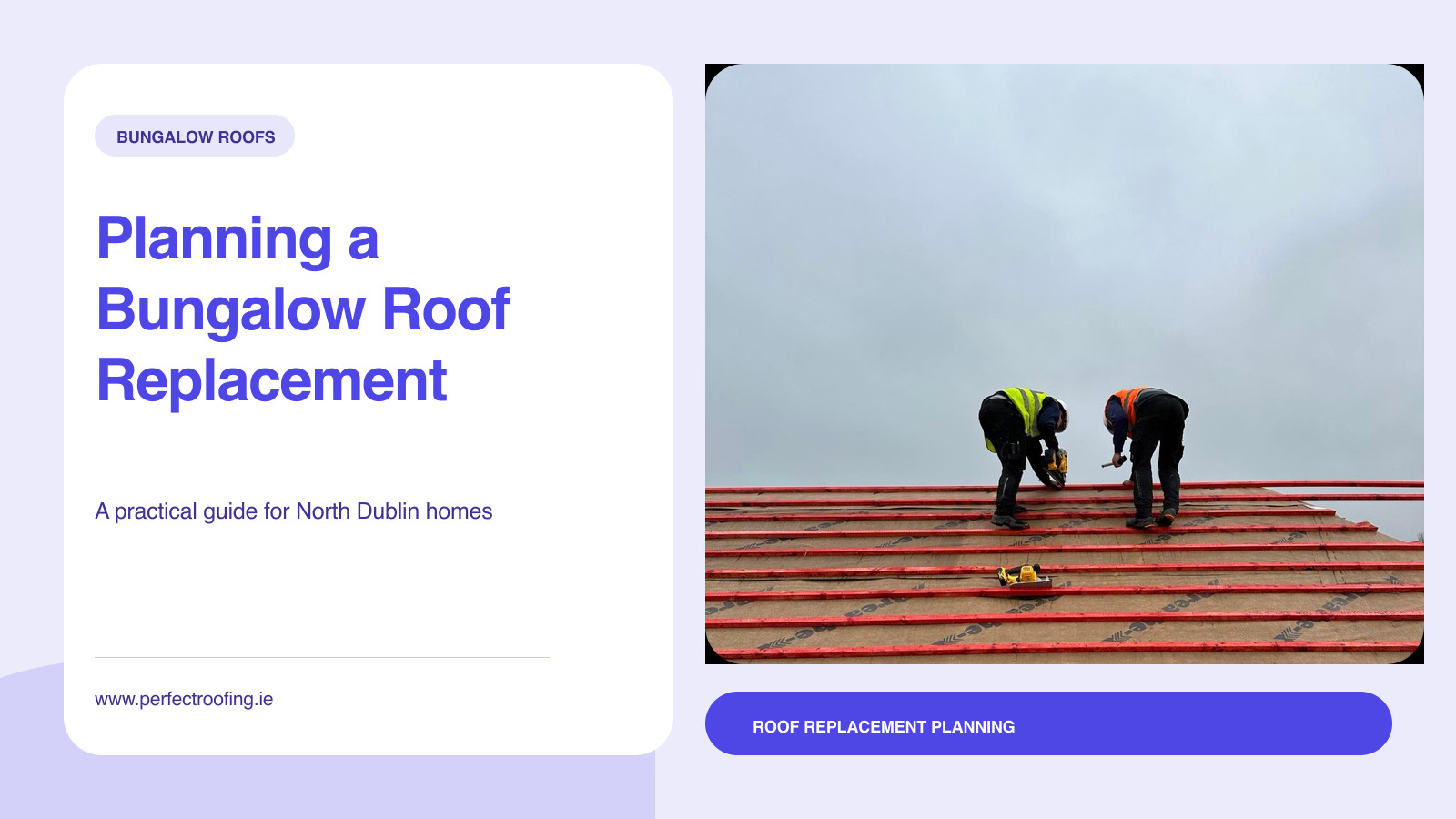
A bungalow roof replacement can be a good opportunity to resolve more than worn slates or tiles. It is also the point to review roofline details, drainage, ventilation, roof windows, chimneys and any junctions that would be harder to reach once the new covering is in place.
For homeowners in North Dublin and nearby areas, the best starting point is a clear inspection and a written scope. Every bungalow has its own roof shape, access constraints and history of repairs, so a site visit matters more than a generic list of materials or a quick estimate from photographs.
Start with the reason for replacement
Roof replacement is usually considered when repairs are becoming frequent, the covering has reached the end of its useful life, or several parts of the roof need attention at the same time. A replacement may also be planned alongside an attic conversion, new insulation work, a roof window upgrade or major roofline repairs.
Before agreeing a scope, ask what is driving the decision. Useful questions include:
- Are leaks limited to one repairable detail, or are there multiple recurring problems?
- Are slates or tiles widely damaged, slipping, worn or difficult to match?
- Is the underlay, battening or roof deck showing signs that need closer assessment?
- Do gutters overflow, fall poorly, or need to be renewed with the roofline?
- Are chimney flashings, valleys, verges, roof windows or ventilation points due for work at the same time?
A replacement should not be recommended just because a roof looks old. Equally, repeated temporary fixes can become poor value if several connected elements are deteriorating. A proper inspection helps separate a focused repair from a wider renewal plan.
What should be checked on a bungalow roof?
Bungalows often make roof areas feel more accessible from the ground, but that does not make them safe to inspect on foot. Do not climb onto the roof or lean ladders against gutters to take a closer look. Ground-level photographs and internal observations are safer and still useful.
An inspection and replacement plan may consider:
- The condition and layout of the existing roof covering.
- Ridges, hips, valleys, verges and abutments where water changes direction.
- Chimney stacks, flashings and flaunching where present.
- Eaves, fascia, soffit, gutters and downpipes.
- The accessible roof structure and signs of historic or active water ingress.
- Existing ventilation paths and whether they need to be retained or improved.
- Roof windows, skylights, vents, pipes, aerials and solar-panel interfaces.
The right scope depends on what is found. If any part of the supporting structure needs specialist assessment, that should be identified before roofing work proceeds rather than assumed within a standard covering replacement.
Plan the roof, roofline and drainage together
Replacing only the visible covering can leave older details at the edge of the roof to deal with later. Sometimes that is appropriate; sometimes it creates avoidable disruption. Discuss the whole rainwater path from the top of the roof to the downpipe outlet.
For example, a quote may need to clarify whether it includes removal and disposal of the old covering, replacement or repair of roofline boards, gutters and downpipes, valley or flashing work, and making good around penetrations. If existing gutters are retained, ask whether their falls, outlets and brackets have been checked.
This is particularly helpful where a bungalow has an extension, porch, garage, bay or other roof area meeting the main roof. Those junctions can need their own detail rather than being treated as an afterthought.
Think about access before work starts
Access affects how a roof replacement can be carried out safely and how the site is managed. A bungalow may have lower eaves than a two-storey home, but access can still be constrained by narrow side passages, conservatories, planted areas, shared drives, overhead cables or neighbouring property.
Before the start date, ask the roofer to explain:
- What access equipment is expected and where it will be positioned.
- How materials will be delivered, stored and moved around the property.
- How the work area will be protected from falling debris and weather.
- Whether any parking, driveway or neighbour-access arrangements are needed.
- How waste removal is included in the scope.
- What happens if rain interrupts a stage of the work.
Clear planning helps keep the job organised, but it does not remove the need to adapt safely to conditions on site.
Choosing the replacement roof covering
The best replacement material is not the same for every bungalow. The roof pitch, existing appearance, local exposure, planning context, drainage layout, budget and future maintenance all matter. A roofer can explain the practical differences between suitable coverings once the roof has been assessed.
Rather than choosing on colour alone, ask how the proposed covering works with the roof pitch, valley details, ridge and verge system, ventilation approach, gutters and any roof windows. If you are comparing quotations, make sure each one states the same assumptions. Two prices are difficult to compare if one includes edge details and waste removal while another only describes the visible covering.
A simple pre-work checklist
You can help the project start smoothly by preparing information and access before the roofer arrives.
- Keep safe ground-level photographs of any leaks, stains or damaged areas.
- Make a note of previous roof repairs and recurring water-entry points.
- Tell the roofer about any attic electrical equipment, solar equipment or roof-window concerns.
- Move vehicles and garden items where agreed, without entering the work zone during the project.
- Ask how temporary weather protection and daily site tidying will be managed.
- Keep children and pets away from ladders, access equipment and stored materials.
If water enters during the planning stage, place a container beneath the drip where it is safe to do so, protect nearby belongings and electrical items, and contact a professional. Do not try to patch the roof yourself in wet or windy conditions.
Get a clear bungalow roof replacement scope
Perfect Roofing can assess roof replacement projects across North Dublin, Dublin City, Lucan, South Dublin, Bray, Wicklow, Naas and nearby areas. We can discuss the condition of your bungalow roof, the access available, roofline and drainage details, and a practical plan for the work.
Contact us by WhatsApp, call 083 066 3462, or email hi@perfectroofing.ie to arrange a site-specific recommendation.
Need a roofer to take a look?
Send a few photos on WhatsApp, email us, or tap the number to call. We cover Dublin City, North Dublin, South Dublin, Lucan, Bray, Wicklow, Naas, and nearby locations.