Flat Roofing
TPO vs PVC Flat Roof Membranes for Dublin Homes
Compare TPO and PVC single-ply membranes for Dublin flat roofs, including installation details, repair planning and questions to ask before choosing a system.
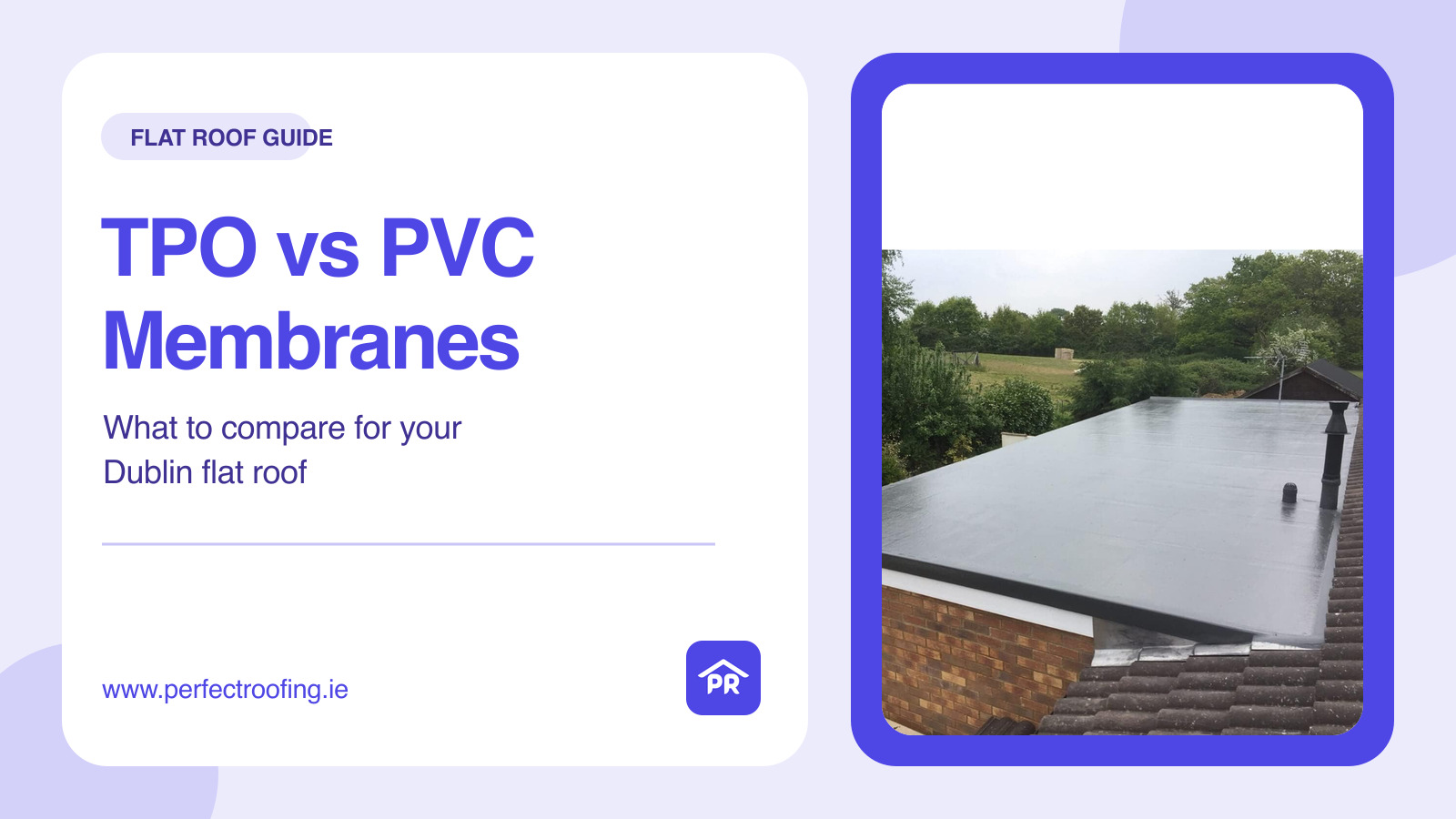
TPO and PVC are both single-ply waterproofing membranes used on flat and low-slope roofs. They can be part of a well-planned replacement for an extension, garage, dormer or roof terrace, but the material name alone does not describe the full job. The deck, falls, insulation, outlets, upstands, rooflights and edge details all need to work together.
For homeowners in Dublin, Lucan, Bray, Wicklow, Naas and nearby areas, the useful question is not simply which membrane is “best”. It is which complete roof build-up is suitable for the existing roof and the work planned around it.
TPO vs PVC: a practical comparison
| Point to compare | TPO single-ply membrane | PVC single-ply membrane |
|---|---|---|
| Material family | Thermoplastic polyolefin | Flexible polyvinyl chloride |
| Typical system role | Exposed single-layer waterproofing | Exposed single-layer waterproofing |
| Reinforcement | Varies by product and system | Varies by product and system |
| Details to confirm | Attachment method, laps, edge details and compatible components | Attachment method, laps, edge details and compatible components |
| Best way to compare | A complete specification for the actual roof | A complete specification for the actual roof |
For example, SOPREMA Ireland describes its FLAGON EP/PR TPO membrane as a reinforced membrane for single-layer roofing, while its FLAGON SR SC PVC membrane is a flexible PVC membrane with polyester reinforcement for exposed flat roof use. Those are product-family details, not a guarantee that either one suits every Dublin roof.
Start with the roof, not the roll material
A membrane cannot compensate for a poorly understood roof beneath it. Before choosing a system, a survey should clarify:
- Whether the existing deck is sound and dry enough for the proposed work.
- How water reaches outlets, gutters or other drainage points.
- The condition and height of upstands at walls, doors and rooflights.
- Whether an overlay is genuinely suitable or the old covering needs removal.
- Where insulation, vapour control and ventilation sit within the intended build-up.
- How edge trims, flashings and penetrations will be finished.
On a Dublin City terrace, access and neighbouring details can affect the sequence of work. On a more exposed property around Bray or Wicklow, the detailing at edges, walls and roof openings deserves particular attention. These are site-specific questions, not reasons to assume that one membrane type automatically wins.
TPO: questions worth asking
TPO systems are commonly specified as exposed single-ply membranes. The exact product may be mechanically fixed, adhered or used in another approved arrangement, depending on the roof design and manufacturer system.
Ask the contractor:
- Which TPO product and thickness are proposed?
- How will seams and perimeter details be formed?
- Is the membrane compatible with the insulation, vapour-control layer and adhesives in the quoted build-up?
- How will rooflight kerbs, pipe penetrations and outlets be waterproofed?
- What compatible repair method is proposed if the roof is damaged later?
Do not treat a product sheet as an installation design. A published membrane feature describes that product, while the finished roof depends on the approved system and workmanship around every junction.
PVC: questions worth asking
PVC single-ply systems can also be used as exposed waterproofing layers. As with TPO, the exact membrane, reinforcement, backing and attachment method need to be named in the quotation.
Questions to include are:
- What specific PVC membrane is being installed?
- Is it suitable for the intended exposure and the existing roof build-up?
- How will the roof be separated from any materials that need a compatible layer between them?
- What trims, outlets and upstand details are included in the price?
- Who is responsible for the rooflight, door-threshold or wall junction if it needs additional work?
A quote that just says “PVC roof covering” leaves too much undecided. Ask for the product family, the full build-up and the detail drawings or installation approach that applies to your roof.
What matters more than the material label
When comparing TPO and PVC proposals, make sure each contractor is pricing the same scope. A lower headline price may exclude the work that makes the roof watertight at its edges and openings.
Look for these details in writing:
- Removal or retention of the old roof covering and the reason for that choice.
- Deck inspection and any allowance for damaged timber or other substrate repairs.
- Insulation thickness and where it sits in the build-up.
- Falls, drainage route and outlet work.
- Membrane manufacturer, product name, thickness and fixing method.
- Flashings, parapet walls, door thresholds, rooflight kerbs and pipe penetrations.
- Edge trims, gutter interfaces and any fascia work.
- Safe access, waste removal, photographs and written product and workmanship terms.
Avoid comparing a material-only price with a complete replacement quotation. It is more useful to compare two like-for-like scopes once the roof condition has been assessed.
Existing leaks and repairs
If a flat roof is leaking, the visible damp patch may be some distance from the entry point. Water can travel beneath a covering or along a wall junction before reaching a ceiling. A repair may be possible, but it should follow an inspection of seams, outlets, upstands, rooflight details and the roof beneath the affected area.
Our guides to flat roof leak checks and flat roof overlay versus replacement explain some of the questions that help organise that inspection. Do not climb onto a roof without suitable safety equipment and access. Photographs from a safe indoor or ground-level position are usually more helpful than a risky close look.
Ask Perfect Roofing about your flat roof
Perfect Roofing can inspect flat roofs and discuss appropriate repair or replacement options across Dublin City, North Dublin, South Dublin, Lucan, Bray, Wicklow, Naas and nearby areas.
Contact us by WhatsApp, call 083 066 3462, or email hi@perfectroofing.ie. Send safe photographs and any existing quotation, and ask for a recommendation based on your roof, budget, weather exposure, access and long-term plans.
Need a roofer to take a look?
Send a few photos on WhatsApp, email us, or tap the number to call. We cover Dublin City, North Dublin, South Dublin, Lucan, Bray, Wicklow, Naas, and nearby locations.