Flat Roofing
Elevate RubberCover vs HERTALAN Easy Cover for Dublin Flat Roofs
Compare two EPDM flat roof systems for Dublin extensions and garages: sheet layout, seams, details, maintenance, and questions to ask before choosing.
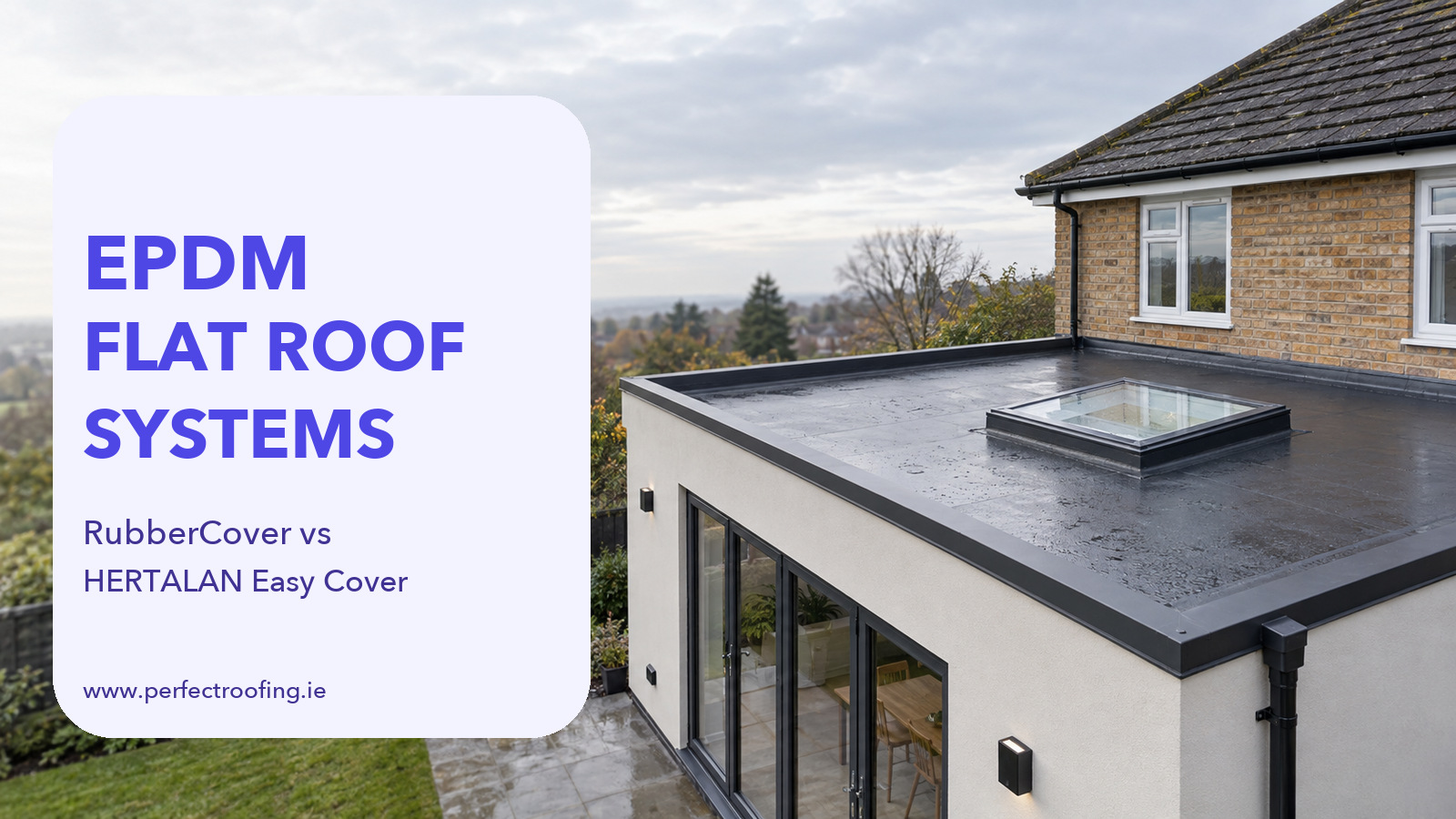
If you are replacing the flat roof on an extension or garage, “EPDM rubber” is a starting point, not a complete specification. The membrane, sheet layout, adhesives, edge trims, outlets, and rooflight details need to work as one system.
Two products available through Irish roofing suppliers are Elevate RubberCover and HERTALAN Easy Cover. Both are EPDM systems, but they approach sheet preparation and site detailing differently. Here is how to compare them for a Dublin home without choosing by brand name alone.
The main difference at a glance
| Elevate RubberCover | HERTALAN Easy Cover | |
|---|---|---|
| Product focus | A residential EPDM system that Elevate specifies for flat roofs up to 150 m² | A professional EPDM system that can use made-to-measure, factory-joined sheets |
| Sheet strategy | Large sheets can cover many domestic roofs with no field seam, depending on roof dimensions | Factory hot bonding can join sheets before delivery, reducing the number of joints formed on site |
| Installation approach | A system of membrane, compatible adhesive, primer, tape, and detail accessories | A system of prefabricated membrane, compatible adhesives, fixings, and detail accessories |
| Key question | Can the selected sheet cover this roof cleanly, including its upstands and penetrations? | Will a prefabricated sheet simplify this roof shape and its site joints? |
These are system descriptions, not a performance ranking. The better answer depends on the existing roof and the proposed installation detail.
Elevate RubberCover: a residential sheet system
Elevate's RubberCover information describes a single-ply EPDM system for residential flat roofs up to 150 m². Irish supplier QBM lists standard and 1.5 mm membrane options and notes that large sheet sizes can let many domestic roofs be covered without a field seam.
RubberCover may be worth discussing for a straightforward rear extension, garage, porch, or dormer where one sheet can be laid out neatly. A simple membrane area does not mean simple detailing: a rooflight, door threshold, parapet, outlet, or adjoining pitched roof can require careful work even on a small roof.
Potential advantages:
- The residential product scope is clearly defined by the manufacturer.
- Large sheets may reduce site seams on a suitably shaped roof.
- The manufacturer provides compatible primers, tapes, flashing, and adhesives for the details.
Points to check:
- Whether the chosen sheet size and roof geometry actually avoid a field seam.
- Whether the deck is sound, smooth, clean, and dry enough for the proposed system.
- Which membrane grade and protection are appropriate if the roof will carry equipment or be accessed regularly.
Elevate says regular roof traffic needs protection. A flat roof that will serve as a terrace, support solar equipment, or receive frequent maintenance visits needs a complete design for access, loading, drainage, and protection; the membrane alone does not settle those questions.
HERTALAN Easy Cover: made-to-measure EPDM
HERTALAN's manufacturer page explains that Easy Cover sheets can be joined by hot bonding in the factory and supplied as larger prefabricated membranes. This can reduce the number of joins made on the roof. Irish supplier Tecron lists HERTALAN Easy Cover for professional flat roof waterproofing.
The prefabricated approach may be helpful where the roof dimensions suit a planned sheet, where site access makes joint work awkward, or where several roof sections need careful sequencing. It does not remove the need for sound outlets, upstands, edge details, compatible adhesives, and suitable installation conditions.
Potential advantages:
- Factory joining can reduce the number of seams that need to be formed on site.
- The sheet can be planned around measured roof dimensions before installation.
- The manufacturer provides system adhesives and accessories for different details.
Points to check:
- Whether accurate site measurements and access allow the proposed sheet to be delivered and handled safely.
- Where any remaining site joins, penetrations, outlets, and upstands will be formed.
- Which fixing or bonding arrangement is specified for the actual deck and roof build-up.
A made-to-measure sheet is most useful when the contractor has mapped the whole water route. A poor outlet or low wall junction can still leak even if the open roof area has very few seams.
Which system suits an extension or garage?
For a simple Lucan or South Dublin extension with one rooflight and clear access, either system may be practical. Compare the proposed sheet layout and all the edge and rooflight details. If one option needs several site joins while the other offers a well-planned prefabricated sheet, that difference is worth discussing.
For a narrow Dublin City rear roof, an awkward terrace junction, or a roof with several changes in level, access and detail work may matter more than membrane area. On an exposed home around Bray or Wicklow, ask how perimeter fixing, upstands, outlets, and wind exposure have been considered in the complete specification.
The same rule applies to a garage roof in Naas or a dormer in North Dublin: neither brand corrects a soft deck, inadequate fall, blocked outlet, or failing wall junction. The existing roof needs inspection before a replacement covering is chosen.
Questions to put in each quotation
Ask each roofer to identify:
- The exact membrane and grade, including the manufacturer and named system.
- What will happen to the old covering, wet insulation, and any damaged decking.
- How the roof will drain, including outlet position, falls, and overflow route where needed.
- The proposed sheet plan and where any site seams will be formed.
- How walls, rooflights, thresholds, parapets, pipes, and perimeter edges will be detailed.
- Which adhesives, primers, tapes, fixings, and trims are included.
- How the roof will be protected if it needs regular access or later equipment work.
- What inspection, maintenance, and written product information you will receive at handover.
Compare complete installed scopes, not membrane names or roll prices. If the quotations differ, ask why before assuming one is a like-for-like alternative.
Ask Perfect Roofing for a flat roof recommendation
Perfect Roofing can inspect a flat roof in Dublin City, North Dublin, South Dublin, Lucan, Bray, Wicklow, Naas, or a nearby area and explain whether a focused repair or a replacement is appropriate. We can discuss Elevate RubberCover, HERTALAN Easy Cover, or another suitable system against your roof shape, deck, budget, weather exposure, access, and long-term plans.
Contact us by WhatsApp, phone, or email. Photos taken safely from the ground or inside the property can help us understand the problem before a visit. Do not climb onto a flat or pitched roof without proper access and safety equipment.
Need a roofer to take a look?
Send a few photos on WhatsApp, email us, or tap the number to call. We cover Dublin City, North Dublin, South Dublin, Lucan, Bray, Wicklow, Naas, and nearby locations.