Flat Roofing
Felt vs EPDM vs GRP Flat Roofs for Dublin Extensions
A practical flat roof material comparison for Dublin, Lucan, Naas, Bray, Wicklow, and nearby homeowners comparing felt, EPDM rubber, and GRP fibreglass options.
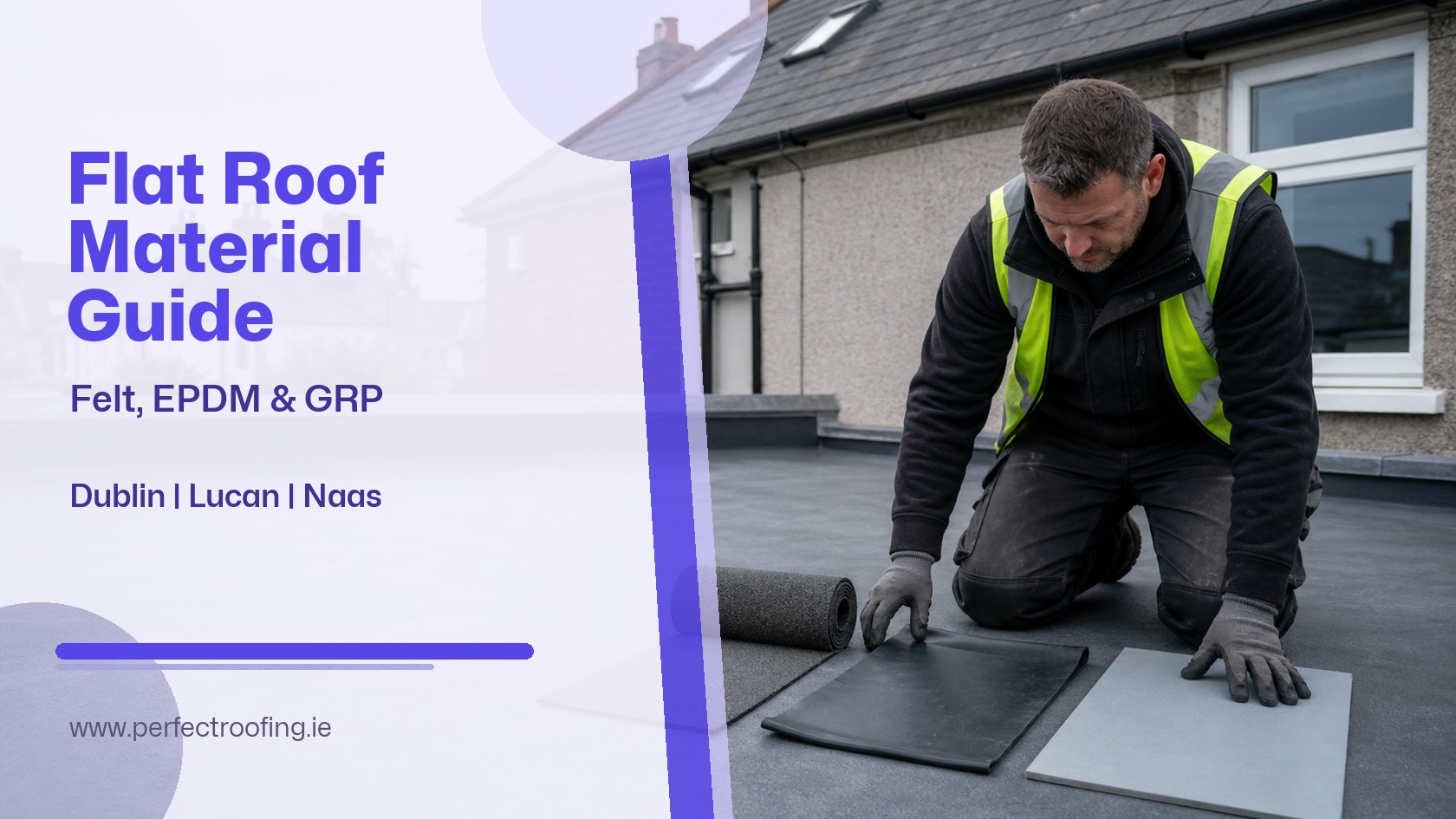
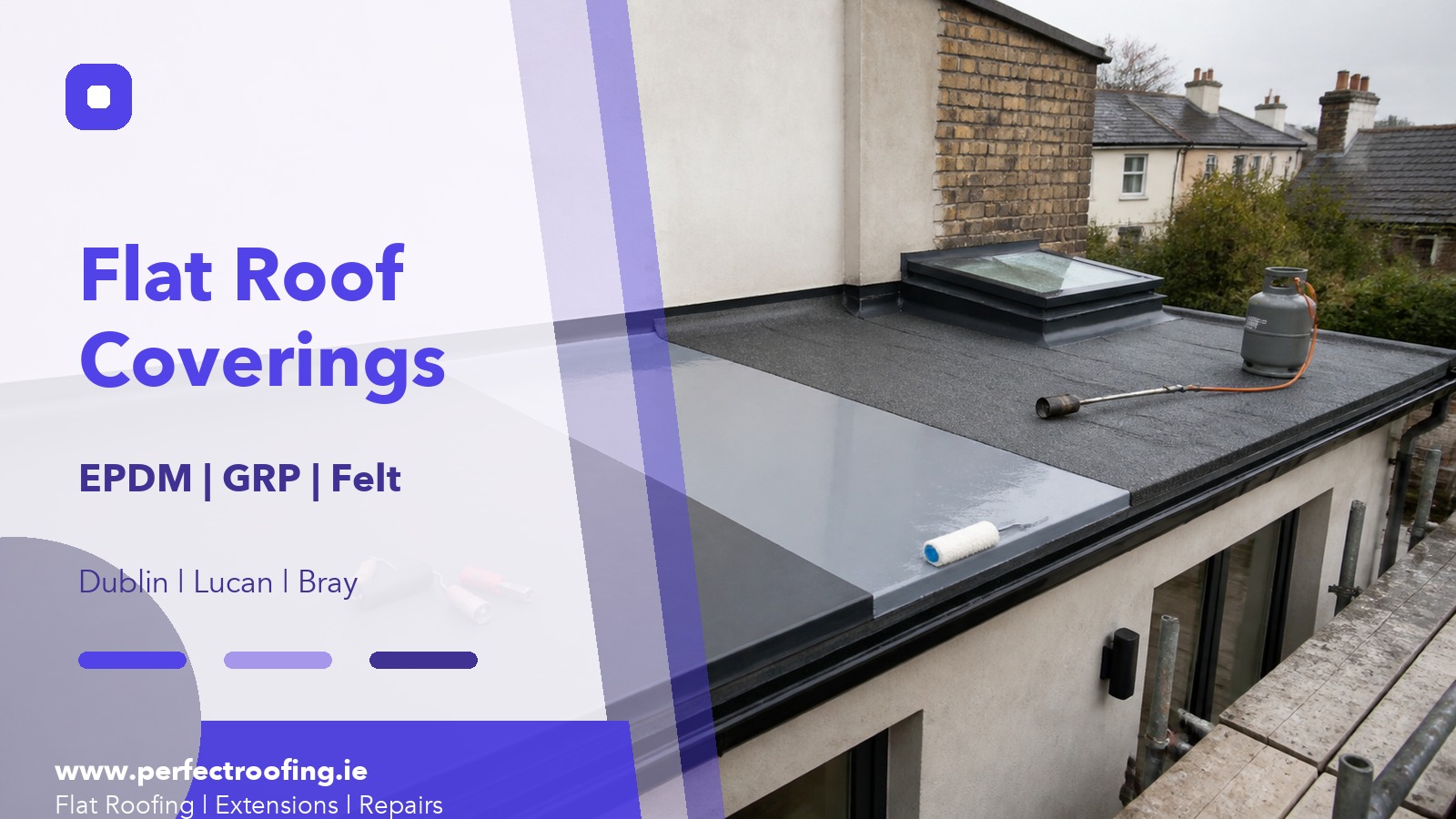
Flat roofs are common on Irish extensions, garages, porches, dormers, garden rooms, and rear additions. When a flat roof starts leaking or reaches replacement age, homeowners are often given several material options: modern felt, EPDM rubber, GRP fibreglass, and sometimes liquid-applied or single-ply systems.
For homes in Dublin City, North Dublin, South Dublin, Lucan, Naas, Bray, Wicklow, and nearby areas, the best choice depends on more than the material name. Roof size, drainage falls, outlet positions, parapets, rooflights, access, weather exposure, insulation, and the existing deck all affect the recommendation.
This guide compares felt, EPDM, and GRP in practical homeowner terms so you can ask better questions before repairing or replacing a flat roof.
Quick comparison
| Option | Often suits | Check carefully |
|---|---|---|
| Felt / bitumen membrane | Extensions, garages, porches, dormers, and flat roofs with many familiar details | Deck condition, number of layers, edge trims, outlets, upstands, torch-on safety, and whether old material should be stripped |
| EPDM rubber | Simple flat roof shapes, larger uninterrupted areas, garages, sheds, and extensions with fewer penetrations | Adhesive choice, trims, seams, rooflight details, outlet detailing, and how the membrane will terminate at walls |
| GRP fibreglass | Smaller domestic flat roofs, porches, bay roofs, balconies, and areas where a neat rigid finish is wanted | Deck specification, weather conditions during installation, movement, edge trims, and whether the roof shape is too complex |
No table can replace a site visit. A small flat roof over a Dublin City return, a large kitchen extension in Lucan, a dormer in Naas, and an exposed roof near Bray or Wicklow can each need different detailing.
Felt and bitumen flat roofs
Modern felt roofing is not the same as the thin shed felt many homeowners imagine. Professional flat roof felt usually means a built-up bitumen membrane system, often with underlayers, cap sheets, primers, trims, and careful detailing around outlets and upstands.
IKO Ireland lists bituminous membranes, built-up flat roofing, single-ply, insulation, and liquid solutions among its roofing product systems, with Dublin North and Dublin South contact locations. IKO's European flat roof pages also describe flat roof systems with bituminous cap sheets, underlayers, insulation, vapour barriers, and roof details.
Felt may be worth considering when:
- The flat roof has a familiar extension, porch, garage, or dormer layout.
- The roof has parapets, chases, wall upstands, or gutter edges suited to bitumen detailing.
- You want a proven material family that many roofers can inspect, repair, and replace.
- The roof needs a robust finish around outlets, drips, and junctions.
- Existing felt can be assessed clearly and either repaired or stripped back properly.
Ask whether the roof needs a full replacement or a local repair. Re-covering a poor deck, wet insulation, rotten boards, or trapped moisture can leave the same problem hidden below a new surface.
EPDM rubber flat roofs
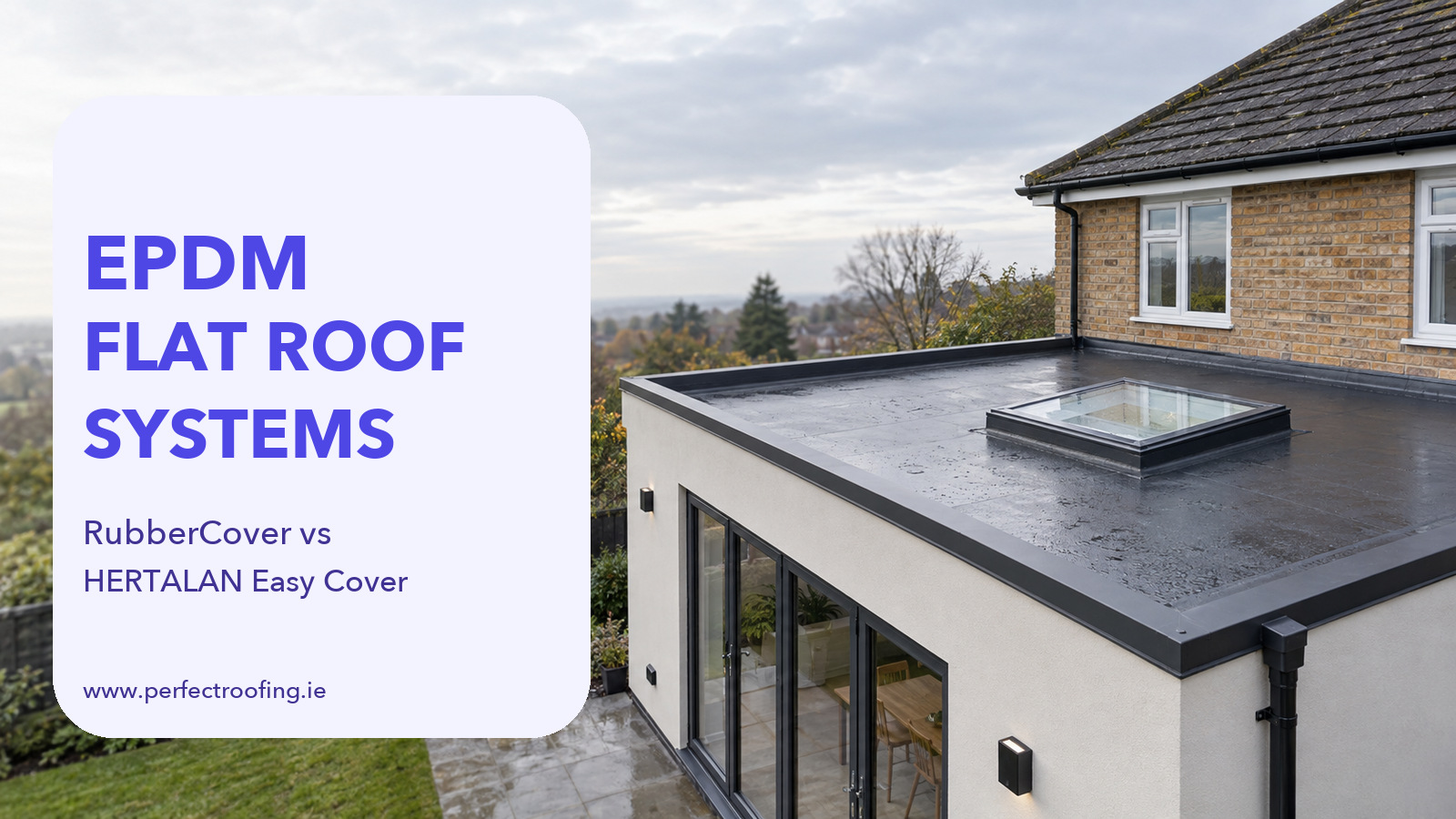
EPDM is a synthetic rubber membrane used on many domestic and commercial flat roofs. Homeowners often hear about it as a single-sheet rubber roof, especially for garages, sheds, simple extensions, and roofs where large open areas can be covered with fewer joins.
PermaRoof UK describes EPDM rubber roofing as an alternative to felt and supplies ELEVATE RubberCover EPDM membranes and accessories for flat roofing. The practical appeal is usually the combination of a flexible membrane, adhesive installation, and fewer seams on simple roof shapes.
EPDM may be worth considering when:
- The roof is a simple rectangle with limited penetrations.
- A large sheet can reduce the number of laps and joins.
- The roof has straightforward edge trims and gutter discharge.
- The existing deck can be prepared cleanly and kept dry during installation.
- The homeowner wants a low-profile black membrane finish.
Check detailing carefully around rooflights, outlet collars, wall upstands, pipes, and door thresholds. A good membrane still needs good terminations. EPDM can be a poor fit if the roof has awkward details that cannot be sealed neatly with the right trims and accessories.
GRP fibreglass flat roofs
GRP flat roofing is a fibreglass system applied over a suitable deck, normally with resin, reinforcement mat, trims, and a coloured topcoat. It creates a rigid, jointless-looking surface when installed correctly.
Cure It describes its GRP flat roofing system as a wet-laid system applied to OSB3 tongue-and-groove decking, with resin, reinforcement mat, topcoat, and edge trims forming the system. For homeowners, the main appeal is often the neat finish and the ability to form crisp edges around smaller domestic flat roofs.
GRP may be worth considering when:
- The flat roof is relatively small, such as a porch, bay, dormer, or compact extension.
- A clean grey finish is important visually.
- The deck can be replaced or prepared to the system requirement.
- There are neat edge details, trims, and upstands rather than awkward movement joints.
- Installation can be done in suitable dry conditions.
Ask about movement, deck specification, weather during installation, and how the system will be detailed at walls and outlets. GRP is not just paint on a roof. It is a full system, and shortcuts around the deck or trims can cause early trouble.
What about liquid and single-ply systems?
Some projects may also involve liquid-applied waterproofing, PVC or FPO single-ply membranes, hot-melt systems, or commercial specification systems. These are not always the first choice for a small domestic extension, but they can be relevant where the roof has complex details, larger areas, insulation upgrades, green roof plans, or specification requirements.
Bauder lists flat roof waterproofing systems including reinforced bitumen membrane, single-ply, hot melt, and cold-applied liquid systems, along with insulation, green roofs, blue roofs, solar PV, rooflights, outlets, and accessories. That range shows why a flat roof recommendation should start with the roof design, not only with a material preference.
For a homeowner, the useful question is simple: what system suits this roof, this access, this budget, and this long-term plan?
How to choose for Irish weather
Irish flat roofs need careful water management. A material can be good on paper and still fail if the falls, outlets, trims, upstands, or rooflight details are wrong.
Before choosing a system, check:
- Falls and ponding: Does water drain away, or does it sit in low spots after rain?
- Outlets and gutters: Are outlets large enough, clear, and positioned sensibly?
- Upstands: Are wall junctions, parapets, and door thresholds high enough for the system?
- Deck condition: Are boards, insulation, and timbers dry, sound, and suitable?
- Rooflights: Are skylights, flat roof windows, or lanterns flashed into the system correctly?
- Access: Will scaffolding, side access, or safe working platforms be needed?
- Ventilation and insulation: Is the roof build-up warm, cold, ventilated, or upgraded?
- Future work: Will gutters, fascia, roof windows, or a nearby pitched roof be repaired at the same time?
Exposed homes near Bray and Wicklow may need extra attention around wind-driven rain and edge details. Dublin City terraces can have tight access, parapets, and awkward rear returns. Lucan, Naas, North Dublin, and South Dublin homes often have extensions where outlets, rooflights, and wall junctions decide how reliable the finished roof will be.
Pros and cons by homeowner priority
If you want a familiar repairable system:
- Felt and bitumen systems are widely understood and can suit many domestic flat roof details.
- The trade-off is that good preparation, safe installation, and correct layering matter. A cheap overlay can hide rotten decking or trapped moisture.
If you want fewer seams on a simple roof:
- EPDM can work well where a large sheet covers a simple roof with clean trims.
- The trade-off is that awkward penetrations, outlets, and wall terminations still need careful system-specific detailing.
If you want a neat rigid finish:
- GRP can look sharp on smaller roofs with the right deck, trims, and dry installation conditions.
- The trade-off is that deck movement, poor preparation, or rushed application can undermine the finish.
If you want a specification-led system:
- Liquid, single-ply, or reinforced bitumen systems may suit more complex projects.
- The trade-off is that these decisions need a proper roof survey and product-specific guidance, not a generic online answer.
Repair or replace the flat roof?
Material choice only matters after the roof has been diagnosed properly. A small leak near an outlet may not mean the whole flat roof has failed. Repeated leaks, soft decking, poor falls, failed edges, wet insulation, or multiple patches often point toward replacement.
Replacement may be better when:
- The roof has been patched several times.
- Water is sitting on the surface after normal rain.
- The deck feels soft, bouncy, rotten, or uneven.
- Damp appears around rooflights, wall upstands, ceilings, or edges.
- The roof is poorly insulated and already being opened up.
- Gutters, fascia, skylights, or nearby roof details also need work.
- A previous overlay has trapped problems underneath.
Do not climb onto a flat roof to inspect it yourself, especially in wet weather. Take photos from a safe upstairs window, garden, or doorway, and ask a roofer to inspect the surface, deck, outlets, and junctions properly.
Ask Perfect Roofing for a flat roof recommendation
Perfect Roofing helps homeowners across Dublin City, North Dublin, South Dublin, Lucan, Bray, Wicklow, Naas, and nearby areas with flat roof repairs, flat roof replacement, roof inspections, gutters, Velux windows, skylights, roof ventilation, and related roofing work.
Contact Perfect Roofing by WhatsApp, phone, or email if you are comparing felt, EPDM, GRP, or another flat roof system. Send photos if you can take them safely, tell us the roof size and location, and explain whether the issue is a leak, ponding water, damaged edge, rooflight problem, or planned replacement. We can then recommend a practical option based on your roof, budget, weather exposure, access, and long-term plans.
Need a roofer to take a look?
Send a few photos on WhatsApp, email us, or tap the number to call. We cover Dublin City, North Dublin, South Dublin, Lucan, Bray, Wicklow, Naas, and nearby locations.