Gutters
Cast-Iron Gutters on Older Homes: Repair or Replace?
How to tell if original cast-iron gutters, downpipes and hoppers on a period home in Dublin City, Bray or nearby can be repaired, and when to replace like for like.
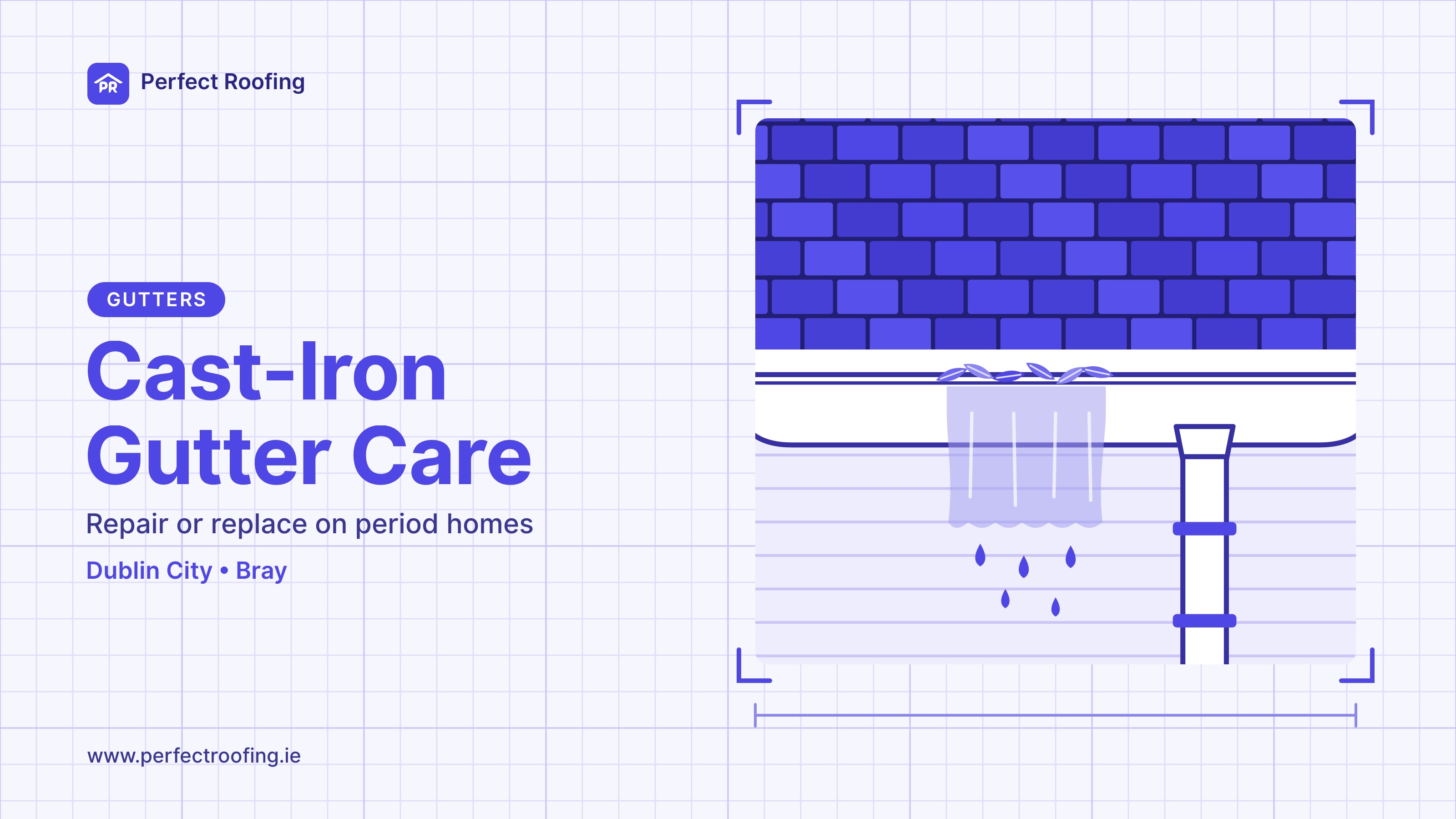
Many Victorian and Edwardian homes in Dublin City, Rathmines, Ranelagh, Drumcondra, Clontarf, Dún Laoghaire and Bray still have their original cast-iron gutters, downpipes and hopper heads. After a century or more, they often look tired: flaking paint, rust streaks, a dripping joint, or a downpipe that has worked loose from the wall.
The common reaction is to rip the lot out and fit plastic. In most cases that is not necessary, and on an older house it is often not the best choice. This guide explains what official Irish heritage guidance says, how to tell repairable cast iron from failed cast iron, and what a sensible repair looks like.
Why cast iron is worth keeping
The Department's Advice Series booklet Roofs: A Guide to the Repair of Historic Roofs (2010) is clear on this point. It describes cast iron as the most common material for rainwater goods on historic buildings and says cast-iron goods "should be retained, maintained and repaired where possible".
The same guide gives practical reasons:
- Weight. Heavy iron gutters do not lift in strong winds, which matters on exposed terraces and in coastal areas like Bray and Greystones.
- Durability. It rates cast iron as better than extruded metal or plastic systems when maintained.
- Line and appearance. It notes that most substitute materials look different and can twist or slip off the line of the eaves, causing rainwater to overspill.
The catch is maintenance. Iron rusts if the paint fails, so cast iron rewards owners who keep on top of painting and cleaning.
Repairable or past saving?
Most problems we see on Dublin period homes fall into the first column.
| Usually repairable | Usually needs a new section |
|---|---|
| Flaking paint and surface rust | Gutter base rusted through in several places |
| Leaking joint between two lengths | Cracked or snapped length of gutter or downpipe |
| Loose or missing downpipe bolts and collars | Downpipe split after freezing (common after a blocked winter) |
| Gutter that has lost its fall towards the outlet | Missing sections or badly distorted castings |
| Blocked hopper head or outlet | Corroded brackets that can no longer hold the gutter |
| A small crack in a decorative gutter that is hard to remove | Decorative castings damaged beyond repair |
The Iron: The Repair of Wrought and Cast Ironwork booklet (2009) notes that a downpipe which freezes while blocked can fracture and then needs replacing. Blocked downpipes in late autumn are worth clearing before the first hard frost.
Signs to look for from the ground
You do not need a ladder to spot most early warning signs. From the garden, street or an upstairs window, look for:
- Rust streaks on the wall below a gutter joint or hopper.
- Drips or a waterfall from a joint during rain, rather than water flowing to the outlet.
- Green or dark staining on brickwork or render behind a downpipe.
- Plants growing from the gutter or hopper head.
- A downpipe standing off the wall at an angle, or a gap between sections.
- Water pooling at the base of a downpipe instead of going into the gully.
The Heritage Council and SPAB Ireland rainwater goods maintenance sheet (2020) points out that heavy rain is a good time to check gutters, because cracks, blockages and leaks become obvious.
Please leave anything above ground floor to a roofer with proper access. Old cast iron is heavy, sharp when cracked, and often fixed high on three-storey terraces.
What a proper repair involves
A good cast-iron repair is usually a combination of the following, depending on what the inspection finds.
Cleaning and clearing
Gutters, hoppers and outlets are cleared of moss, leaves and silt. The Iron booklet recommends cleaning gutters and hoppers at least twice a year, in spring and in late autumn after leaves have fallen. For homes under mature trees in areas like Terenure, Glasnevin or Bray, late autumn is the critical clean.
Re-making leaking joints
Joints between lengths are a common source of drips. A lasting fix means taking the joint apart, cleaning back the old sealant and rust, and remaking it with a suitable sealant and new bolts. Smearing mastic over the outside of a joint rarely lasts. We covered why surface sealants often fail in our post on quick-fix sealant repairs.
Rust treatment and repainting
The Iron booklet advises that cast-iron rainwater goods be cleaned and repainted periodically, with rust removed by wire brush and sandpaper before painting. It recommends painting external ironwork at least once every five years, and stresses the backs of downpipes, which are hard to reach and prone to corrosion.
Two cautions from the same booklet:
- Old paint may contain lead. Lead paint was used on metalwork until the 1960s, and dust from sanding or fumes from burning it off are hazardous. Sound lead paint is best left and overpainted; removal must follow safety standards.
- Colour changes may need permission on some buildings, so check with the council before changing the colour scheme.
Refixing downpipes and brackets
Loose collars and corroded bolts are replaced so the downpipe sits straight. The Roofs guide recommends spacers to hold downpipes off the wall, so a small leak runs down the back of the pipe instead of soaking the masonry, and suggests hinged brackets to make later maintenance easier. For missing gutter brackets, the Iron booklet says mild steel is not a suitable substitute; new brackets should match the originals, with stainless steel as a fallback.
Resetting the fall
Over time, roof timbers move and brackets bend, so a gutter can lose its fall and hold water. Resetting the brackets so water runs towards the outlet is often all that is needed to stop an overflow. Our guide to sagging and leaking gutters covers this in more detail.
Sleeving a decorative gutter
Some decorative gutters cannot be removed without disturbing the bottom course of slates. For these, the Roofs guide describes fitting a metal insert or continuous sleeve inside the gutter to cover cracks or corrosion spots, using a metal that will not cause galvanic corrosion and fitting it in dry weather. It treats this as an interim repair until larger roof works allow a permanent fix.
When replacement makes sense
Replacement is the right call for sections that are cracked, rusted through or missing. Both booklets say replacement cast-iron gutter and downpipe sections in common profiles (half round, box and ogee) are readily available, and that specialist foundries can often match or recast decorative patterns.
Before you replace anything, think about:
- Matching the profile. A new length should match the size and shape of the existing one so joints seal properly and the run looks continuous.
- Mixing materials. Joining plastic to cast iron mid-run is awkward to seal and looks patched. If only one section is failed, a cast-iron replacement is usually neater.
- Protected structures and ACAs. If your house is a protected structure or in an Architectural Conservation Area, swapping cast iron for PVC-U changes its character. Speak to your council first. Our post on protected structure roof repairs explains how this works in Dublin.
- Capacity. If the existing system genuinely cannot cope, the Roofs guide notes that larger sections in a similar design, or an extra downpipe, may be possible. Planning permission or a neighbour's consent can be needed depending on location.
On houses with no heritage protection, a good-quality cast-iron-style system can be a reasonable option. Our gutter material comparison covers the pros and cons.
A simple maintenance calendar
| When | What to do |
|---|---|
| Late autumn (November) | Clear gutters, hoppers and outlets after leaf fall; check downpipes run freely before frost |
| During heavy rain | Look from the ground for drips, overflowing joints and wet walls |
| Spring | Second clean; check for winter damage and loose brackets |
| Every year | Ground-level check of paint, rust spots and downpipe fixings |
| At least every five years | Clean back and repaint (by a contractor with safe access) |
The Heritage Council sheet also suggests checking that downpipes discharge away from the wall and into the gully, not against the base of the house.
Before you call a roofer
To get useful advice quickly, it helps to send:
- Photos of the gutters, hoppers and downpipes, taken safely from the ground.
- A photo of any damp patch or stain inside or on the wall outside.
- Whether the house is a protected structure or in an ACA, if you know.
- How many storeys and whether there is side or rear access.
Cast-iron gutter repairs across Dublin and nearby areas
Perfect Roofing repairs, refixes and replaces cast-iron and traditional gutters, hoppers and downpipes on period and older homes across Dublin City, North Dublin, South Dublin, Lucan, Bray, Wicklow, Naas and nearby areas. We will tell you honestly what can be saved, show you photos of what we find, and quote clearly for any sections that need replacing.
Contact us by WhatsApp, call 083 066 3462, or email hi@perfectroofing.ie.
Need a roofer to take a look?
Send a few photos on WhatsApp, email us, or tap the number to call. We cover Dublin City, North Dublin, South Dublin, Lucan, Bray, Wicklow, Naas, and nearby locations.