Roof Repairs
Chimney Cowl and Cap Leak Checks for Bray and Wicklow Homes
A practical guide to chimney cowls, caps, pots, flaunching, and leak warning signs for homeowners in Bray, Wicklow, Dublin, Lucan, Naas, and nearby areas.
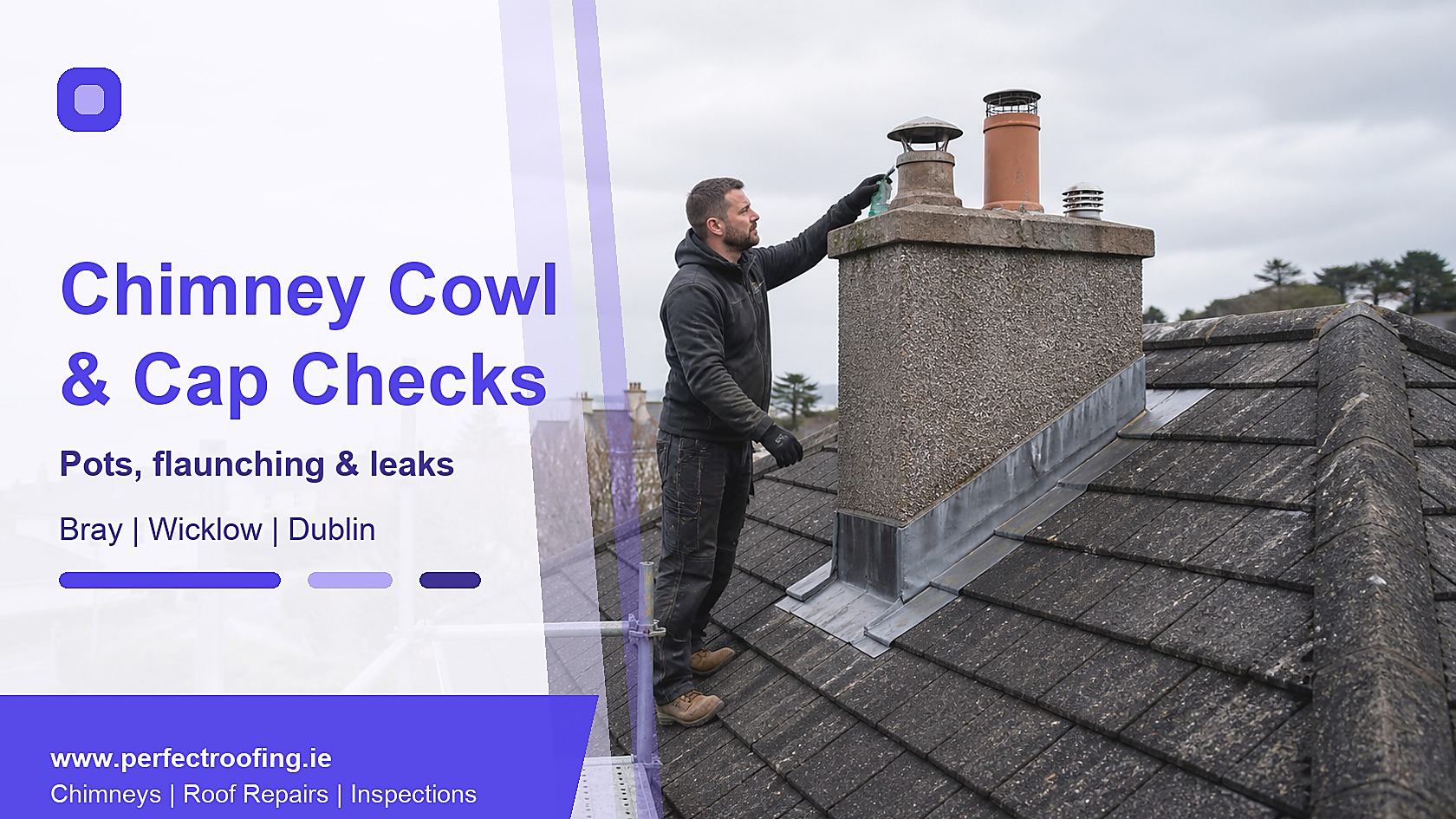
Chimneys are exposed to rain, wind, salt air, moss, and temperature changes all year. When a chimney pot, cowl, cap, flaunching, or top course starts to fail, the first sign inside the house may be a damp mark beside the chimney breast, staining in the attic, loose debris in the fireplace, or water appearing after windy rain.
For homes in Bray, Wicklow, Dublin City, South Dublin, North Dublin, Lucan, Naas, and nearby areas, chimney problems are often mixed with roof leaks, flashing defects, blocked gutters, old repairs, and weathered mortar. This guide explains what homeowners can check safely, why chimney tops leak, and when Perfect Roofing may recommend a chimney inspection, roof repair, lead flashing repair, or wider roof maintenance visit.
Why chimney tops cause roof leak symptoms
A chimney sits above the roof covering, but water can enter through several details before it shows indoors. The chimney top has to shed rain, protect the pot or flue opening where appropriate, and keep the surrounding masonry weather-tight.
Common weak points include:
- A loose or missing chimney cowl
- A cracked or poorly seated chimney cap
- Weathered flaunching around chimney pots
- Open mortar joints near the top of the stack
- Cracked render, damaged brickwork, or loose coping
- A pot that has moved or opened around its base
- Lead flashing at the roof line that has lifted or split
- Moss, leaves, or debris holding moisture around the stack
- Previous sealant patches that no longer bond properly
Water may enter at the top of the chimney, around the side of the stack, or at the roof-to-chimney junction. A careful inspection should follow the full water path rather than assuming the cowl or flashing is the only issue.
Safe signs to check inside the home
Do not climb onto the roof or lean out to inspect a chimney. Chimney areas can be slippery, high, and awkward to reach without proper access equipment. You can still collect useful information from inside the house.
Look for:
- Brown or yellow staining beside a chimney breast
- Damp marks in an attic near the chimney stack
- A musty smell after several wet days
- Drips or staining that appear during wind-driven rain
- Loose grit, mortar, or debris in a fireplace
- Damp patches that return after repainting
- Plaster bubbling near a chimney corner
- Staining that seems higher than the fireplace opening
Take photos when marks are fresh and note the weather conditions. If the stain appears only during rain from one direction, that can help separate a chimney-top issue from a valley leak, slipped slate, gutter overflow, or condensation problem.
What may be visible from ground level
Some chimney clues can be seen from a garden, driveway, footpath, or upper window across the property. Use a safe viewpoint only. Wide photos are more useful than very tight zooms because they show how the chimney connects with the roof around it.
From a safe place, look for:
- A missing, tilted, or damaged cowl
- A pot that looks cracked, loose, or uneven
- Flaunching that looks broken, hollowed, or separated
- Cracked render or open joints near the top of the stack
- Dark staining down one side of the chimney
- Loose leadwork around the chimney base
- Moss or vegetation collecting behind the stack
- Slipped slates or cracked tiles close to the chimney
- Gutters or valleys above the area sending water toward the stack
If the chimney is difficult to see clearly, do not force the inspection. A roofer can check it from safe access and confirm whether the visible chimney detail is actually connected to the damp inside.
Cowls, caps, pots, and flaunching: what each part does
Homeowners often use the words cowl, cap, pot, and flashing interchangeably, but they are different details.
| Chimney detail | What it usually does | What can go wrong |
|---|---|---|
| Chimney pot | The clay or concrete outlet at the top of the flue | Cracking, movement, open gaps at the base, loose bedding |
| Chimney cowl | A fitted cover or terminal over a pot or flue opening | Loose fixings, poor fit, corrosion, storm movement, wrong type for the flue |
| Chimney cap | A cover used to close, shelter, or protect a chimney opening depending on the chimney use | Cracks, poor seating, blocked ventilation where it is still needed |
| Flaunching | Mortar around the chimney pots on top of the stack | Cracking, weathering, dips that hold water, separation from pots |
| Flashing | Lead or other weathering detail where the chimney meets the roof | Lifted edges, splits, loose soakers, blocked back gutter, poor patch repairs |
The right repair depends on whether the flue is active, redundant, ventilated, or connected to an appliance. Perfect Roofing can assess the roof and chimney weathering, but appliance flues, live fireplaces, stoves, gas appliances, and ventilation requirements may also need advice from the relevant qualified specialist.
When a cowl or cap may help
A cowl or cap can be useful when the chimney opening is exposed and rain, wind, nesting material, or debris is contributing to a problem. It may also be part of a tidy repair when old pots and flaunching are being reset.
A cowl or cap may be considered when:
- Rain appears to be entering through an exposed pot
- A redundant chimney opening needs proper weathering and ventilation planning
- Loose debris is dropping into the flue
- The existing terminal is damaged, corroded, or poorly fitted
- The chimney top is being repaired and the pot detail can be corrected at the same time
It should not be treated as a universal fix. If water is entering through cracked flaunching, failed flashing, open masonry joints, or a blocked back gutter, fitting a new cowl alone may leave the leak source untouched.
When the leak is likely lower down
Chimney leaks are often blamed on the visible top detail, but the entry point may be lower on the roof.
The problem may involve flashing or the surrounding roof if:
- Damp appears on the ceiling beside the chimney rather than inside the fireplace
- The chimney top looks sound but leadwork at the base is loose
- Water appears after heavy rain running down the roof slope
- There are slipped slates or cracked tiles close to the stack
- Moss or debris is collecting behind the chimney
- A valley, ridge, dormer, or roof window sits above the same area
- A previous repair used thick surface sealant around the base
Bray and Wicklow homes can be exposed depending on elevation and coastal position, while Dublin City homes may have older stacks, tight access, shared rooflines, and repairs from several different periods. The inspection should consider the roof context as well as the chimney itself.
Local repair or wider chimney and roof inspection?
A local repair may be enough when the stack is otherwise sound and the defect is clearly limited to one detail.
Local work may suit:
- Re-seating or replacing a loose cowl
- Repairing cracked flaunching around a pot
- Securing or replacing a damaged cap
- Refitting a small section of lead flashing
- Replacing one or two damaged slates or tiles near the stack
- Clearing debris from a back gutter or chimney shoulder
A wider inspection is better when:
- Damp marks keep returning after small patches
- More than one room shows staining
- The chimney has cracked render, open joints, or loose masonry
- The roof covering around the stack is old, uneven, or repeatedly repaired
- Several chimneys, pots, cowls, valleys, or roof junctions sit close together
- You are planning roof replacement, roof maintenance, attic work, or ventilation improvements
- Access costs would make repeated small visits inefficient
The goal is not just to stop the visible drip. It is to make sure the chimney, flashing, roof covering, and drainage route are all working together.
What Perfect Roofing checks
When Perfect Roofing inspects a suspected chimney cowl, cap, or chimney-top leak, we look at the full roof area around the stack.
A practical inspection may include:
- Chimney pots, cowls, caps, flaunching, render, brickwork, and pointing
- Lead flashing, soakers, apron flashing, cover flashing, and back gutters
- Nearby slates, tiles, ridges, valleys, gutters, and roof junctions
- Attic staining, damp insulation, ceiling marks, and safe access points
- Whether water is entering through the chimney top, the chimney base, or a higher roof detail
- Whether a local repair, leadwork repair, chimney maintenance visit, or wider roof repair plan is more sensible
This joined-up approach matters because a chimney can be the entry point, the collection point, or simply the place where water finally becomes visible indoors.
Chimney cowl and cap checks across Bray, Wicklow, and nearby areas
Perfect Roofing helps homeowners with roof leak tracing, chimney and flashing repairs, roof repairs, emergency roof repairs, roof inspections, roof maintenance, gutters, flat roofing, Velux windows, skylights, roof ventilation, and roof replacement planning across Bray, Wicklow, Dublin City, North Dublin, South Dublin, Lucan, Naas, and nearby locations.
Bray and Wicklow properties may face stronger wind exposure depending on position. Dublin homes often have older chimney stacks and compact access. Lucan and Naas homes can include extensions and mixed roof sections where gutters, valleys, and chimneys all affect the same water path.
The right repair depends on the chimney condition, roof covering, access, weather exposure, flue use, and whether the surrounding roof is still shedding water properly.
Ask Perfect Roofing before a chimney leak spreads
If you notice staining near a chimney breast, loose chimney cowls, cracked caps, damaged flaunching, slipped slates, or damp after windy rain, do not climb onto the roof to investigate it yourself. Take clear photos from a safe place and note when the damp appears.
Contact Perfect Roofing by WhatsApp, phone, or email for practical advice, a roof inspection, or a repair quotation. We can help decide whether the issue is a chimney-top defect, flashing leak, damaged roof covering, blocked drainage, ventilation concern, or part of a wider roof repair plan.
Need a roofer to take a look?
Send a few photos on WhatsApp, email us, or tap the number to call. We cover Dublin City, North Dublin, South Dublin, Lucan, Bray, Wicklow, Naas, and nearby locations.