Roof Repairs
Dry Ridge Systems Compared for Dublin and Wicklow Homes
A practical dry ridge system comparison for Dublin, Wicklow, Lucan, Bray, and Naas homeowners comparing Marley, Klober, Manthorpe, Easy-Trim, and BMI Redland ridge options.
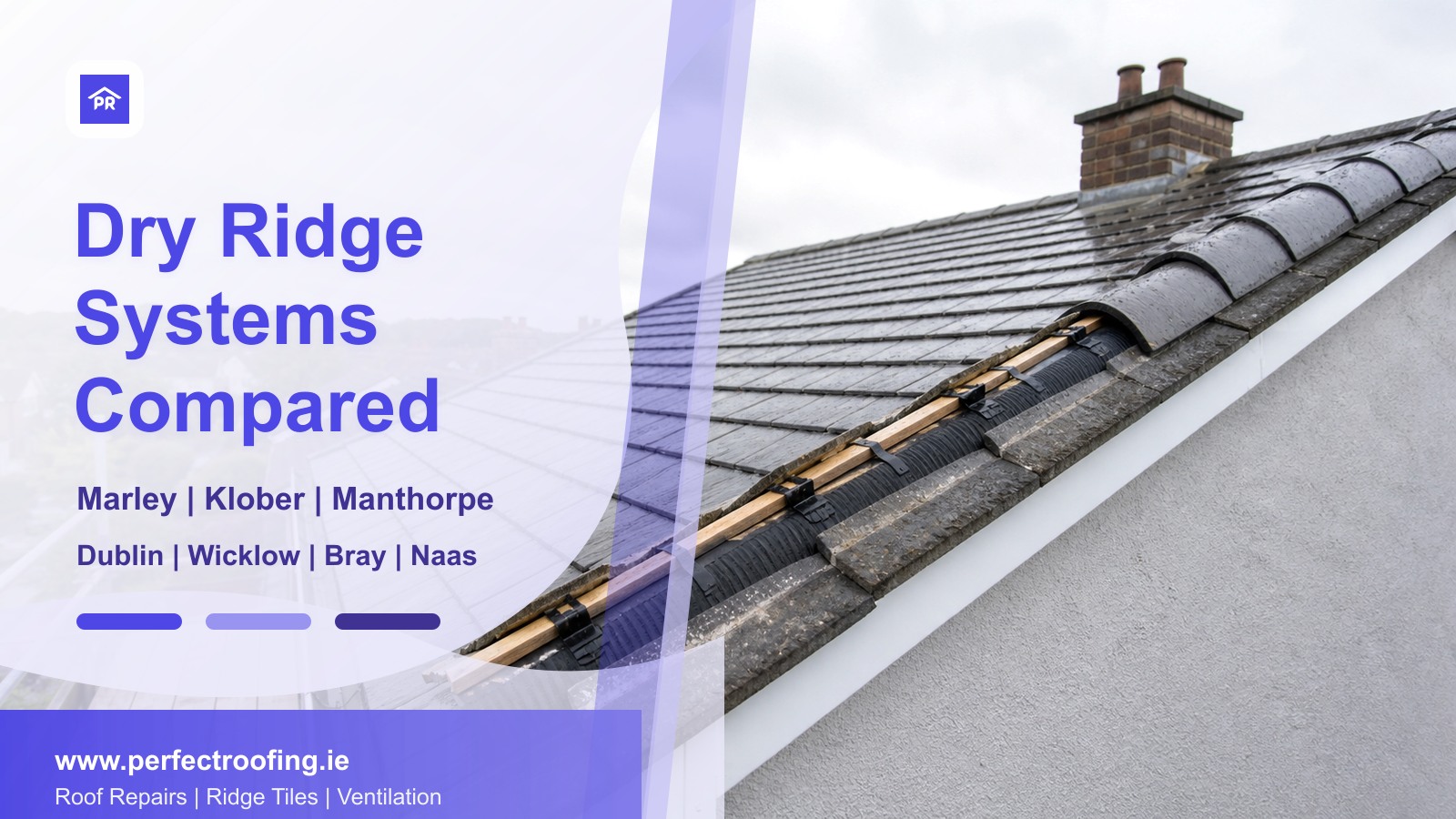
Ridge tiles sit at the highest point of many pitched roofs, so small defects can create surprisingly stubborn leaks. Cracked mortar, loose ridge tiles, failed hip details, poor ventilation, and gaps around old bedding can all let wind-driven rain reach the roof structure.
For homeowners in Dublin City, North Dublin, South Dublin, Wicklow, Bray, Lucan, Naas, and nearby areas, the choice is often framed as traditional mortar repair versus a modern dry ridge system. That is a useful starting point, but the better question is more practical: which ridge detail suits the roof covering, pitch, exposure, ventilation needs, budget, and long-term repair plan?
This guide compares common dry ridge product routes from Marley, Klober, Manthorpe, Easy-Trim, and BMI Redland, along with the situations where a mortar-bedded ridge with mechanical fixing may still be discussed.
Quick comparison
| Option | Often worth considering when | Check carefully before choosing |
|---|---|---|
| Marley Universal RidgeFast | You want a complete dry ridge kit with broad tile and slate compatibility, continuous ridge ventilation, and a recognisable roof-system manufacturer behind it | Roof pitch, ridge tile shape, compatibility with the existing covering, and whether hip details need separate planning |
| Klober Roll-Fix Universal Kit | You want a ventilating dry ridge and dry hip kit route for most concrete and clay ridge or hip tiles, with colour choices to blend with the roof | Minimum pitch, whether hip trays or clips are needed, colour match, and how the ridge batten will be fixed |
| Manthorpe dry ridge and hip systems | You want dry ridge, dry hip, dry verge, and valley details considered together during wider roofline repairs | Whether the work is only a ridge repair or part of a larger roofline upgrade involving verges, hips, valleys, and ventilation |
| Easy-Trim dry ridge kits | You want a practical dry fix kit route and need to confirm angled or half-round ridge compatibility, batten straps, and hip accessories | Exact kit, ridge tile shape, hip requirements, underlay gap, and installer familiarity |
| BMI Redland ridge fittings | You need concrete or clay ridge tiles and colours that match a Redland-style roof covering, with the option to discuss dry fixing or mortar bedding with mechanical fixing | Whether the existing roof covering matches the range, the fixing method, and whether the project is a repair, partial replacement, or re-roof |
No product name removes the need for a roof inspection. A dry ridge kit installed over rotten battens, loose top-course tiles, poor hip details, or a badly ventilated roof space can still leave problems behind.
What is a dry ridge system?
A dry ridge system fixes ridge tiles mechanically instead of relying only on wet mortar bedding. A typical system may include a ridge roll, ridge batten supports or straps, unions, clamps, screws, washers, seals, and end caps. The details vary by manufacturer and roof type.
Dry ridge systems are popular because they can:
- Reduce reliance on mortar that can crack, shrink, loosen, or fall out over time.
- Mechanically secure ridge tiles against wind uplift when specified and installed correctly.
- Provide high-level roof ventilation on many pitched roofs.
- Give a cleaner, more consistent ridge line on suitable roofs.
- Make future inspection and repair planning more straightforward than patching loose mortar repeatedly.
That does not mean every old mortar ridge should automatically be replaced. A small local repair may be enough where the rest of the ridge is sound. On the other hand, if the mortar is failing along several lengths, ridge tiles are loose, hip lines are affected, or the attic has condensation issues, a dry ridge upgrade may be worth considering as part of a wider repair.
Do not climb onto the roof to check ridge tiles yourself. Ridge lines are exposed, slippery, and easy to damage. Use photos from the ground, attic observations from a safe boarded area, or professional roof access.
Marley Universal RidgeFast
Marley describes Universal RidgeFast as a completely dry fixed ridge system for standard ridge tiles. Its official product information says the system provides continuous 5mm ventilation along the ridge, can be used with Marley tiles and slates as well as other manufacturers' tiles and slates, and is suitable for roof pitches between 12.5 and 60 degrees.
Marley also states that RidgeFast meets BS 5534, BS 8612 requirements, and NHBC guidelines. For Irish homeowners, treat those as manufacturer-referenced standards and specification cues rather than a shortcut around site-specific advice.
Marley Universal RidgeFast may suit:
- Roof repairs where the ridge is being upgraded from tired mortar to a dry fixed detail.
- Re-roofs where Marley or compatible tiles and slates are being used.
- Homes where ridge ventilation is useful as part of a broader roof-space ventilation plan.
- Straightforward ridge runs on semi-detached, terraced, detached, or bungalow roofs.
- Projects where a recognised roof-system brand and stockist route are important.
Check the ridge tile shape carefully. Marley lists specific limitations and technical conditions for the system, so the roofer should confirm the exact ridge tile profile and roof pitch before treating it as universal in practice.
Klober Roll-Fix Universal Kit
Klober's Roll-Fix Universal Kit is described as a ventilating dry ridge and dry hip system suitable for fixing most concrete and clay ridge and hip tiles. Klober lists it as a complete kit with ridge roll, seals, stainless steel screws and washers, clamping plates, and ridge batten straps.
Klober's official product information says the kit complies with BS 8612 for performance, BS 5250 for ventilation, and BS 5534 for mechanical fixing. It is listed in red, brown, and anthracite, with a minimum pitch of 15 degrees.
Klober Roll-Fix may suit:
- Roofs where the ridge colour needs to blend with red, brown, or dark coverings.
- Homes with concrete or clay ridge and hip tiles where a ventilating dry fix route is suitable.
- Repairs where the roofer wants a known ridge roll and clamp-style kit.
- Projects where a ridge and hip conversation is needed, not only a ridge-only repair.
- Roofs where matching the dry ridge detail to the roof pitch is a key decision.
The important check is scope. Klober notes that the kit can be used on hips, but trays and clips are not included. If a roof in Wicklow, Bray, or South Dublin has both ridge and hip failures, the quote should make clear which hip accessories are included and where they are needed.
Manthorpe dry ridge and hip systems
Manthorpe's dry fix roofing range covers dry verge, dry ridge, dry hip, and GRP valley products. Manthorpe describes its dry fix range as mechanically secured systems that offer alternatives to traditional wet fix methods, and says its dry fix products have been independently tested to conform with BS 8612 requirements.
Manthorpe may be worth discussing when the roofline needs more than a single ridge repair. A ridge leak can sit alongside loose verge units, cracked hip bedding, tired valley details, blocked eaves ventilation, or damaged roof-edge materials.
Manthorpe dry fix products may suit:
- Wider roofline repair projects where ridges, hips, verges, and valleys need to be reviewed together.
- Homes with exposed gables or hips where wind-driven rain has opened up several roof details.
- Re-roofs or larger repairs where the roofer wants a connected accessory range.
- Jobs where dry verge, dry hip, and dry ridge decisions need to look consistent.
- Properties where long-term maintenance is a bigger priority than a quick mortar patch.
For a simple Dublin City terrace with one short ridge defect, this may be more scope than is needed. For a detached home in Wicklow or a semi-detached roof with exposed hips in Bray or Naas, it may make sense to look at the roofline as a system.
Easy-Trim dry ridge kits
Easy-Trim's FAQ gives practical installation guidance for its dry fix products. It says Easy-Trim Ridge Kits are compatible with angled and half-round ridge tiles, that batten straps are required to secure battens and comply with BS 8612, and that a ridge kit plus hip accessory kit are used together for a dry fix hip.
Easy-Trim may suit:
- Straightforward domestic ridge repairs where angled or half-round ridge compatibility is confirmed.
- Roofs where a roofer already uses Easy-Trim accessories and can specify the correct kit.
- Jobs where the ridge and hip accessory count needs to be clear in the quote.
- Homeowners who want a practical dry fix option without choosing solely by the tile manufacturer.
The main caution is detail discipline. Dry ridge systems are not just a roll thrown under ridge tiles. The underlay gap, batten fixing, clamps, screws, unions, end caps, ridge tile shape, and hip accessories all need to be right. Ask the roofer to explain what is included rather than accepting the phrase "dry ridge kit" on its own.
BMI Redland ridge fittings
BMI Redland Ireland lists concrete and clay ridge fittings in universal angle, half round, and monoridge styles, with colours and finishes intended to suit the roof. Its product page says the ridge fittings can be dry fixed or mortar bedded with mechanical fix.
BMI Redland is useful to consider when the ridge tile itself is part of the decision, not only the fixing kit. If a roof is already covered with a Redland-style concrete or clay tile, matching the ridge tile profile, colour, and surface finish can matter as much as the fixing method.
BMI Redland ridge fittings may suit:
- Re-roof projects where the tile and ridge fittings are being specified together.
- Repairs where the existing ridge tiles are damaged and need replacement rather than reuse.
- Homes where colour and profile matching are important from the street.
- Roofs where mortar bedding with mechanical fixing is still being considered for appearance or compatibility.
The fixing method should not be assumed from the ridge tile alone. A ridge fitting can be used in different ways depending on the roof design, manufacturer's guidance, and roofer's specification.
Dry ridge versus mortar ridge repair
Traditional mortar ridges are familiar on many Irish roofs. They can look neat when new, and small repairs may be sensible where only one local section has failed. The problem is repeated patching. If mortar is cracked along a long ridge, ridge tiles rock by hand, bedding has fallen out, or several repairs have failed, replacing like-for-like may only reset the same problem.
Dry ridge is often stronger as a long-term repair route when:
- Multiple ridge tiles are loose or the mortar is failing in several places.
- The ridge has already been patched more than once.
- The roof is exposed to regular wind-driven rain.
- Ridge ventilation would help the overall roof-space airflow plan.
- A re-roof, roof replacement, attic conversion, or ventilation upgrade is already being planned.
Mortar repair may still be discussed when:
- The defect is small, local, and the surrounding ridge remains sound.
- The property has appearance requirements that need a specific finish.
- Existing fittings, roof pitch, or surrounding details make a dry kit unsuitable without wider work.
- The homeowner needs a phased repair plan and the roof is otherwise in serviceable condition.
The weakest option is often an unclear patch: a bit of mortar pushed into a visible gap without checking ridge movement, top-course tiles, underlay, ventilation, hip junctions, or water staining inside the attic.
What to check before approving a dry ridge quote
Before choosing Marley, Klober, Manthorpe, Easy-Trim, BMI Redland, or another suitable system, ask practical questions:
- Are the existing ridge tiles being reused or replaced?
- What ridge tile shape is on the roof: half-round, angled, roll-top, hogsback, mono ridge, or something else?
- What is the roof pitch, and is the selected kit suitable for it?
- Are hips included, or is the quote ridge-only?
- Are ridge battens, batten straps, unions, clamps, screws, washers, seals, and end caps included?
- Will loose or damaged top-course tiles be replaced?
- Is the underlay sound near the ridge?
- Does the attic need high-level ventilation, low-level ventilation, or both?
- Are chimneys, valleys, roof windows, vents, and gutters being checked at the same time?
- How will the roof be accessed safely?
- What maintenance checks should be done after installation?
On a Dublin City terrace, access and matching neighbouring ridge lines can be the main issues. On a North Dublin or Lucan semi-detached home, exposed verges and long ridge runs may matter more. Around Bray and Wicklow, wind-driven rain exposure can put extra pressure on ridge and hip details. In Naas and nearby commuter towns, wider roof replacement planning may make it sensible to handle ridge, gutters, ventilation, and roofline repairs together.
Signs your ridge needs attention
You may need a ridge inspection if you notice:
- Mortar missing from beneath ridge or hip tiles.
- Cracked, loose, or uneven ridge tiles.
- Small pieces of mortar in gutters or on the ground.
- Damp marks in the attic near the roof apex.
- Water staining on underlay, rafters, or insulation after wind-driven rain.
- Ridge tiles that look lifted or misaligned from the street.
- Repeated leaks after previous ridge patch repairs.
- Condensation symptoms in the attic alongside poor high-level ventilation.
- Birds, insects, or debris entering gaps near the roof apex.
Take safe photos from the ground, garden, driveway, or an upstairs window where possible. Do not walk on roof tiles or lean ladders against gutters to get a closer look.
Ask Perfect Roofing for a site-specific recommendation
Dry ridge systems can be a good upgrade, but the right choice depends on the actual roof. Perfect Roofing can inspect ridge tiles, hip lines, mortar condition, underlay, battens, roof ventilation, gutters, chimneys, roof windows, and safe access before recommending a repair or replacement plan.
If you are comparing Marley, Klober, Manthorpe, Easy-Trim, BMI Redland, or another ridge option for a home in Dublin, Wicklow, Bray, Lucan, Naas, or nearby areas, send photos by WhatsApp, call us, or email Perfect Roofing. We can help you decide whether a local mortar repair, a dry ridge upgrade, a wider roofline repair, or a full roof replacement discussion makes the most sense for your roof, budget, weather exposure, and long-term plans.
Need a roofer to take a look?
Send a few photos on WhatsApp, email us, or tap the number to call. We cover Dublin City, North Dublin, South Dublin, Lucan, Bray, Wicklow, Naas, and nearby locations.