Roof Repairs
Ridge and Hip Tile Repair Checks for Dublin and Bray Homes
A practical guide to spotting loose ridge tiles, cracked hip tiles, mortar gaps, dry-ridge issues, and early leak risks around homes in Dublin, Bray, Wicklow, Naas, Lucan, and nearby areas.
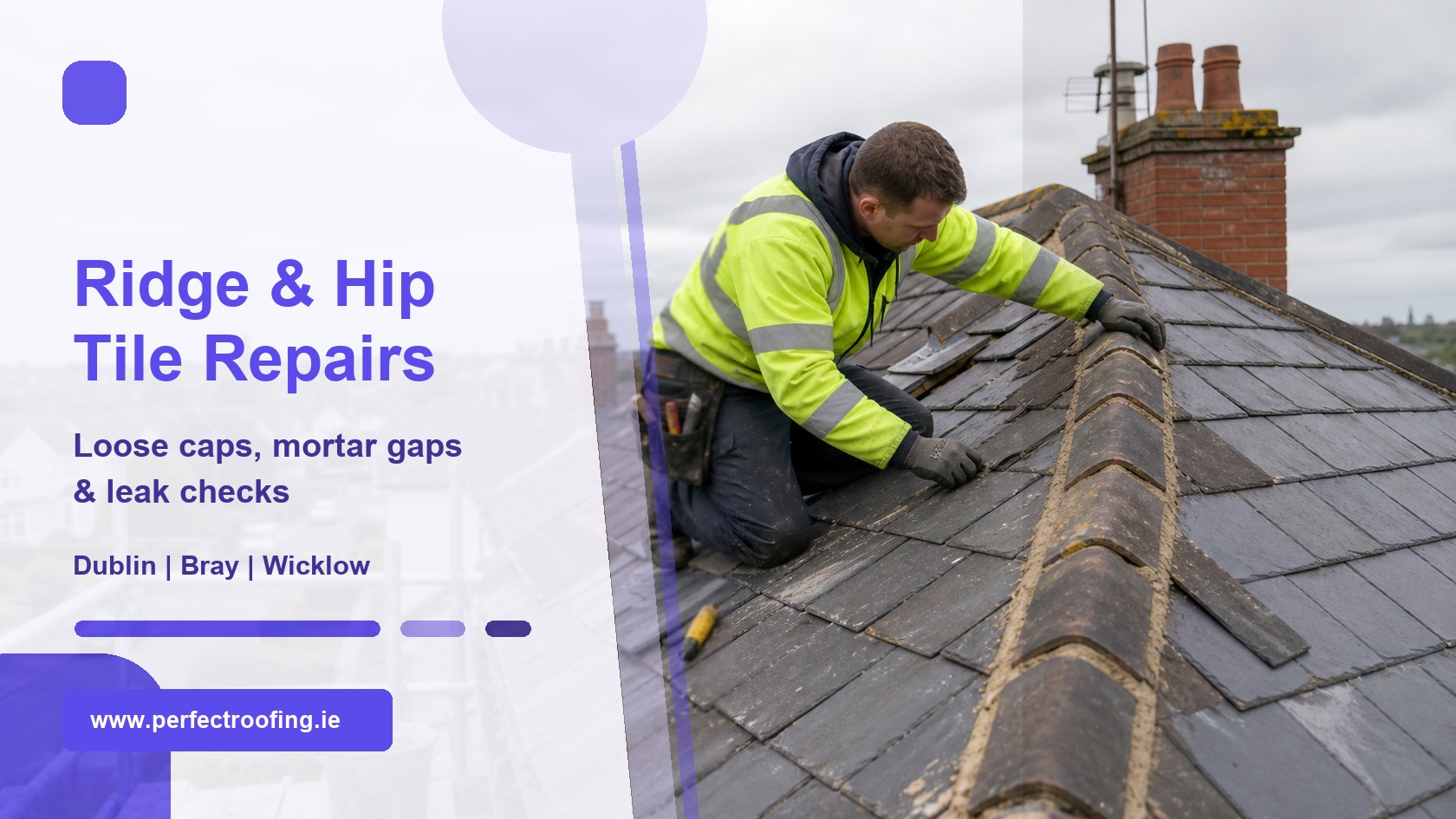
Ridge tiles and hip tiles sit on some of the most exposed parts of a pitched roof. They finish the top and angled edges of the roof, help protect the junctions between roof slopes, and take a lot of wind and rain over the years.
For homeowners in Dublin City, North Dublin, South Dublin, Bray, Wicklow, Naas, Lucan, and nearby areas, a loose ridge tile or cracked hip tile is worth dealing with before it becomes a leak, a falling tile risk, or a bigger repair around the roof structure. This guide explains what to look for safely, why ridge and hip problems happen, and when to ask Perfect Roofing to inspect the roof properly.
What ridge tiles and hip tiles do
The ridge is the highest horizontal line where two roof slopes meet. The hips are the sloping external corners where roof planes meet on hipped roofs, often seen on semi-detached homes, bungalows, extensions, and bay roofs.
These details matter because they cover exposed joints in the roof covering. A sound ridge or hip should:
- Keep rain from entering the junction between roof slopes
- Help secure the roof covering at exposed edges
- Allow the roof to shed wind-driven rain cleanly
- Finish the roof neatly where tiles or slates meet
- Work with ventilation, underlay, fixings, mortar, or dry-ridge systems
When ridge or hip details start to fail, water may not appear inside immediately. The first signs are often outside: a shifted tile, cracked mortar, a gap along the ridge line, or small pieces of bedding on the ground.
Safe signs to look for from the ground
Do not climb onto the roof to check ridge or hip tiles. Pitched roofs are dangerous without proper access, fall protection, and roofing equipment. Most early checks can be made from ground level, an upstairs window, or a safe distance with phone photos.
Look for:
- Ridge tiles that look uneven, lifted, twisted, or out of line
- Hip tiles with visible gaps between sections
- Cracked, missing, or loose mortar along the ridge or hips
- Small pieces of mortar, tile, or pointing on patios, paths, gutters, or driveways
- Damp staining near upstairs ceilings, attic timbers, chimney breasts, or party walls
- Daylight visible in the attic near the ridge area
- Birds, insects, or debris entering gaps at the top of the roof
- Moss or plant growth holding moisture around ridge and hip details
After strong wind or heavy rain, check from the ground again. A tile that was already loose can move further, and broken mortar may fall into gutters or onto lower roofs.
Common causes of ridge and hip tile problems
Ridge and hip tile issues are usually caused by a mix of age, exposure, movement, and older repair methods. The roof does not have to look badly damaged for the top details to need attention.
Common causes include:
- Weathered mortar that has cracked, shrunk, or separated from the tile
- Wind movement loosening older bedding and pointing
- Frost damage in already cracked or porous mortar
- Roof movement from timber settlement, past repairs, or changes in loading
- Broken or poorly fixed hip irons at the bottom of hip lines
- Slipped tiles or slates beside the ridge or hip
- Past patch repairs that bonded poorly to older material
- Inadequate mechanical fixing on exposed roof edges
- Poor ventilation causing moisture issues in the roof space below
On older Dublin City terraces, access can make repairs more awkward because ridge work may need careful scaffold planning. In Bray and Wicklow, more exposed roofs can also need particular attention to wind-driven rain and secure fixing. In Lucan, Naas, North Dublin, and South Dublin, many family homes have hipped roof sections, extensions, valleys, and dormers that make the roof geometry more complex.
Mortar repairs versus dry-ridge systems
Some roofs use traditional mortar bedding for ridge and hip tiles. Others use dry-ridge or dry-hip systems with mechanical fixings and weathering components. The right repair depends on the existing roof, tile type, exposure, ventilation needs, and how much of the detail has failed.
A localised mortar repair may be suitable when:
- Only a small area has cracked or come loose
- The ridge tiles are otherwise sound and aligned
- The surrounding roof covering is stable
- The repair can be tied into sound existing material
A larger re-bed, re-point, or replacement detail may be needed when:
- Long sections of mortar are cracked or hollow
- Several ridge or hip tiles are loose
- Previous patch repairs are failing in different places
- Water is entering the attic near the ridge or hip
- The roof is exposed and the existing fixing method is not reliable
Dry-ridge systems can be useful on many modern roofs, especially where mechanical fixing and ventilation are part of the roof design. They still need correct installation, compatible components, proper end details, and careful integration with the existing roof covering.
Why a small gap can become a bigger repair
A gap in ridge or hip bedding can let wind-driven rain, debris, and pests into places the roof should protect. Water may track along underlay, battens, rafters, or insulation before it appears as a ceiling mark. In some cases, the visible leak is lower down, even though the entry point is near the top of the roof.
Loose ridge or hip tiles can also affect nearby roof sections. Movement at the top edge may disturb cut tiles, slates, verge details, valleys, dormers, chimneys, or roof windows nearby. That is why a proper inspection should look beyond the single tile that appears damaged.
Early repair is usually simpler than waiting until water has damaged battens, underlay, plasterboard, or insulation. It can also reduce the risk of loose material falling during windy weather.
What Perfect Roofing checks during an inspection
When Perfect Roofing inspects ridge and hip tile problems, the goal is to identify the actual cause, not just patch the most visible crack.
Depending on the roof and access, an inspection may include:
- Checking ridge and hip tile alignment, movement, cracks, and secure fixing
- Looking at the condition of mortar, bedding, pointing, or dry-ridge components
- Inspecting nearby slates, tiles, battens, underlay, valleys, chimneys, and gutters
- Checking the attic for daylight, staining, damp insulation, or ventilation issues
- Reviewing whether safe access, scaffold, or roof ladders are needed
- Advising whether a local repair, longer re-bed, dry-ridge upgrade, or wider roof repair is more sensible
For homes in Dublin, Bray, Wicklow, Naas, Lucan, and nearby areas, access and roof shape can change the recommendation. A simple bungalow hip repair, a high Dublin terrace ridge, and a multi-plane extension roof may each need a different approach.
When to book a roofer
Arrange a roof inspection if you notice any of the following:
- A ridge or hip tile has visibly moved
- Mortar is falling into gutters, onto lower roofs, or onto the ground
- There are repeated damp marks near upper ceilings or attic timbers
- A previous ridge repair is cracking again
- Birds or debris appear to be entering near the roof peak
- You are planning solar panels, roof windows, chimney work, or a roof replacement and want the top details checked first
Do not wait for an internal leak if the outside signs are clear. Ridge and hip repairs are often easier to handle before bad weather exposes the weakness further.
Need ridge or hip tile repairs in Dublin or Bray?
Perfect Roofing helps homeowners with ridge tile repairs, hip tile repairs, roof leak diagnosis, roof inspections, roof replacements, gutters, flat roofing, Velux windows, and wider roofing maintenance across Dublin City, North Dublin, South Dublin, Bray, Wicklow, Naas, Lucan, and nearby areas.
If you have loose ridge tiles, cracked hip mortar, damp marks near the top of the house, or roof details that look uneven from the ground, contact Perfect Roofing by WhatsApp, phone, or email. We can inspect the roof safely, explain the likely cause, and recommend a repair based on your roof type, access, exposure, and long-term plans.
Need a roofer to take a look?
Send a few photos on WhatsApp, email us, or tap the number to call. We cover Dublin City, North Dublin, South Dublin, Lucan, Bray, Wicklow, Naas, and nearby locations.