Roof Ventilation
Klober vs Glidevale vs Manthorpe Roof Ventilation Products for Dublin Homes
A practical roof ventilation product comparison for Dublin, Lucan, Bray, Wicklow, and Naas homeowners comparing Klober, Glidevale Protect, and Manthorpe options.
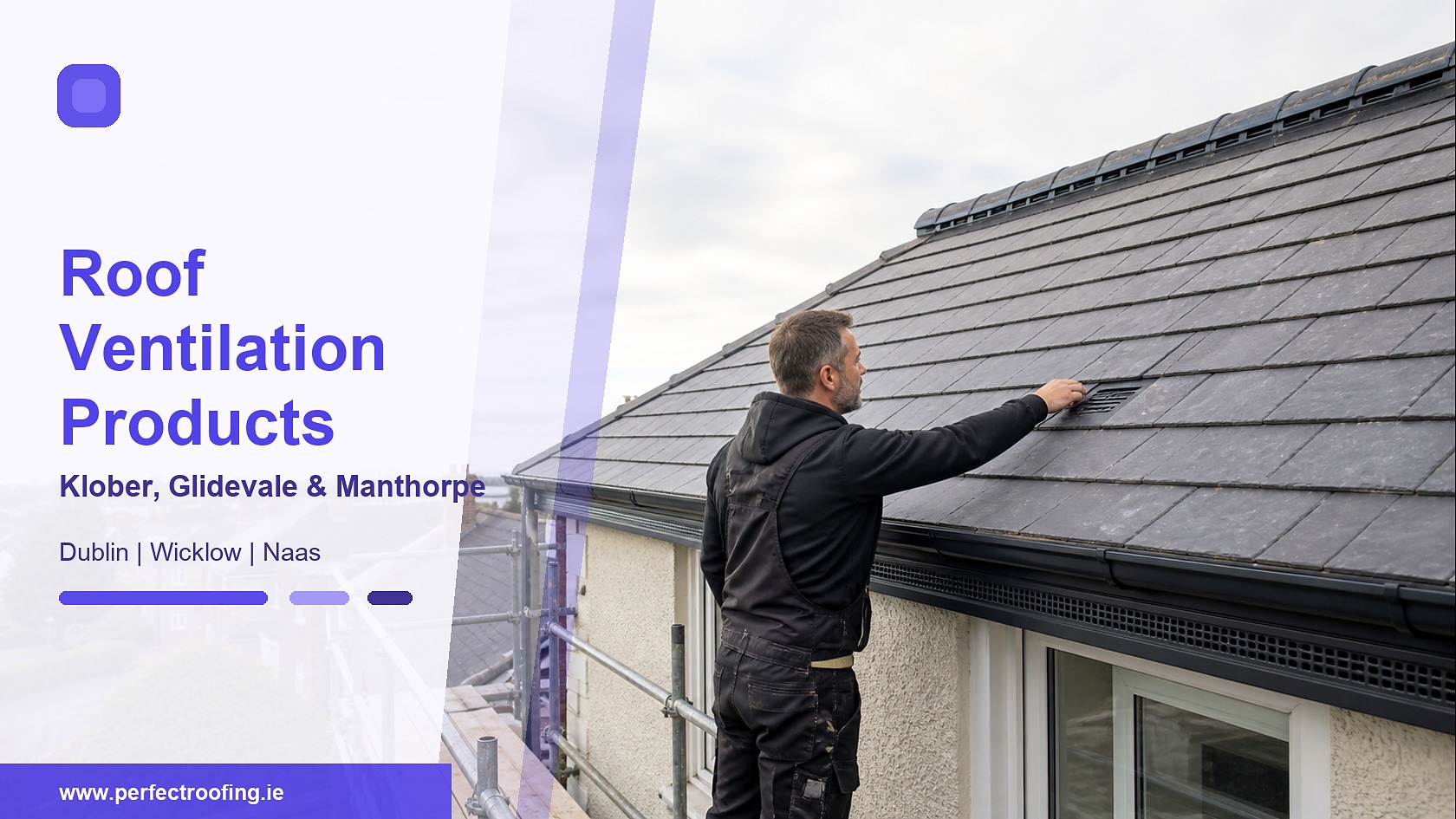
Roof ventilation products are easy to overlook until a roof space starts to smell musty, insulation feels damp, or condensation marks appear on ceilings. The product choice matters because a vent that works well on one roof may be awkward, too visible, or poorly matched on another.
For homeowners in Dublin City, North Dublin, South Dublin, Lucan, Bray, Wicklow, Naas, and nearby areas, the right ventilation plan depends on the roof shape, roof covering, insulation layout, exposure, and whether the issue is condensation, a roof leak, or both. This guide compares Klober, Glidevale Protect, and Manthorpe roof ventilation product families in practical homeowner terms.
It is not a substitute for a roof inspection. Do not climb onto a roof to check vents yourself. Use safe ground-level photos, attic observations from a stable boarded area, and professional roof access where needed.
Quick comparison
| Brand | Useful product families | Often suits | Check carefully |
|---|---|---|---|
| Klober | Tile vents, slate vents, universal vents, eaves ventilation, ridge and hip ventilation products | Roofs where matching a pitched roof covering, adding roof-space ventilation, or connecting extractor/soil ventilation through the roof is being considered | Tile/slate compatibility, pitch, colour match, adaptor needs, and whether the roof needs low-level, high-level, or balanced ventilation |
| Glidevale Protect | Slate and tile ventilators, abutment ventilation, eaves ventilators, ridge ventilators, rafter/fascia/soffit/eaves options | Roofs needing a broader ventilation strategy across eaves, ridge, abutments, and tile or slate areas | Profile match, visible cowls versus in-line vents, airflow path, and whether the system suits a cold roof, warm roof, extension, or refurbishment |
| Manthorpe | Roofspace ventilation, tile and slate ventilators, dry ridge, dry verge, dry hip, GRP valleys, eaves products | Homes where roofline, eaves, ridge, verge, and ventilation details are being upgraded together | How dry-fix, ventilation, existing mortar details, tile profile, and roof repair scope interact |
The best choice is rarely just a brand decision. It is usually a system decision: where fresh air enters, where moist air exits, how rain is kept out, and how the vent blends with the roof covering.
Why ventilation product choice matters
Irish homes can hold a lot of moisture in the roof space. Showers, cooking, laundry, warm rooms, attic insulation, and cold roof surfaces can all contribute. If air cannot move properly through the roof space, moisture can linger around felt, rafters, battens, insulation, and roof penetrations.
Poor ventilation may show up as:
- Damp or musty attic insulation
- Water droplets on the underside of felt or membrane
- Mould spots near top-floor ceiling corners
- Rusting nail tips or staining on attic timbers
- Condensation around roof windows, pipes, tanks, or cold surfaces
- Damp that seems widespread rather than linked to one cracked tile or flashing defect
Roof vents are not magic patches. A vent should be part of a planned airflow route. Low-level intake at soffits or eaves usually needs a high-level exit point through ridge, tile, slate, or other roof ventilation details. If one part is blocked, undersized, or incorrectly placed, adding more products may not solve the real problem.
Klober roof ventilation products
Klober offers pitched roof ventilation products including roof tile vents, slate roof vents, universal roof air vents, eaves trays, soffit vents, and felt support trays. Its roof-vent range includes in-line tile vents, universal tile vents, traditional tile vents, slate vents, and plain tile vents.
Klober may be worth considering when:
- The roofer needs a low-profile tile or slate vent that blends with the existing roof.
- The project needs both roof-space ventilation and a possible terminal for soil or mechanical extraction, subject to the correct adaptor.
- A universal vent is useful because the exact tile profile is difficult to match.
- The roof has concrete interlocking tiles, plain tiles, fibre cement slate, or natural slate and needs product-specific selection.
- A colour match is important because the vent will sit on a visible roof slope.
Klober's technical support notes that tile vents are used for both roof-space ventilation and soil or mechanical ventilation, and that the chosen tile or slate vent should suit the roof finish. That is important on Dublin terraces, Lucan semis, Bray homes near more exposed weather, and Wicklow properties where a poorly matched vent can be more noticeable.
The caution is that a universal product is still not universal in every practical sense. Roof pitch, tile profile, underlay cuts, adaptor requirements, rain exposure, and installer access all matter. A vent placed neatly in the wrong airflow strategy can still leave condensation unresolved.
Glidevale Protect roof ventilation products
Glidevale Protect lists roofing ventilation products for tile and slate roofs, including cowl slate and tile vents, in-line slate and tile vents, rafter vents, fascia vents, soffit vents, eaves vents, abutment ventilation, and ridge ventilators.
Glidevale Protect may be worth considering when:
- The roof needs a joined-up ventilation plan across eaves, ridge, abutments, and roof slopes.
- The property has a complex roof shape where simple soffit-only ventilation will not be enough.
- A tile or slate ventilator needs to blend into the roof covering rather than look like a large add-on.
- There are dormers, extensions, roof windows, or abutments interrupting the airflow route.
- The roofer wants product options across both intake and exhaust ventilation.
Glidevale's range is useful to think about as a system rather than a single item. For example, a South Dublin extension roof may need attention at the eaves, abutment, and ridge area. A Dublin City terrace may have limited roof-edge access, so roof-slope ventilation could be part of the plan. A Wicklow roof may need careful detailing because wind-driven rain exposure can make poor placement more obvious.
Irish distributor context is also useful. McMahons lists ventilation products including Glidevale G5 tile vents, Klober slate vents, soffit vent strips, round soffit vents, flexible ducting, eaves protector trays, and ventilated ridge rolls. Availability changes, so check current stock and suitability before assuming a specific product will be used.
Manthorpe roof ventilation products
Manthorpe describes a broad building-products range covering roofing, floor and wall ventilation, cavity trays, loft access, drainage, and air leakage systems. Its roofing category includes roofspace ventilation, tile and slate ventilators, dry ridge and hip systems, dry verge systems, and valley products.
Manthorpe may be worth considering when:
- Roof ventilation is being handled alongside eaves, ridge, verge, hip, or valley repair work.
- A reroof or larger repair is already opening up the roofline details.
- The roof needs mechanical fixing and ventilation considerations at the ridge or hip.
- The issue is not just attic condensation, but also ageing mortar, loose ridge/hip details, or poor roofline detailing.
- The roofer needs practical eaves and roofspace ventilation components as part of a broader roof repair.
Manthorpe's roofing guidance discusses roof-space ventilation products designed to increase airflow into loft spaces and dry-fix systems for mechanically secured ridge and hip details. That makes the brand relevant when a homeowner is not only asking, "Which vent should I add?" but also, "Should we modernise the roofline while repairs are being done?"
The caution is scope. If the roof has local condensation symptoms only, a wider dry-ridge or verge project may not be necessary. If the ridge, hips, mortar, vents, and roofline details are already failing, a single soffit vent may be too small a fix.
Tile vents, soffit vents, ridge vents, or abutment vents?
Brand choice comes after the ventilation route is understood. The product type usually matters first.
| Vent type | What it does | Homeowner notes |
|---|---|---|
| Soffit and eaves vents | Let fresh air enter low down at the roof edge | Often important for intake airflow, but can be blocked by insulation, paint, debris, old fascia work, or poor detailing |
| Tile and slate vents | Add ventilation through the roof slope | Useful where the roof needs extra high-level or low-level ventilation, or where a soil or extractor terminal must pass through the roof with the correct adaptor |
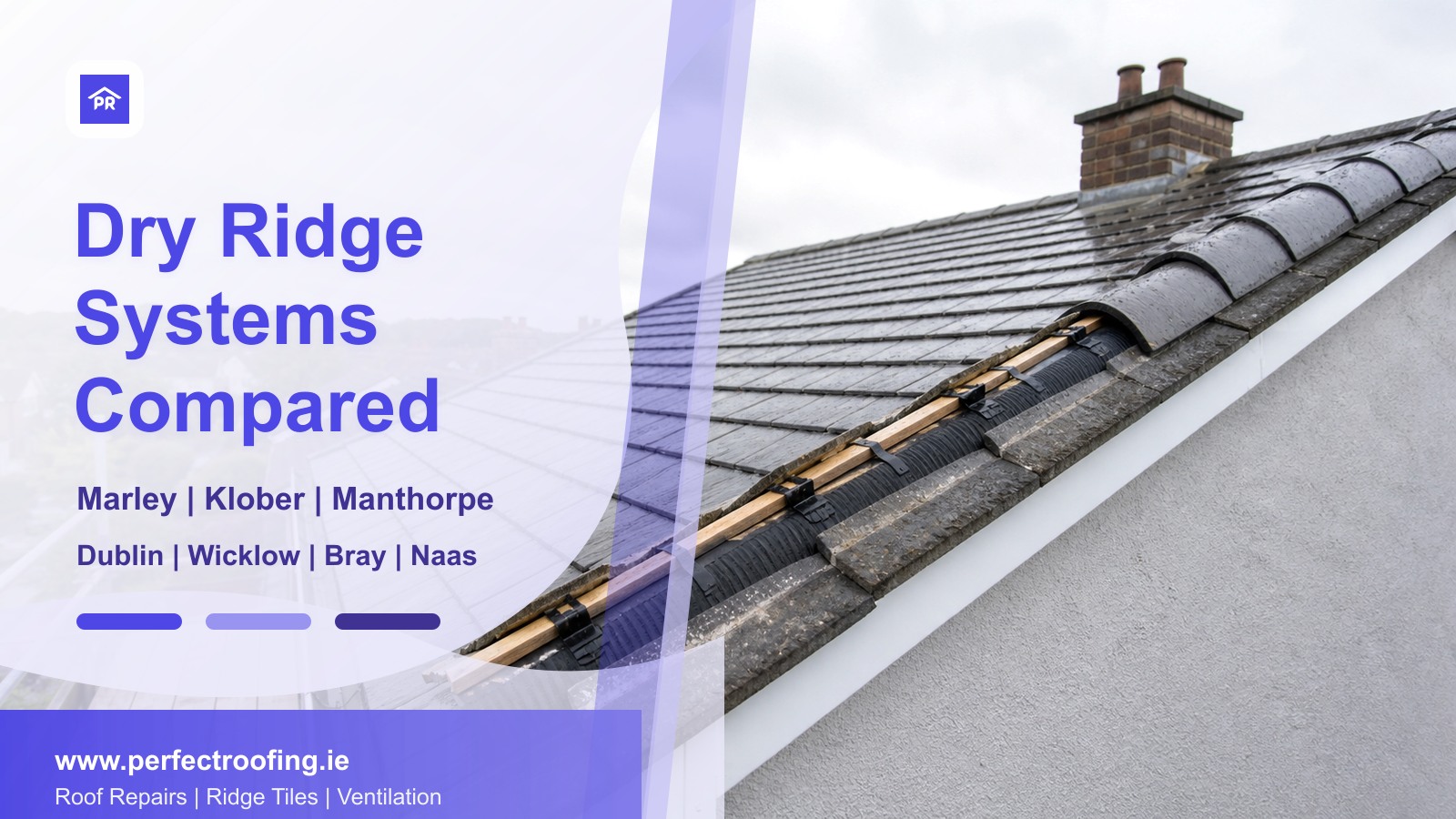
| Ridge vents or ventilated dry ridge systems | Let air leave at the highest point of many pitched roofs | Can work well as high-level ventilation, but the ridge detail, fixing method, roof covering, and existing condition must be assessed |
| Abutment vents | Help ventilate where a pitched roof meets a wall | Useful around extensions, lean-to roofs, and roof-to-wall junctions where normal airflow can be interrupted |
| Rafter trays and felt support trays | Keep airflow paths open and support underlay at eaves | Often relevant where insulation blocks the eaves or old felt sags into the airflow route |
For a Bray or Wicklow home with exposed roof slopes, the weathering and placement of roof-slope vents needs particular care. For a Lucan or Naas extension, abutments and eaves may be the details that decide whether the ventilation actually works. For Dublin City terraces, access and matching older roof coverings can be just as important as the product name.
Pros and cons by homeowner priority
| Priority | Klober | Glidevale Protect | Manthorpe |
|---|---|---|---|
| Matching tile and slate roofs | Strong range of tile, slate, plain tile, traditional, and universal vent options | Strong range of dedicated and in-line slate/tile ventilators | Strong tile and slate ventilator range, especially when paired with wider roofline products |
| Whole-roof ventilation planning | Good eaves, tile/slate, and ridge/hip ventilation options | Particularly strong breadth across eaves, rafter, fascia, soffit, abutment, ridge, and roof-slope ventilation | Strong where ventilation overlaps with dry ridge, dry hip, dry verge, and roofline repair work |
| Discreet appearance | Low-profile and in-line options may suit visible slopes | In-line and cowl options allow different appearance choices | In-line vent options and roofline systems can be selected to suit the roof finish |
| Renovation and repair work | Useful for targeted vent additions and reroof detailing | Useful where extensions, abutments, and complex roof shapes need a plan | Useful when ridge, hip, verge, valley, eaves, and ventilation details are being considered together |
| Price positioning | Depends heavily on product type, adaptor, stock, and installation complexity | Depends heavily on profile match, product family, and scope | Depends heavily on whether the work is a simple vent addition or part of wider roofline repairs |
Exact prices should be checked against the current product, supplier, and installation details. A product that looks cheaper on a shelf can cost more if it is wrong for the tile, needs extra adaptors, creates awkward roof cuts, or has to be corrected later.
How Perfect Roofing would narrow the choice
A good recommendation starts with the roof, not the catalogue. Before choosing Klober, Glidevale Protect, Manthorpe, or another suitable system, Perfect Roofing would look at:
- Whether the damp is condensation, a leak, or both
- Roof type, pitch, tile or slate profile, and existing underlay
- Whether the roof is cold, warm, insulated at ceiling level, or part of an attic conversion
- Where intake airflow can enter safely and continuously
- Where moist air can exit without creating weathering problems
- Existing soffits, fascia boards, gutters, and roofline condition
- Ridge, hip, valley, chimney, roof-window, and abutment details
- Whether bathroom or kitchen extractor ducts are correctly routed outside
- Access for safe installation and later maintenance
- How visible the vent will be from the street or neighbouring homes
If a roof already has damp insulation, blocked eaves, ageing felt, leaking flashings, or repeated patch repairs, the ventilation product may only be one part of the answer.
Questions to ask before approving roof ventilation work
Before agreeing to a ventilation upgrade, ask:
- Is the issue definitely condensation, or could there be a roof leak too?
- Where will fresh air enter and where will moist air leave?
- Is the vent compatible with my tile or slate profile?
- Will any insulation be moved or restrained so it does not block the eaves?
- Are adaptors needed for bathroom, kitchen, soil, or mechanical ventilation ducts?
- Will the product be visible from the front of the house?
- Are ridge, hip, verge, valley, gutter, and flashing issues being checked at the same time?
- Is the work a targeted repair, a roofline upgrade, or part of a wider reroof?
- How will the roof be accessed safely?
The best answer should explain the airflow route in plain language. If the recommendation is just "add a vent" without explaining intake, exhaust, and the roof covering, ask for more detail.
Ask Perfect Roofing for a roof-specific recommendation
Perfect Roofing helps homeowners with roof ventilation, attic condensation checks, roof repairs, roof inspections, gutters, flat roofing, Velux windows, skylights, and roof replacement planning across Dublin City, North Dublin, South Dublin, Lucan, Bray, Wicklow, Naas, and nearby areas.
If you are comparing Klober, Glidevale Protect, Manthorpe, or another roof ventilation option, contact Perfect Roofing by WhatsApp, phone, or email. We can inspect your roof, check the attic and eaves safely, look at the roof covering and weather exposure, and recommend a product approach that suits your home, budget, access, and long-term plans.
Need a roofer to take a look?
Send a few photos on WhatsApp, email us, or tap the number to call. We cover Dublin City, North Dublin, South Dublin, Lucan, Bray, Wicklow, Naas, and nearby locations.