Roof Windows
Manual vs Electric vs Solar Roof Windows for Dublin and Bray Homes
A practical roof-window operation comparison for Dublin, Bray, Wicklow, Lucan, Naas, and nearby homeowners choosing between manual, electric, and solar roof windows.
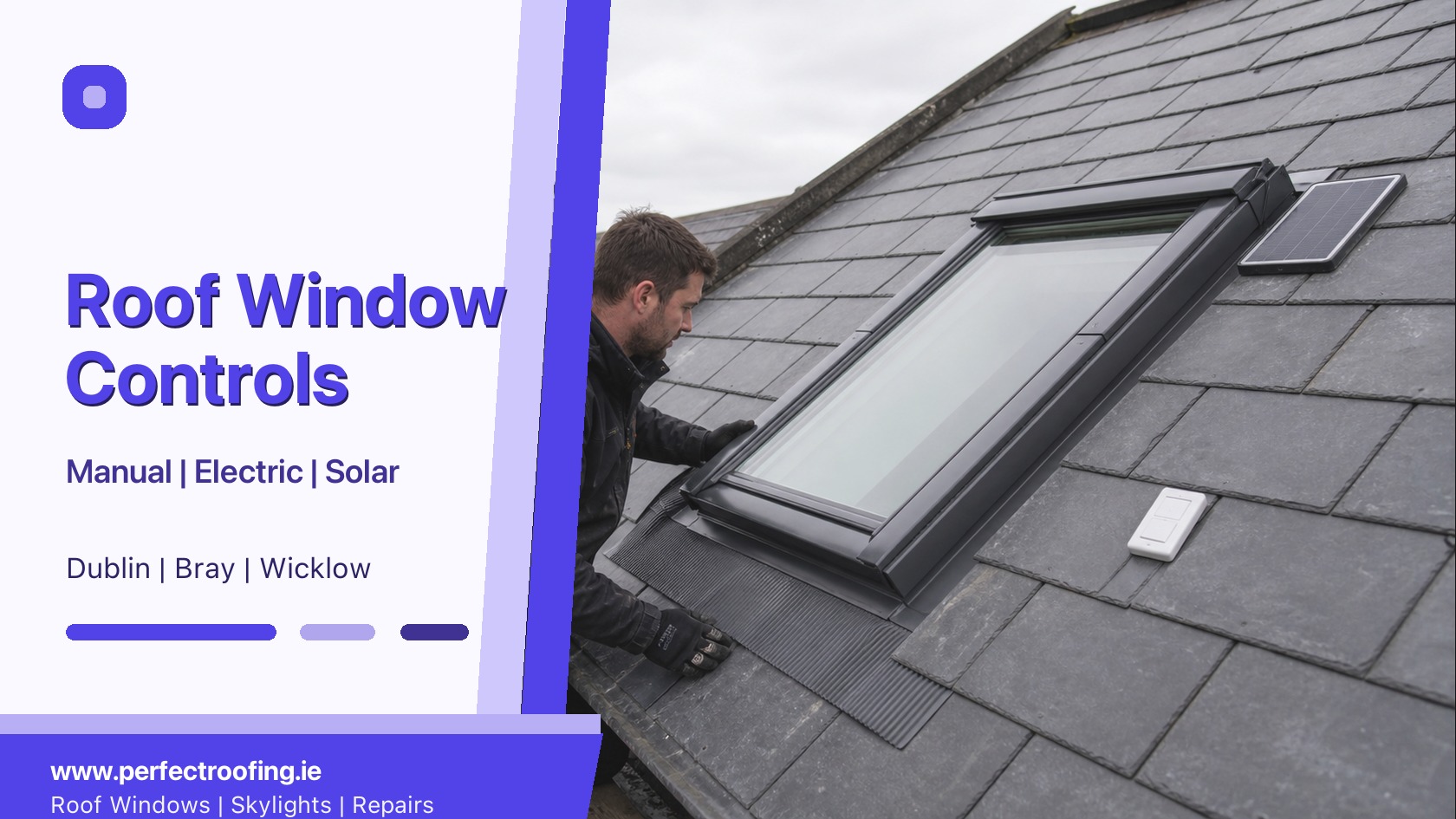
Choosing a roof window is not only about the brand or the glass size. The way the window opens can affect everyday comfort, installation planning, maintenance access, rain protection, and whether the window actually gets used once the room is finished.
For homeowners in Dublin City, South Dublin, North Dublin, Bray, Wicklow, Lucan, Naas, and nearby areas, the three common choices are manual, electric, and solar-powered roof windows. Each can work well in the right setting. The best option depends on the room, roof pitch, access, wiring, weather exposure, budget, and long-term plans for blinds or smart controls.
This guide compares manual, electric, and solar operation in practical roofing terms so you can ask better questions before replacing an old Velux window, adding a new roof window, or planning skylights for an attic, landing, bathroom, or extension.
Quick comparison
| Operation type | Often suits | Check carefully |
|---|---|---|
| Manual roof window | Windows within easy reach, spare rooms, stairwells, landings, simple attic spaces | Handle height, furniture layout, ventilation habits, and whether the window will still be easy to use later |
| Electric roof window | Hard-to-reach windows, bathrooms, kitchens, high ceilings, multi-window layouts | Mains wiring route, switch position, rain sensor details, future blind compatibility, and service access |
| Solar roof window | Replacements where wiring is awkward, finished rooms, high windows, retrofit projects | Roof orientation, shading, battery and control details, model compatibility, and maintenance access |
No comparison table replaces a site visit. A Dublin City terrace, a South Dublin attic conversion, a Bray coastal home, and a Wicklow house with exposed roof slopes can all need different flashing, access, and control decisions.
Manual roof windows: simple when the window is easy to reach
Manual operation is the straightforward option. The window is opened by hand, usually with a handle or bar depending on the model and opening style. VELUX Ireland describes manual roof windows as hand-operated and suited to roof windows within easy reach. Keylite's centre pivot range also lists manual operation, with the handle controlling both opening and ventilation.
Manual roof windows may suit:
- Attic rooms where the window is low enough to operate comfortably
- Landings, stairwells, and spare rooms where simple ventilation is enough
- Homeowners who want fewer electrical components
- Replacement jobs where the existing window is already easy to reach
- Rooms where blinds can also be operated manually without awkward stretching
The main advantage is simplicity. There is no motor, no mains cable, no solar battery, and no wall switch to plan. For a small accessible roof window in a Dublin, Lucan, or Naas attic, manual operation can be perfectly practical.
The weakness is also simple: if the window is awkward to reach, it may not be opened often. A roof window above a bath, stair void, high landing, kitchen island, or deep furniture layout can look good on paper but become inconvenient in daily use.
Electric roof windows: useful for high or frequent-use windows
Electric roof windows are motorised and connected to mains power. They are usually operated by a wall switch, remote, app, or brand-specific control depending on the product. VELUX's solar and electric page lists electric roof windows with wall-switch control, app options, timers, and integrated rain sensors. Keylite's electric roof-window page describes standard and premium electric kits for centre pivot roof windows, including hard-wired operation and rain-sensor features on premium electric options. FAKRO Ireland's Z-Wave roof-window page describes factory-equipped centre pivot Z-Wave windows with remote control and an automatic rain sensor.
Electric roof windows may suit:
- High ceilings where a manual pole would be awkward
- Bathrooms and kitchens where quick ventilation is useful
- Multiple roof windows that need easier daily control
- Bedrooms or attic offices where blinds may later be motorised
- Renovations where electrical work is already planned
The key roofing point is that electric operation is not just a product choice. It affects the installation plan. The route for mains power, the switch location, the timing of electrical work, and the sequence of plastering and internal finishing should be agreed before the roof window goes in.
For homeowners in South Dublin, North Dublin, Bray, or Wicklow, electric operation can be especially useful where the room needs regular airing but the window is too high to use comfortably. It can also reduce the temptation to leave a roof window open and hope for the best during changeable weather.
Solar roof windows: motorised control without a mains wiring route
Solar-powered roof windows use an integrated solar cell and battery to operate the motor. They are often considered when homeowners want motorised convenience but do not want to chase cables through a finished room. VELUX says its solar-powered roof windows need no wiring and include wall-switch control and rain-sensor protection. Keylite describes its solar electric kit as using a built-in solar-charged battery for installations without mains power.
Solar roof windows may suit:
- Replacement roof-window projects in finished attic rooms
- High roof windows where wiring would be disruptive
- Homes where roof access is already being set up for repair or replacement work
- Bedrooms, bathrooms, landings, and loft spaces where easy ventilation matters
- Homeowners who want motorised operation but prefer a simpler wiring plan
The main benefit is retrofit practicality. If an old manual roof window is being replaced and the surrounding room is already decorated, solar operation may avoid opening walls or ceilings for cable routes.
The main checks are orientation, shading, model compatibility, and maintenance access. A roof slope shaded heavily by trees, chimneys, dormers, neighbouring buildings, or a higher roof section may need closer review. A professional roofer should also confirm that the flashing, underlay, insulation collar, and roof covering can be upgraded neatly at the same time.
How VELUX, Keylite, and FAKRO position the options
The exact product range changes by brand and model, so always check the current manufacturer information and the model being quoted.
| Brand | Manual | Electric | Solar |
|---|---|---|---|
| VELUX | Lists manual roof windows as hand-operated and suited to accessible positions | Lists mains electric roof windows with wall-switch control, app options, timer features, and rain sensors | Lists solar-powered roof windows with no wiring needed, wall-switch control, rain sensors, and cloudy-weather battery claims |
| Keylite | Lists manual centre pivot operation with a top handle and ventilation control | Lists standard and premium electric kits for centre pivot windows, with mains wiring and control options | Lists a solar electric kit with a built-in solar-charged battery and rain-closing features |
| FAKRO | Lists centre pivot and other roof-window types, including models that can accept electrical controls | Lists Z-Wave controlled roof windows with remote operation, 230V connection, and rain sensor | Solar information is more prominent for selected accessories; confirm roof-window solar options or alternatives with the Irish distributor before specifying |
This does not mean one brand is always better. A good installation depends on the roof build-up, flashing kit, internal reveal, insulation, ventilation, access, and aftercare route. In some homes, the sensible choice is a simple manual window. In others, paying more for electric or solar control can make the window more useful every week.
Which option suits each room?
Different rooms create different priorities.
For attic bedrooms:
- Manual can work if the window is close to the bed, desk, or walking route.
- Electric or solar can suit higher windows or rooms where blackout blinds may also be motorised.
- Ventilation and condensation control should be considered with the roof and room design, not treated as a window-only issue.
For bathrooms:
- Manual can work if the window is reachable and safe to operate.
- Electric or solar can help where the window is above a bath, shower area, or high sloped ceiling.
- Moisture-resistant finishes, good extraction, neat flashing, and insulated reveals all matter.
For kitchens and extensions:
- Manual may suit low-pitch or flat roof windows only if access is practical.
- Electric can be useful where heat, cooking steam, and high-level glazing make frequent airing desirable.
- Solar can suit finished extensions where retrofitting mains wiring would be awkward.
For landings and stairwells:
- Manual may be fine if the handle is reachable from a stable floor area.
- Electric or solar is often easier for tall stair voids and high attic landings.
- Safe cleaning and future maintenance access should be discussed before choosing a large unit.
Rain sensors are useful, but they are not a substitute for good installation
Rain sensors can reduce the risk of a roof window being left open when showers arrive. VELUX, Keylite, and FAKRO all describe rain-sensor features on selected electric or motorised options. That is useful in Irish weather, especially for rooms that are aired while people are downstairs or away from the room.
Still, a rain sensor does not fix poor roofing detail. A roof window can leak for reasons that have nothing to do with whether it was left open:
- Incorrect or damaged flashing
- Slates or tiles poorly dressed around the frame
- Blocked drainage channels above or beside the window
- Failed underlay or poor laps around the opening
- Condensation caused by cold reveals or poor ventilation
- Old sealant patches hiding a wider roof issue
If an existing Velux window or skylight is leaking in Bray, Wicklow, Dublin, Lucan, or Naas, do not assume the answer is a new motor. The roof covering, flashing, underlay, drainage, and internal signs should be inspected first.
When solar is worth discussing
Solar operation is often worth discussing when the roof window is high, the room is already finished, or the homeowner wants a motorised upgrade without planning a mains wiring route. It can also make sense during replacement work if scaffold is already being used and the old window is due for an upgrade.
Solar may be less straightforward when:
- The roof slope is heavily shaded for much of the day
- The window position is under trees, a chimney, a dormer, or another roof plane
- The existing frame or roof opening is not compatible with the preferred model
- Future blind, shutter, or control options are uncertain
- The roof itself needs more repair work than expected
Ask for the exact model, control type, battery and solar details, and warranty terms before committing. Broad product pages are useful, but your quotation should match the roof window being supplied.
When electric is worth the extra planning
Electric operation is worth considering when the roof window will be used often but is too high or awkward to operate by hand. It is also useful when a room has several roof windows and the homeowner wants easier airing from one control point.
Plan electric operation early if:
- Electrical work is already part of the attic conversion or renovation
- The ceiling or wall finishes are still open
- The homeowner wants future app control, sensors, or motorised blinds
- The roof window sits above a stairwell, kitchen island, bath, or high landing
- The property needs tidy internal finishing with no visible cable improvisation
The roofer and electrician should be coordinated. It is much easier to plan a neat mains route before plasterboard, insulation, and trims are closed up.
When manual is still the right answer
Manual operation can still be the best answer when the window is reachable, the room is simple, and the homeowner does not need motorised control. It can also avoid unnecessary product complexity in a spare room, storage room, landing, or low attic space.
Manual may be enough when:
- The window handle is easy to reach from the floor
- The room is not used as a bathroom or high-humidity space
- The homeowner wants a straightforward replacement
- There is no practical need for app, remote, or switch operation
- A manual blind or pole is comfortable to use
Before choosing manual, stand where the room will actually be used. Think about beds, desks, wardrobes, kitchen units, stairs, and future furniture. A window that is easy to reach during building work may be awkward after the room is finished.
Ask these questions before choosing
Before deciding between manual, electric, and solar roof windows, ask:
- Is the window on a pitched roof, flat roof, low-pitch extension, dormer, or main roof slope?
- Can the opening handle be reached safely without standing on furniture?
- Is the room a bathroom, kitchen, bedroom, landing, office, or attic storage space?
- Will the window be used daily, occasionally, or mainly for light?
- Is wiring already planned, or would it disturb finished walls and ceilings?
- Is the roof slope shaded by trees, chimneys, neighbouring buildings, or a higher roof?
- Will blinds, blackout, heat protection, insect screens, or shutters be needed later?
- Does the surrounding roof also need slates, tiles, flashing, gutters, or ventilation work?
- Will scaffold be needed, and can other roof repairs be handled during the same access setup?
Do not climb onto the roof to check a roof window yourself. Take photos safely from inside the room, the garden, or an upstairs window, and ask a roofer to inspect the outside details.
Ask Perfect Roofing for a site-specific recommendation
Perfect Roofing helps homeowners across Dublin City, North Dublin, South Dublin, Bray, Wicklow, Lucan, Naas, and nearby areas with Velux windows, roof windows, skylights, flat roof windows, flashing, roof repairs, gutters, roof ventilation, and roof replacement planning.
Contact Perfect Roofing by WhatsApp, phone, or email if you are choosing between manual, electric, and solar roof windows. Send photos if you can take them safely, and tell us the room use, roof type, access situation, budget expectations, weather exposure, and long-term plans. We can then recommend a practical option based on your roof, not just a product brochure.
Need a roofer to take a look?
Send a few photos on WhatsApp, email us, or tap the number to call. We cover Dublin City, North Dublin, South Dublin, Lucan, Bray, Wicklow, Naas, and nearby locations.