Roof Repairs
Nail Sickness in Slate Roofs: Checks for Dublin City and Bray Homes
A practical guide to nail sickness, slipped slates, safe warning signs, inspection choices, and repair planning for older slate roofs in Dublin City and Bray.
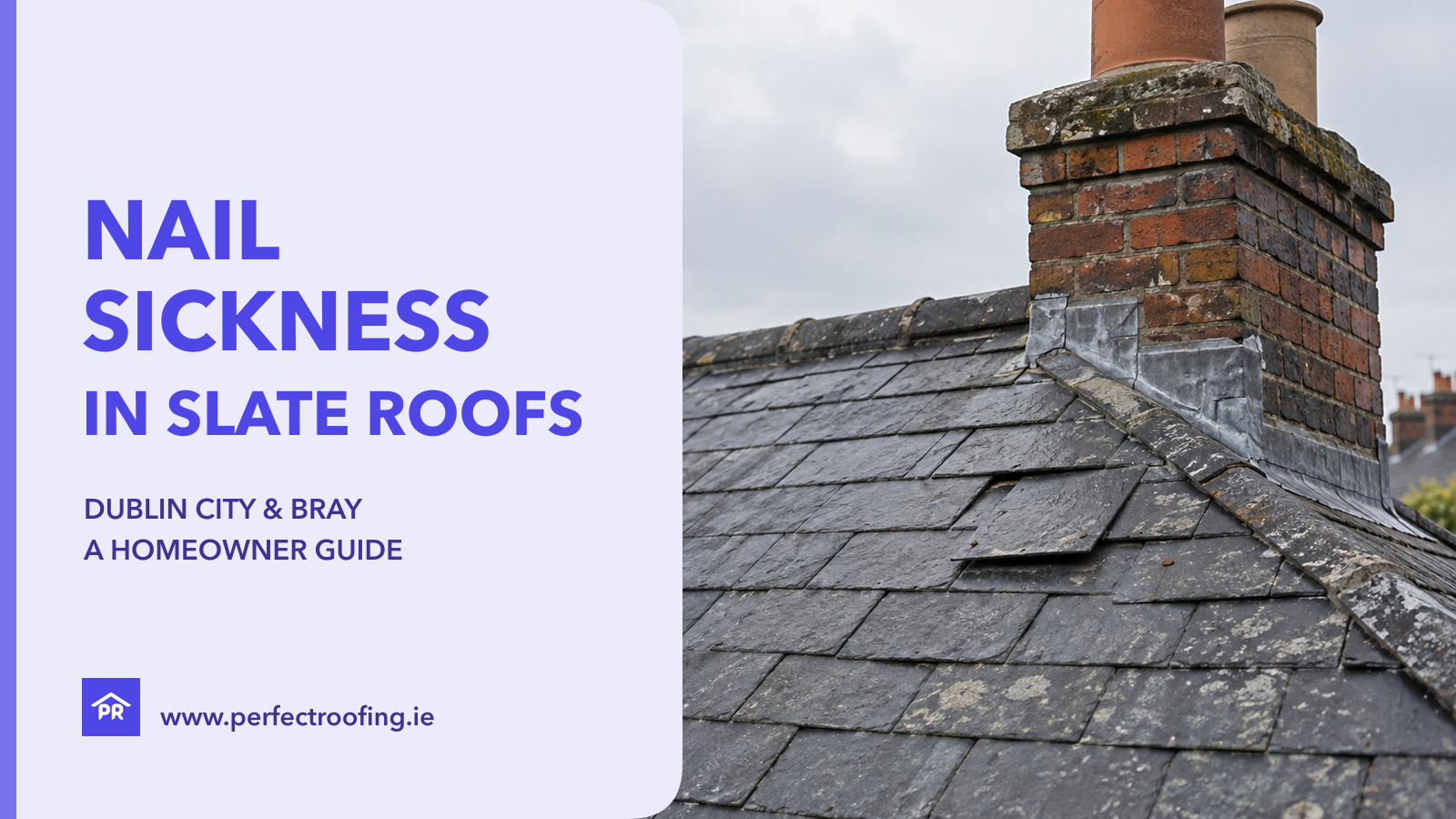
One slate in the gutter can look like an isolated problem. When more slates begin to slip, particularly across an older roof, the issue may be with the fixings rather than the slates themselves. Roofers often use the term nail sickness when ageing or corroded slate fixings can no longer hold the roof covering securely.
This is a useful distinction for homeowners in Dublin City, Bray, and nearby areas. Replacing one visible slate may weatherproof a local gap, but it will not resolve a wider fixing problem. A proper inspection should establish whether the movement is isolated, limited to one roof slope, or part of broader deterioration.
What Does Nail Sickness Mean?
Natural slates are commonly secured to roof battens with nails or other appropriate fixings. Over time, older metal fixings can corrode, weaken, or fail. A slate may then slide out of position even though the slate itself is still largely intact.
The phrase describes the condition of the fixings, not a disease in the slate. It also does not explain every slipped slate. Movement can have other causes, including:
- A cracked or damaged slate
- A fixing hole that has broken away
- Poorly fitted replacement slates
- Loose or deteriorated battens
- Wind affecting an already vulnerable section
- Earlier repairs that did not secure the slate correctly
- Movement around ridges, valleys, chimneys, verges, or roof windows
That is why diagnosis matters. The right repair depends on what has failed below or around the visible slate.
Warning Signs Homeowners May Notice
You do not need to climb onto the roof to gather useful evidence. From ground level, a safe upstairs window, or another properly protected position, look for changes in the slate pattern.
Possible warning signs include:
- A slate sitting lower than the rows around it
- A clean gap where a slate has slipped or fallen
- Several slates moving on the same roof slope
- Intact slates collecting in a gutter, garden, or lower roof
- Repeated slipping after individual repair visits
- Uneven courses that have become more noticeable over time
- Pieces of slate or fixing debris near downpipes
- New damp marks in the attic or on an upstairs ceiling after rain
Photograph the roof from the same safe position whenever you notice a change. A wide image showing the full slope is often more helpful than a close zoom because it reveals the pattern and nearby details.
Do not climb a ladder or walk on the roof to push a slate back. Older slates may be fragile, the roof surface may be wet or mossy, and a loose slate can move unexpectedly.
One Slipped Slate or a Wider Fixing Problem?
A single displaced slate does not automatically mean the whole roof has nail sickness. A roofer will look for a pattern rather than relying on one symptom.
| What is visible | What it may suggest | Sensible next step |
|---|---|---|
| One cracked slate after a local impact | Isolated slate damage | Inspect and repair the affected detail |
| One intact slate has slipped | A local fixing or fixing-hole failure | Check the slate, batten, and nearby course |
| Several intact slates are slipping across one slope | More widespread fixing deterioration may be present | Survey the slope before planning repeated patches |
| Slates repeatedly slip after small repairs | The repair area or surrounding fixings may need wider attention | Review repair history and roof condition together |
| Slate movement appears near a chimney, valley, verge, or ridge | A junction or edge detail may also be involved | Inspect the connected detail, not only the loose slate |
| Indoor staining follows slate movement | The weatherproof layers may have been exposed | Arrange a leak investigation promptly |
An inspection may also find more than one cause. For example, ageing fixings could be present alongside brittle underlay, tired battens, failed flashing, or previous patch repairs.
Why Older Dublin Slate Roofs Need a Joined-Up Inspection
Many Dublin City terraces and period houses have slate roofs with chimneys, party-wall junctions, narrow rear access, valleys, parapets, or several generations of repair. Water entering through one slipped slate can travel along underlay, battens, rafters, or masonry before showing as a stain indoors.
The visible gap is therefore only part of the investigation. Depending on access and roof design, a roofer may need to assess:
- The number and distribution of loose or displaced slates
- Whether fallen slates are cracked or substantially intact
- The condition of accessible fixings and fixing holes
- Battens and underlay where these can be viewed safely
- Ridge, hip, verge, valley, and eaves details
- Chimney flashing and party-wall junctions
- Gutters and lower roofs where fallen slates may collect
- Attic evidence such as daylight, staining, damp timber, or damaged felt
Bray homes can have their own combinations of older slate, extensions, dormers, roof windows, and exposed positions. The recommendation should reflect the actual roof rather than its location alone.
When Is a Local Slate Repair Appropriate?
A local repair may be suitable when the problem is genuinely isolated, the surrounding slates remain secure, the batten can accept a dependable fixing, and the roof has no evidence of widespread movement.
The replacement or refixed slate should be integrated with the existing roof covering using a suitable repair method. Simply gluing a loose slate on the surface or wedging it into place may hide the gap temporarily without providing a durable fixing.
A focused repair can also be reasonable when a sound roof has suffered local damage around one junction or after a specific event. The key question is whether nearby slates and their supporting components remain serviceable.
When Might Wider Work Make More Sense?
Repeated individual repairs become less attractive when new slates keep slipping from different parts of the same roof. Each visit may address the latest opening while leaving similar ageing fixings nearby.
Wider repair or roof replacement planning may be worth discussing when:
- Slipped slates are appearing across a substantial area
- Fixing failures are confirmed in several locations
- Battens, underlay, or roof timbers also need significant work
- The roof has extensive patching and recurring leaks
- Safe access or scaffolding would be needed for repeated visits
- Valleys, flashings, ridges, gutters, and roofline details are also near the end of their useful condition
- The homeowner is planning attic, roof-window, ventilation, or solar work that should be coordinated with the roof
This does not mean every old slate roof should be replaced. Good natural slates may sometimes be suitable for careful reuse after they are assessed, while damaged or unsuitable units are replaced. The scope depends on slate condition, roof structure, weather exposure, access, budget, and long-term plans for the property.
What to Do After a Slate Falls
Keep people, pets, vehicles, and belongings away from the area below the roof edge. A second loose slate may still be above, and a slate fragment can be dangerous when it falls from height.
If it is safe to do so:
- Photograph the fallen slate where it landed before moving it.
- Take a wide ground-level photo of the roof slope and visible gap.
- Note the date, recent weather, and whether this has happened before.
- Check the attic from a boarded or otherwise safe area for daylight or staining, without touching wet wiring or unstable materials.
- Move indoor belongings away from an active drip and contact a roofer.
Do not attempt a roof-level temporary patch yourself. Tarpaulins, loose boards, and improvised fixings can create further hazards if they are not installed by someone with suitable access and equipment.
Questions to Ask Before Approving Repairs
A useful quotation should explain whether the proposed work treats an isolated defect or a wider pattern. Ask:
- What caused the slate to slip?
- Are nearby slate fixings showing similar deterioration?
- Is the batten sound enough for the proposed repair?
- Is the underlay still directing water toward the eaves?
- Do chimneys, valleys, ridges, verges, or gutters need related work?
- Will safe access or scaffolding be required?
- If several repairs are needed, would a planned wider scope offer better long-term value?
- Can sound existing slates be retained or reused where appropriate?
Clear answers help homeowners compare the scope rather than choosing only on the headline price.
Arrange a Slate Roof Inspection with Perfect Roofing
If slates are slipping, falling, or repeatedly needing attention, avoid climbing onto the roof or standing below the affected edge. Send photographs taken from a safe place and mention any attic staining, previous slate repairs, chimney or valley concerns, and access limitations.
Contact Perfect Roofing by WhatsApp, phone, or email to arrange practical advice, a slate-roof inspection, or a repair quotation. We work across Dublin City, North Dublin, South Dublin, Lucan, Bray, Wicklow, Naas, and nearby areas, helping homeowners assess roof repairs, replacement planning, gutters, flashing, roof ventilation, Velux windows, skylights, and related roofing work.
Need a roofer to take a look?
Send a few photos on WhatsApp, email us, or tap the number to call. We cover Dublin City, North Dublin, South Dublin, Lucan, Bray, Wicklow, Naas, and nearby locations.