Roof Repairs
Removing an Old TV Aerial or Satellite Dish: Roof Checks for Dublin Homes
Planning to remove an unused aerial or satellite dish? Learn what to check around brackets, cables, chimney masonry and roof seals before booking in Dublin.
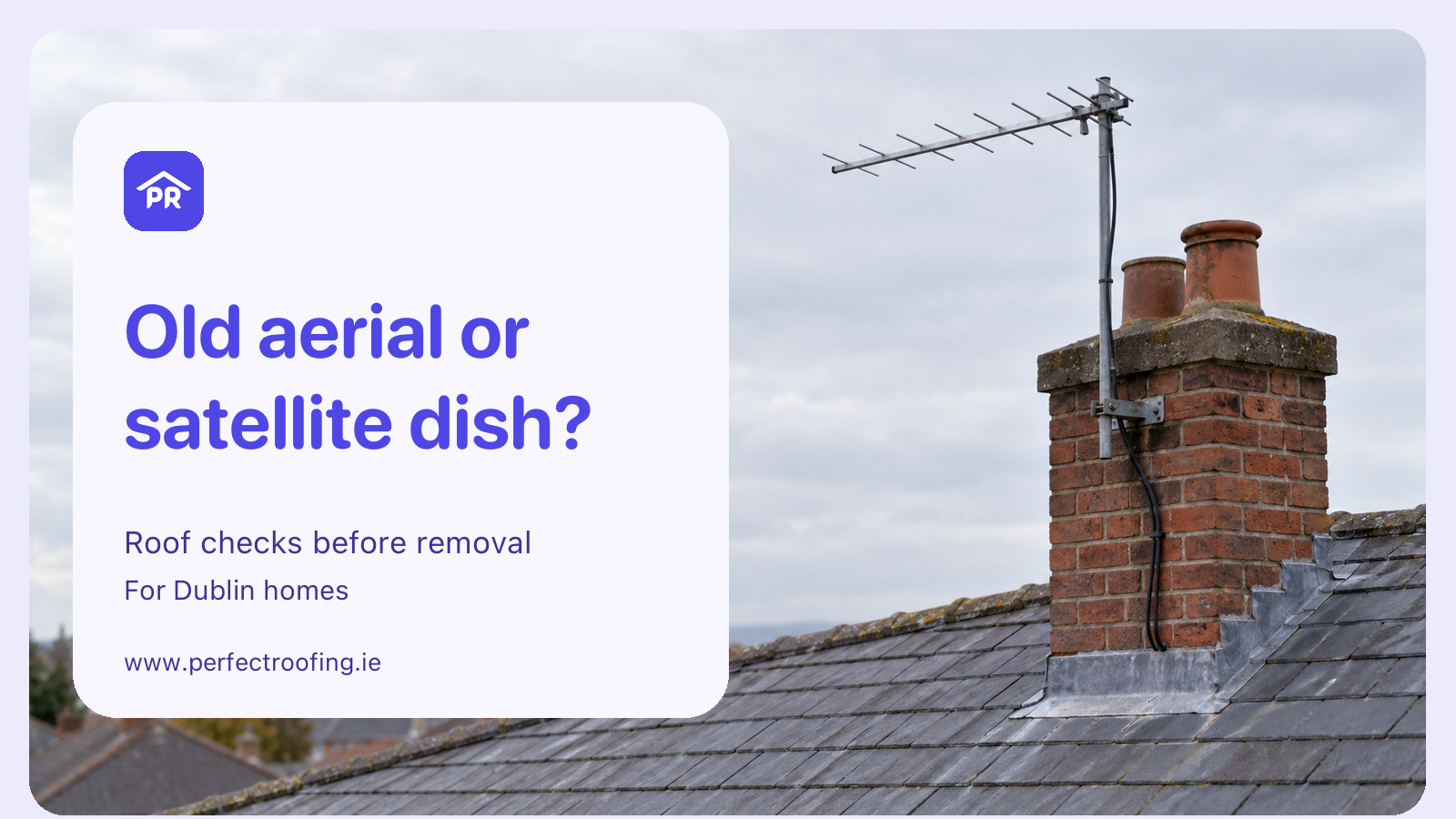
An unused TV aerial or satellite dish can remain on a house long after the service has changed. If you are planning to remove it, include the mounting points and cable entry in the job, rather than treating removal as simply taking down the equipment.
For Dublin and Lucan homeowners, the practical questions are whether anything still uses the installation, how it is attached, and what needs repairing once the fittings are exposed. Removing an aerial does not automatically solve a nearby roof leak, but it can provide an opportunity to inspect details that were previously hidden.
First confirm that the equipment is unused
Check with everyone who uses the property before arranging removal. An older aerial or dish may still serve another television, a radio connection, or a shared installation. Appearance alone cannot tell you whether it is redundant.
Where its purpose is unclear, ask an aerial or satellite installer to identify the equipment and trace the connections. For a rental or shared building, confirm who is responsible for the installation and who can authorise the work.
Agree whether the job includes the aerial or dish, mast, brackets, lashings, external cable, and any indoor termination. Leaving parts in place may be appropriate, but the quotation should explain which parts will remain and why.
The mounting method changes the roof repair scope
Not every aerial passes through the roof. Some attach to a chimney or gable wall; others involve a mast passing through a weatherproof roof seal. A satellite dish on a wall also needs a different assessment from equipment on an extension roof.
The CAI installation code for communal and commercial reception systems describes several mounting arrangements and stresses weatherproofing where a mast passes through a pitched roof. Although its scope is different from a private Irish house, it illustrates why the actual fixing detail matters.
| Existing arrangement | Questions to include in the assessment |
|---|---|
| Chimney bracket or lashing | Is the surrounding masonry sound, and what is concealed behind the bracket or wire? |
| Wall-mounted dish or aerial | What will happen to redundant fixings, holes, and the cable entry? |
| Mast passing through a roof seal | How will the opening be closed and the affected roof layers restored? |
| Equipment on a flat roof | What condition is the covering beneath and around its support? |
Do not assume that removing a chimney-mounted aerial requires replacing roof slates. Equally, do not accept a simple bracket-removal price as a complete repair scope where a mast penetrates the roof.
Check what removal exposes
A close inspection should distinguish existing defects from any damage discovered during dismantling. Ask for photographs before and after removal where safe access allows.
Depending on the installation, the roofer may need to assess:
- Brickwork, render, or mortar around brackets and lashings.
- Redundant fixing holes and the condition of their surrounding material.
- Slates or tiles beneath the equipment and along the cable route.
- Flashing or a roof seal associated with a penetrating mast.
- Previous patches, exposed backing materials, or gaps left by altered fittings.
The repair should suit the material and detail affected. A surface bead of sealant should not be assumed to replace a missing slate, damaged flashing, or an incomplete roof penetration detail.
Where chimney masonry appears unstable or badly deteriorated, the removal plan may need specialist assessment before work proceeds. Do not try to loosen the bracket yourself. Our chimney flashing guide explains other nearby details that may need checking if damp is also present.
Include the cable route and entry point
Taking down the dish while leaving a loose cable or an open entry hole creates an unfinished job. Ask how redundant cables will be traced, removed or secured, and how any opening will be made weather-tight.
The CAI code also addresses protection against water entry at cable holes. For your house, the repair method should reflect whether the opening is through masonry, roof covering, or another part of the building.
Avoid pulling a cable from indoors or cutting unidentified wiring. Its route, fixings, and connection to other equipment may not be visible. If some cabling remains in use, have the reception installer confirm how it will be retained without interfering with the roof repair.
What can you check safely before a visit?
From ground level, take a wide photograph showing the whole installation and its position on the house. If visible without approaching a hazard, photograph loose cables, a leaning mast, displaced brackets, or nearby roof damage. Record any indoor damp and whether it appeared before or after recent equipment work.
Do not climb onto the roof without proper safety equipment, suitable access, and competence. The Irish Health and Safety Authority's roofwork guidance is relevant to planning professional access. Keep people away from the area below equipment that appears loose, and seek prompt professional advice.
Tell the contractor about access restrictions. A Dublin City terrace with limited rear access may need a different arrangement from a Lucan home with a side passage. If roof repairs are already planned, ask whether the two jobs can share suitable access, rather than assuming that an installer can reach every fixing during a quick visit.
Ask for a quotation that leaves the roof complete
Before booking, confirm:
- Who identifies and disconnects any working reception equipment.
- Which fittings and cables are being removed or retained.
- How access, controlled lowering, and disposal are included.
- What making good is included at fixing holes and cable entries.
- How any roof penetration will be closed and checked.
- What happens if hidden roof or masonry defects are found.
- Whether photographs of the completed repair will be provided.
If you are also reporting a leak, ask whether its source has been confirmed. Water near a chimney may involve flashing or masonry independently of the aerial. Equipment removal and leak diagnosis should each have a clear scope.
Contact Perfect Roofing before removing old roof equipment
Planning to remove an unused aerial or satellite dish in Dublin City, Lucan, or nearby areas? Send Perfect Roofing safe photographs, your location, and details of any damp or loose fittings. We can discuss the roofing assessment and whether coordination with an aerial or satellite installer is needed.
Message us on WhatsApp, call 083 066 3462, or email hi@perfectroofing.ie. Ask for a roof repair recommendation based on the mounting detail, roof condition, weather exposure, access, budget, and your long-term plans.
Need a roofer to take a look?
Send a few photos on WhatsApp, email us, or tap the number to call. We cover Dublin City, North Dublin, South Dublin, Lucan, Bray, Wicklow, Naas, and nearby locations.