Roof Inspections
Roof Checks Before Solar Panels for Dublin and Wicklow Homes
A practical pre-solar roof inspection guide for Dublin, Wicklow, Bray, Lucan, Naas, and nearby homeowners covering slates, tiles, gutters, flashing, flat roofs, roof windows, ventilation, and safe access.
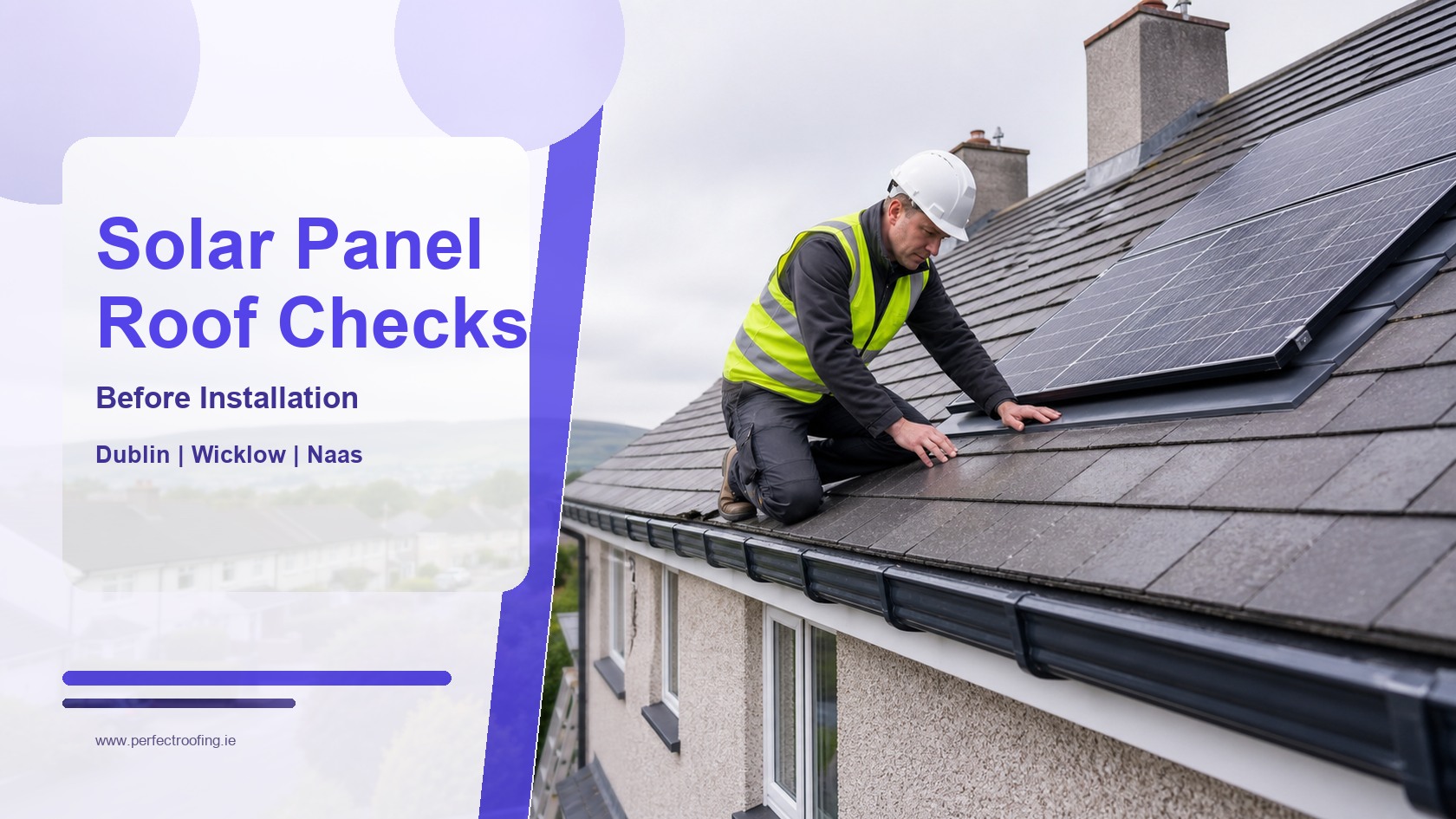
Solar panels can be a good long-term upgrade, but they should not be treated as separate from the roof beneath them. Once panels, rails, brackets, cables, and access equipment are in place, small roofing defects can become harder to see and more awkward to repair.
For homeowners in Dublin City, North Dublin, South Dublin, Lucan, Bray, Wicklow, Naas, and nearby areas, a roof check before solar installation is a practical way to avoid repeating access costs, disturbing new panels later, or discovering a leak after the upgrade is complete.
This guide explains what to check before solar panels go on the roof, when roofing repairs should happen first, and how Perfect Roofing can help prepare the roofline, gutters, flashing, roof windows, and ventilation details around the project.
Why check the roof before solar panels are fitted?
Solar installers normally focus on the panel system, roof fixing method, electrical work, and the layout needed for performance. A roofer looks at a different question: is the existing roof ready to be covered, loaded, and worked around?
A pre-solar roof inspection can help identify:
- Slipped, cracked, loose, or weathered slates and tiles
- Ridge, hip, verge, or valley details that may need repair
- Chimney flashing, wall flashing, soakers, or back gutters with early signs of failure
- Gutters, fascia, soffits, and downpipes that may need attention before access is removed
- Roof window or skylight flashing that could be affected by panel layout
- Flat roof outlets, upstands, edge trims, and ponding areas
- Attic condensation or ventilation issues that can be mistaken for roof leaks
- Safe access requirements for roofing and solar trades
The aim is not to delay the solar project. It is to make sure the roof is ready before extra equipment is fitted above it.
Start with the age and condition of the roof
A newer roof in good condition may only need a straightforward visual check before solar work begins. An older roof, especially one with repeated repairs, missing pointing, brittle tiles, or visible staining inside the attic, deserves a closer look.
Before installation, ask:
- Has the roof leaked in the last few years?
- Are there damp marks near ceilings, chimney breasts, roof windows, or attic timbers?
- Have slates or tiles slipped after windy weather?
- Are gutters overflowing or pulling away from the fascia?
- Is the roof covering close to the end of its useful life?
- Will panels be fitted near valleys, chimneys, dormers, roof windows, or parapets?
If a roof is already due for larger repair or replacement, it is usually better to have that conversation before panels are installed. A small repair may be simple now but more complicated once panel frames and cables are in the way.
Slates, tiles, ridges, and verges
Pitched roofs across Dublin and Wicklow often have a mix of slate, concrete tile, clay tile, ridge tile, hip, verge, and valley details. Solar panels usually sit above the main roof covering, but the roof still has to shed rain properly around the system.
Look for signs such as:
- Cracked or missing slates and tiles
- Tiles that have slipped out of line
- Loose ridge or hip tiles
- Crumbling mortar on older ridge, hip, or verge details
- Gaps around dry verge or roof edge components
- Exposed underlay, damaged battens, or uneven roof lines
- Previous patch repairs that look temporary or mismatched
Do not climb onto the roof to check these items yourself. Take photos from the ground, from a safe upstairs window, or from inside the attic where accessible. A roofer can then inspect the roof covering and advise whether repairs should be completed before solar panels are fitted.
Chimneys, flashing, valleys, and roof junctions
Many roof leaks start around details rather than in the middle of an open roof slope. This matters for solar planning because panels may reduce clear working space around chimneys, valleys, dormers, and wall junctions.
Important areas to check include:
- Lead flashing around chimneys and walls
- Soakers beside slates or tiles
- Back gutters behind chimneys
- Roof valleys carrying water from two roof slopes
- Dormer cheeks and flat roof junctions
- Extension roof junctions and parapet details
- Old sealant repairs around awkward corners
If a chimney flashing is close to failure, fitting panels nearby will not solve it. The flashing still needs proper access, correct detailing, and suitable materials. Homes in Dublin City can have tight chimney and parapet layouts, while exposed homes around Bray and Wicklow may need careful attention where wind-driven rain hits roof junctions.
Gutters, fascia, soffits, and downpipes
Solar panels can change how rainwater reaches parts of the roof surface, and installation access can make gutter problems easier to deal with at the same time. Before the project starts, check whether the roofline is already showing signs of trouble.
Warning signs include:
- Gutters overflowing in normal rain
- Downpipes blocked or slow to clear
- Fascia boards sagging, staining, or pulling away
- Soffits showing dark marks, rot, or gaps
- Plants, moss, or tile grit sitting in gutter runs
- Water marks on walls below gutter corners
- Loose brackets or poorly aligned sections
If scaffolding or other safe access is being arranged for solar work, it may be sensible to inspect gutters and roofline details before it is removed. That is especially useful on taller homes in North Dublin, South Dublin, Lucan, Naas, and nearby areas where access is a major part of the job.
Roof windows, skylights, and flat roof areas
Solar panels are often planned around Velux windows, skylights, roof lanterns, dormers, and flat roof extensions. These features need careful checking because leaks may be blamed on the new solar work even when an older roof-window or flat-roof detail was already weak.
Before installation, check:
- Roof window flashing, drainage channels, and surrounding slates or tiles
- Condensation patterns around glass, frames, and reveals
- Skylight upstands, kerbs, and seals on flat roofs
- Flat roof outlets, trims, laps, and ponding areas
- Junctions between pitched roofs and flat roof extensions
- Any damp marks below roof windows, lanterns, or dormers
For homes with kitchen extensions, converted attics, or roof windows in South Dublin, Bray, Wicklow, Lucan, and Naas, a roof inspection can help separate condensation, flashing defects, and genuine roof leaks before the solar installation adds another variable.
Attic ventilation and condensation checks
Not every damp mark near a roof is a leak from outside. Poor ventilation can cause condensation in the attic, especially where insulation has been pushed into eaves, vents are blocked, or moist indoor air reaches cold roof surfaces.
Before solar panels are fitted, it is worth checking:
- Whether attic vents are blocked by insulation or storage
- If there is black staining, mould, or dampness on roof timbers
- Whether insulation is wet, compressed, or uneven
- If bathroom or kitchen extract fans discharge into the attic instead of outside
- Whether roof windows, dormers, or ceiling penetrations are showing damp marks
A ventilation issue will not be fixed by solar panels. If condensation is present, it should be understood before homeowners assume every future stain is caused by the roof covering or the panel installation.
Questions to ask before the solar project starts
Good coordination between the homeowner, solar installer, and roofer can prevent confusion later. Before work begins, ask practical questions such as:
- Which roof slopes will receive panels?
- Will panels sit near chimneys, valleys, roof windows, or gutters?
- Is scaffolding or edge protection being used, and can the roof be inspected while it is in place?
- Are any cracked slates, loose tiles, or flashing issues already visible?
- Will cables pass near roof windows, gutters, fascias, or attic ventilation points?
- Who should be contacted if a roofing defect is found during installation?
- Should any roof repairs be completed before panels, rails, or brackets are fitted?
Keep photos from before the work starts. They can help everyone understand the roof condition, existing defects, and any areas that were repaired in advance.
When roof repairs should happen first
Not every minor issue has to stop a solar installation, but some problems should be repaired before the roof is partly covered.
Repair-first situations may include:
- Active leaks or damp patches inside the home
- Missing, broken, or badly slipped slates and tiles
- Loose ridge, hip, verge, or valley details
- Chimney flashing that is cracked, lifted, or poorly patched
- Gutters that overflow against walls or roof edges
- Rotten fascia or soffit sections near the planned work area
- Flat roof ponding, soft decking, or failed upstands
- Roof windows or skylights with known flashing leaks
If a roof is in poor overall condition, a small patch may not be the right answer. A proper inspection can help decide whether targeted repairs, wider maintenance, or replacement planning makes more sense before solar panels are fitted.
Contact Perfect Roofing before fitting solar panels
Perfect Roofing helps homeowners across Dublin City, North Dublin, South Dublin, Lucan, Bray, Wicklow, Naas, and nearby areas prepare roofs for planned upgrades. We can inspect slates, tiles, flashing, gutters, roof windows, flat roofs, roof ventilation, and other roofline details before panels are installed.
If you are planning solar panels, contact Perfect Roofing by WhatsApp, phone, or email before the installation date. Send photos if you can take them safely, tell us the roof type and area, and explain whether there have been leaks, slipped tiles, gutter problems, or roof-window issues. We can advise what should be repaired first and what can be monitored as part of normal roof maintenance.
Need a roofer to take a look?
Send a few photos on WhatsApp, email us, or tap the number to call. We cover Dublin City, North Dublin, South Dublin, Lucan, Bray, Wicklow, Naas, and nearby locations.