Roofing Guides
Roofing Work Access for Dublin City Terraces: Scaffolding and Planning
Planning roofing work on a Dublin City terrace? Learn what to discuss about scaffolding, narrow rear access, public footpaths, disruption, and the access scope in your quote.
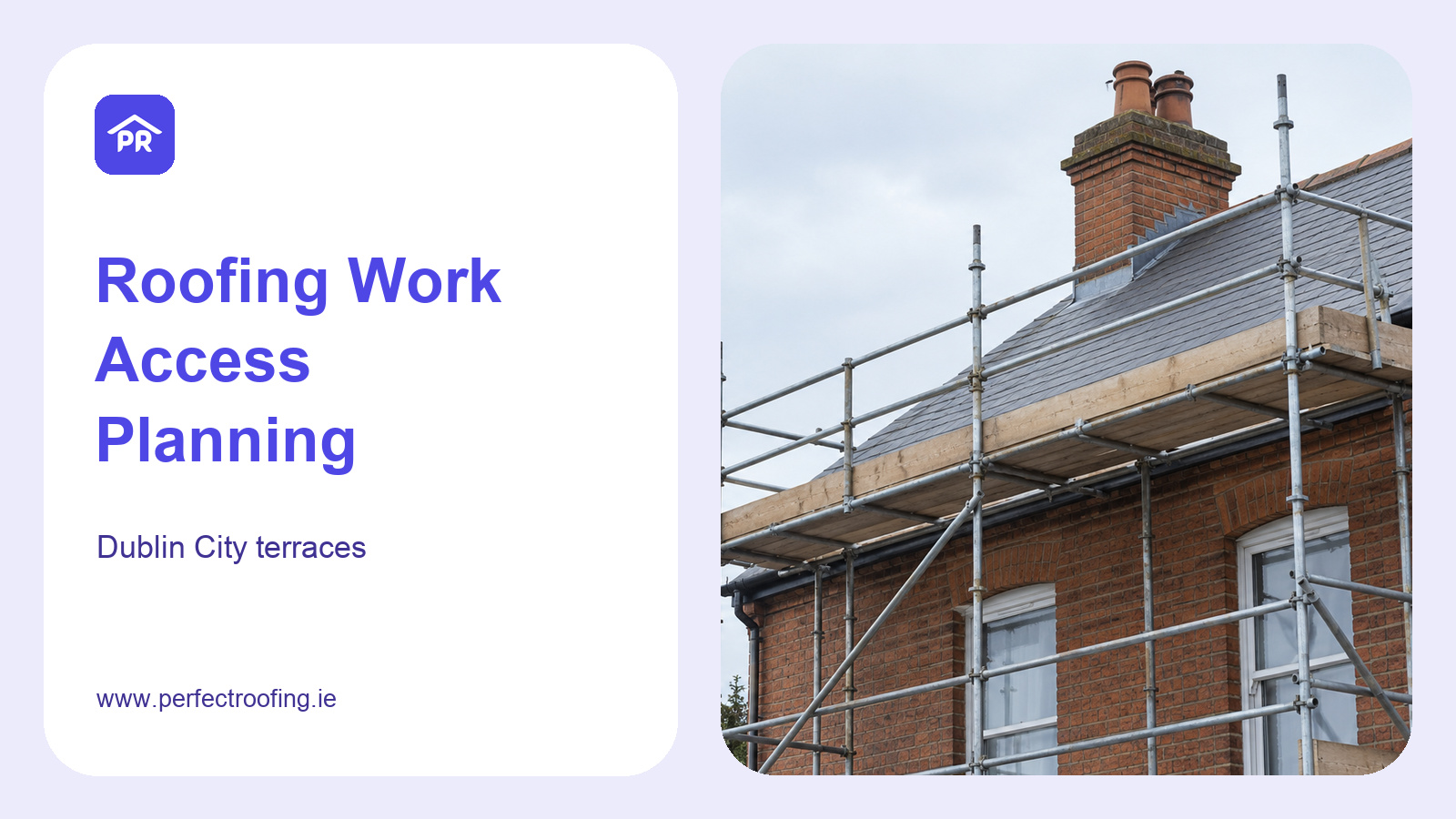
A small roof defect can involve more planning than its size suggests. On a Dublin City terrace, the roofer may need to reach a high front roof, carry equipment through the house, or work above a rear extension with no side entrance. The repair itself and the arrangements for reaching it are both part of the job.
You do not need to choose or organise access equipment before contacting a roofer. You can help by describing the property and asking how access will be assessed, included in the quote, and managed while you remain at home.
Does every roofing job need scaffolding?
There is no reliable answer from a photograph of the damaged slate alone. The work location, roof height, pitch, condition, ground space, materials, and movement needed during the job all affect the access plan.
The Health and Safety Authority's working at height guidance emphasises assessment, planning, competent workers, and suitable equipment. It prioritises measures such as working platforms and guard rails that protect people from falls. A short job still needs an appropriate plan.
Ask the roofer to explain how the proposed arrangement lets them reach and carry out the work. Getting to the roof and having a suitable position from which to work are related questions, but they are not interchangeable.
Do not climb onto the roof or hire a tower to investigate the problem yourself. Roof access needs competent assessment and proper safety equipment; equipment alone does not make a roof safe to walk on.
Scaffolding, towers, platforms, and ladders
The HSA's Code of Practice for Safety in Roofwork discusses scaffolds, scaffold towers, mobile access equipment, and ladders. These are options for professionals to assess, rather than a homeowner shopping list.
| Access option | What to discuss with the roofer |
|---|---|
| Scaffolding | Where it would stand, which roof sections it serves, and how entrances remain usable |
| Fixed or mobile scaffold tower | Whether the available space and work location suit that arrangement |
| Mobile elevating work platform | Whether it can reach the work from suitable ground and how it would arrive on site |
| Ladder access | Why it is appropriate for the particular task and what additional work-position protection is needed |
The code notes that a mobile platform can suit some inspections and minor maintenance, subject to site conditions and competent operation. It also explains that ladders are not appropriate in every situation. Avoid assuming that a narrow frontage automatically means ladder work, or that a platform can reach a rear roof simply because it can reach the front gutter.
Tell the roofer about restricted rear access
A street view may hide the most awkward part of the property. A kitchen return, glazed conservatory, flat roof, or small enclosed yard can change the route to the work area.
Before the visit, mention:
- Whether there is a side passage or rear lane, and how it is reached.
- Narrow doors, gates, stairs, or corners along the route through the house.
- Extensions, roof windows, glazing, or lightweight coverings below the proposed work.
- Steps, uneven paving, planted areas, or other ground features in the yard.
- Whether access would involve any neighbouring property.
- Where equipment and materials could be delivered without blocking the entrance.
Take wide photos from the ground or a safe indoor position. Show the route as well as the roof. Do not walk onto an extension roof to get a better view, and do not promise a neighbour's garden as an access route before it has been discussed and agreed.
What if scaffolding reaches the public footpath?
Dublin City Council says a licence is needed to erect a scaffold or hoarding on a public footpath or roadway. Its current hoarding and scaffold permit guidance explains the application process.
If the proposed access could occupy public space, ask who will check the council requirements, arrange the application, and account for it in the programme and quote. Do this before agreeing a start date that depends on that access. A roof repair booking does not itself settle the permission to occupy a footpath.
For homes elsewhere in North Dublin, South Dublin, Lucan, Bray, Wicklow, or Naas, ask about the relevant local authority's requirements. Do not assume Dublin City's process applies to every address.
Make the access scope clear in the quote
An access arrangement should be tied to the agreed roofing work. A front-eaves setup may not cover a chimney, rear valley, or roof window in another part of the house.
Useful questions include:
- Does the price include the proposed access equipment, delivery, installation, and removal?
- Which roof sections can be inspected and worked on from it?
- Are permit arrangements or associated charges included where applicable?
- What happens if inspection reveals a defect outside the accessible area?
- Who explains and approves a change to the access scope before extra work begins?
- How will changes to the work schedule affect the equipment arrangements?
There is no useful universal scaffolding price for a terrace without assessing the site. Ask for a clear allowance or scope, rather than comparing an inclusive quote with one that leaves access unresolved. Our guide to comparing roof replacement quotes covers the wider specification questions if a full reroof is being considered.
Prepare the house for the agreed plan
Once the contractor has assessed access, agree which routes and areas need to stay clear. Discuss school runs, deliveries, bins, pets, and any household member who needs reliable access through the entrance.
Move garden furniture, planters, or parked vehicles only as agreed. If equipment must pass through the house, ask about protecting floors and doorways. Confirm the site contact, how the work area will be kept separate from household activity, and when equipment removal is expected.
Stay off scaffolds, towers, and roofing equipment. If an entrance becomes obstructed or an arrangement changes, contact the site lead instead of moving equipment yourself. For the finished work, request photographs of details that cannot be seen safely from below.
Plan your roofing work with Perfect Roofing
Perfect Roofing helps homeowners in Dublin City and nearby areas plan roof inspections, repairs, replacements, gutter work, flat roofing, and roof-window projects. Tell us about the roof concern and any narrow access, rear extension, shared route, or public footpath beside the house.
Contact us on WhatsApp, call +353 83 066 3462, or email hi@perfectroofing.ie. Send safe photographs and your location so we can discuss a visit and a practical roofing scope based on the property, access, budget, and long-term plans.
Need a roofer to take a look?
Send a few photos on WhatsApp, email us, or tap the number to call. We cover Dublin City, North Dublin, South Dublin, Lucan, Bray, Wicklow, Naas, and nearby locations.