Skylights
VELUX vs FAKRO vs Keylite Flat-Roof Rooflights for Dublin Extensions
Compare VELUX glass rooflights, FAKRO Type F and Keylite Select Flat Glass for Dublin extensions, including opening options, kerbs and quotation questions.
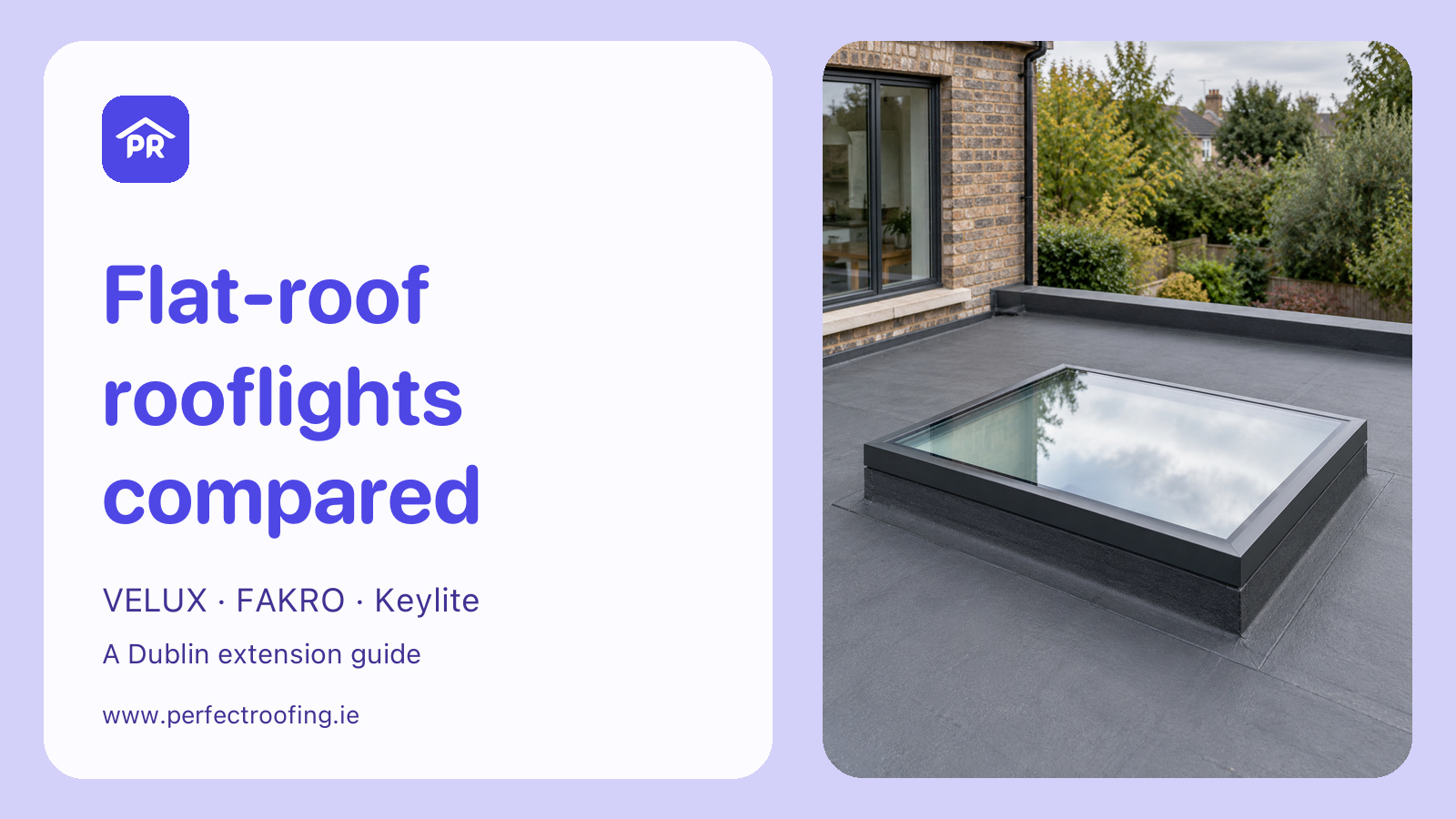
Choosing a rooflight for a kitchen extension starts with the roof and the room beneath it. Do you need daylight alone, an opening window, shading, or a replacement that fits an existing opening? Those decisions make a brand comparison much more useful.
This guide compares VELUX flat and curved glass rooflights, FAKRO Type F, and Keylite Select Flat Glass for homeowners planning work in Dublin and nearby areas. These are specific product families, so another model from the same brand may have different features or installation requirements.
Flat-roof rooflights: a quick comparison
| Product family | Opening choices to discuss | Main point to check |
|---|---|---|
| VELUX flat and curved glass rooflights | Fixed, electric or solar-powered | Correct glass cover and base unit for the roof slope |
| FAKRO Type F | DXF fixed, DMF manual, DEF electric; solar version also listed | Exact model, glazing and suitability for the measured slope |
| Keylite Select Flat Glass | Fixed and electric configurations | Glazed frame only or a package with a compatible kerb |
The manufacturer sources linked below verify these features. Irish supply, accessories and aftercare for the exact specification should be confirmed before ordering. A product name or nominal size does not establish whether it will fit an existing roof opening.
VELUX: flat or curved glass with powered opening options
The VELUX Irish glass-rooflight guide lists flat glass for roof pitches of 2–15° and curved glass for 0–15°. The distinction matters when a low-slope extension is being assessed. The curved cover is designed to help rainwater drain from the glass; it does not correct drainage problems elsewhere on the roof.
VELUX offers fixed, electric and solar-powered versions. Its flat glass product information also describes double or triple glazing and compatible shading accessories.
- May suit: a homeowner choosing between flat and curved glass, or wanting powered ventilation from a high ceiling.
- Advantages: cover and operation choices allow a specification to be matched to different room priorities.
- Trade-offs: the quotation must identify the complete cover/base combination and compatible accessories. An existing unit cannot be assumed to accept a new cover.
Ask which base, top cover, glazing and blind are included, rather than accepting a quotation that says only “VELUX skylight”.
FAKRO Type F: a manual-opening option worth comparing
FAKRO's Type F product page identifies DXF as non-opening, DMF as manually opened with a rod, and DEF as electrically operated. It lists a 2–15° installation range and triple or quadruple glazing options. The manufacturer's flat-roof buying guide also lists a solar version of DEF.
- May suit: a homeowner who wants to compare manual ventilation with a powered option for an extension.
- Advantages: clearly differentiated fixed, manual and electric models make operation an explicit buying decision.
- Trade-offs: manual operation needs to be practical from inside the room. Type F is not specified for every low-slope roof, so the installed angle must be checked.
FAKRO lists Ireland in its official distribution directory. Confirm the proposed model's Irish supply route and support arrangements, including any control components, before finalising the order.
Keylite Select Flat Glass: compare the kerb package carefully
Keylite's Flat Roof Solutions brochure describes Select Flat Glass as a factory-glazed rooflight with a thermally broken aluminium frame. It lists fixed and electric configurations, with glazed-frame-only options or packages using timber sloping and uPVC kerbs.
- May suit: a homeowner comparing a contemporary glass rooflight for a new extension or a carefully measured replacement.
- Advantages: kerb options make it possible to compare a more complete package with a frame-only quotation.
- Trade-offs: a frame-only price leaves the kerb and its installation to be specified separately. Select and Premium are different product ranges, so their specifications should not be mixed.
The brochure distinguishes roof pitch from the fall needed at the glazing and discusses sloping kerbs. Ask the installer to confirm the correct arrangement for your roof rather than relying on a broad “flat roof” label.
Which option fits your room and roof?
There is no universal winner. The following are practical selection priorities, rather than claims that one brand performs best:
- Daylight only: compare fixed units, visible glazing area and where light will fall within the room.
- Ventilation: compare opening models, how you will operate them and the room's wider ventilation needs. A rooflight should not be treated as a replacement for an assessed ventilation design.
- An opening above a high ceiling: establish whether a manual rod is workable, or whether powered operation makes more sense.
- A kitchen or living area: discuss glare, summer sun and compatible shading before choosing the size.
- An existing rooflight: have the opening, kerb and surrounding roof measured before comparing replacement products.
For a South Dublin or Lucan extension, the room layout and existing roof build-up may drive the decision. For more exposed properties around Bray and Wicklow, ask how the kerb, waterproofing and fixings will be detailed for the site. Access through a Dublin City terrace can also affect the installation scope.
Compare installation details as well as the glass
The quotation should explain how the rooflight becomes part of the roof. Ask about the condition of the existing deck, insulation around the opening, waterproofing at the upstand and the route water takes towards the outlet.
If changing an opening is proposed, ask who will assess the necessary support and design. Do not assume a larger rooflight can be fitted simply by cutting a bigger hole.
If your existing rooflight leaks, the defect may be at the kerb or surrounding membrane. Our flat-roof skylight kerb leak guide explains the observations that can help organise an inspection.
Do not climb onto a roof without proper access and safety equipment, and never stand on a rooflight. Send photographs from inside the room or a safe ground-level viewpoint instead.
What should a rooflight quotation include?
Use the same scope when comparing proposals:
- Exact brand, product family, model, size and opening type.
- Glazing specification and any proposed blinds or controls.
- Kerb supply, insulation and waterproofing details.
- Any electrical work, internal lining and decoration.
- Removal of the old unit and repairs around the opening.
- Access arrangements, waste removal and completion photographs.
- Written product guarantee terms, exclusions and separate installation cover.
- Irish supply and aftercare contacts for the specified unit.
Ask whether any thermal figure describes the glass alone or the complete unit, and whether figures are directly comparable. A headline number without its measurement basis is not enough to rank products.
Product-only prices also leave out site work. Compare complete installed quotations for your home rather than assuming a brand is always the cheapest or most expensive.
Ask Perfect Roofing for a rooflight recommendation
Perfect Roofing can assess your existing rooflight or planned installation and help you compare suitable options. We work across Dublin City, North Dublin, South Dublin, Lucan and nearby areas, including Bray, Wicklow and Naas.
Send safe photographs on WhatsApp, call 083 066 3462, or email hi@perfectroofing.ie. Tell us about the room, any active leak and your preferred opening style. Ask for a recommendation based on your roof, budget, weather exposure, access and long-term plans.
Need a roofer to take a look?
Send a few photos on WhatsApp, email us, or tap the number to call. We cover Dublin City, North Dublin, South Dublin, Lucan, Bray, Wicklow, Naas, and nearby locations.