Roof Ventilation
Bathroom Extractor Venting Into the Attic? Checks for North Dublin and Naas Homes
Does your bathroom fan discharge into the attic? Learn what to check safely, how roof terminals differ from attic vents, and what to include in a repair quote.
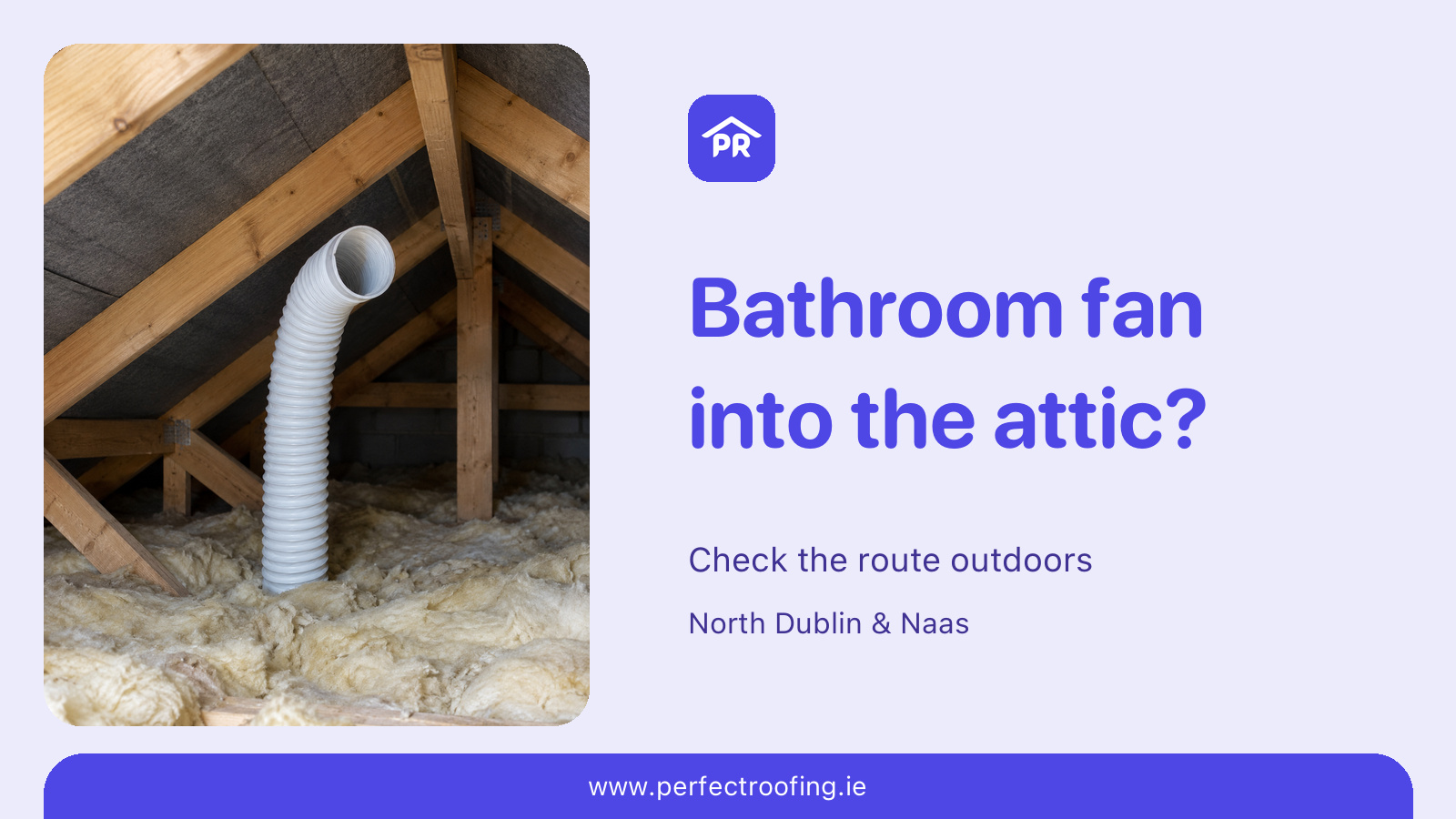
A bathroom fan can sound as though it is working while its duct finishes inside the attic. If you spot an open hose above the bathroom, or cannot tell where the extract air goes, ask for the route to be checked before paying for more roof vents or a replacement fan.
For homeowners in North Dublin and Naas, the useful question is simple: is there a continuous, suitable connection from the bathroom to an outdoor outlet? This guide explains what to record safely and how to agree the roofing and ventilation work needed to put that connection right.
Should a bathroom extractor discharge into the attic?
No. The fan needs an appropriate route outdoors. SEAI's home ventilation guidance explains that extract fans remove bathroom moisture directly outside. It also describes how moisture reaching a colder attic can condense on roof timbers and other cold surfaces.
A running fan or a grille on the ceiling does not confirm that the outlet is connected. Ask the person inspecting the system to trace the whole route, including any concealed section, rather than judge it by sound alone.
An open duct near the eaves still needs checking
A hose aimed towards the roof edge is not evidence of a finished outdoor connection. SEAI's attic insulation technical bulletin specifically identifies extract ducting ending in an attic or closed soffit as a problem found during its insulation inspections. Its illustrated corrective guidance takes the duct outside through a suitable outlet.
The bulletin addresses attic-insulation installations and illustrates the connection to ask about. If your duct disappears into the eaves, ask where it actually terminates and request a photograph of the completed connection.
A roof-space vent and a bathroom outlet do different jobs
General roof ventilation serves the roof space. A bathroom extract outlet carries air from the fan through connected ductwork to outdoors. Adding an unconnected tile vent nearby does not complete that duct route.
Some roof terminals can serve either purpose with the appropriate components. For example, Timloc's Universal Hooded Slate Vent documentation lists both roof-space ventilation and mechanical extraction uses, with a separate adaptor for the duct connection. This illustrates why the connection matters; it is not a recommendation for every roof.
Ask the roofer and ventilation installer to confirm:
- Whether the proposed terminal is intended for mechanical extraction.
- Which adaptor and duct size the selected system requires.
- Whether it suits the roof covering, pitch and proposed position.
- How the surrounding slates or tiles and underlay will be weathered.
Choose the complete arrangement before ordering a vent by colour or appearance. A suitable outlet for one roof may be unsuitable for another.
What can you record without disturbing the installation?
You do not need to investigate the entire attic before contacting us. From the bathroom, record the fan's make or model if its label is visible without opening it, any unusual noise, and when damp marks appear. Mention recent bathroom, insulation or roofing work, without assuming that it caused the problem.
If the attic hatch has safe access, lighting and a secure viewing position, a wide photograph may show:
- An open or apparently detached duct end.
- The visible route towards a roof slope, gable or soffit.
- An obvious crushed section or loose connection.
- Staining near the duct and the position of the bathroom below.
Stay at the hatch if there is no safe boarded route. Do not step on insulation or ceiling plasterboard, pull on ducting, open electrical equipment, or climb onto the roof without proper safety equipment and competent access planning. Leave inaccessible sections for the inspection.
What if water drips from the bathroom fan?
Do not assume that every drip means rain is coming through the roof terminal. Record whether it follows showers, cold conditions, rainfall, or a combination. The inspector should consider the external weathering, duct connections and route, and whether condensation management is needed for the chosen system.
Ask for the duct manufacturer's requirements to be checked, including support, insulation where needed, bends and any specified condensate arrangements. Avoid a universal DIY fix such as puncturing the hose, wrapping it in spare insulation, or sealing the fan grille.
Keep clear of a wet fan or nearby electrical fittings and arrange an electrician's assessment. Our ceiling-stain guide explains why timing is a useful clue, but an inspection is needed to identify the source.
Who handles the roof, duct and fan work?
Agree responsibility before booking. Perfect Roofing can assess the roof covering, proposed roof outlet and weatherproofing. A ventilation installer may need to specify and check the fan-and-duct arrangement, while electrical work belongs with a qualified electrician.
Tell us whether this is a single bathroom fan or part of a whole-house ventilation system. Do not disconnect or alter a shared system based on advice for an individual extractor.
For a North Dublin home with a difficult roof slope, or a Naas house where a bathroom was moved during renovations, send photographs of the wider layout as well as the visible duct. Access and the actual route should inform the proposed work.
What should the quotation and handover include?
Ask for a written scope that makes clear:
- Which inspection, roof outlet and weatherproofing work is included.
- Who supplies and connects the duct, adaptor and fan if required.
- Who checks the completed extraction system and records the result.
- What access equipment and making good are included.
- How hidden damage or an unsuitable existing route will be discussed before extra work.
At handover, request photographs showing the outdoor terminal and its duct connection, plus the selected product details and any maintenance instructions. A photo of a new vent on the roof is useful, but ask for evidence of the connection underneath as well.
Ask Perfect Roofing to check your extractor roof outlet
If your bathroom duct ends in the attic, its destination is unclear, or damp returns around the outlet, contact Perfect Roofing to discuss the roof-side inspection and any coordination needed with a ventilation installer. We help homeowners across North Dublin, Naas and nearby areas, including Dublin City and Lucan.
Send your location, safe photos and a short description on WhatsApp, call +353 83 066 3462, or email hi@perfectroofing.ie. We can discuss access, the roof condition and a practical quotation for the roofing work your installation needs.
Need a roofer to take a look?
Send a few photos on WhatsApp, email us, or tap the number to call. We cover Dublin City, North Dublin, South Dublin, Lucan, Bray, Wicklow, Naas, and nearby locations.