Roofing Materials
Natural Slate vs Fibre-Cement Slate for Dublin and Wicklow Homes
Compare natural slate and fibre-cement slate for Irish roofs, including appearance, weight, weathering, installation, repairs, budget, and suitability.
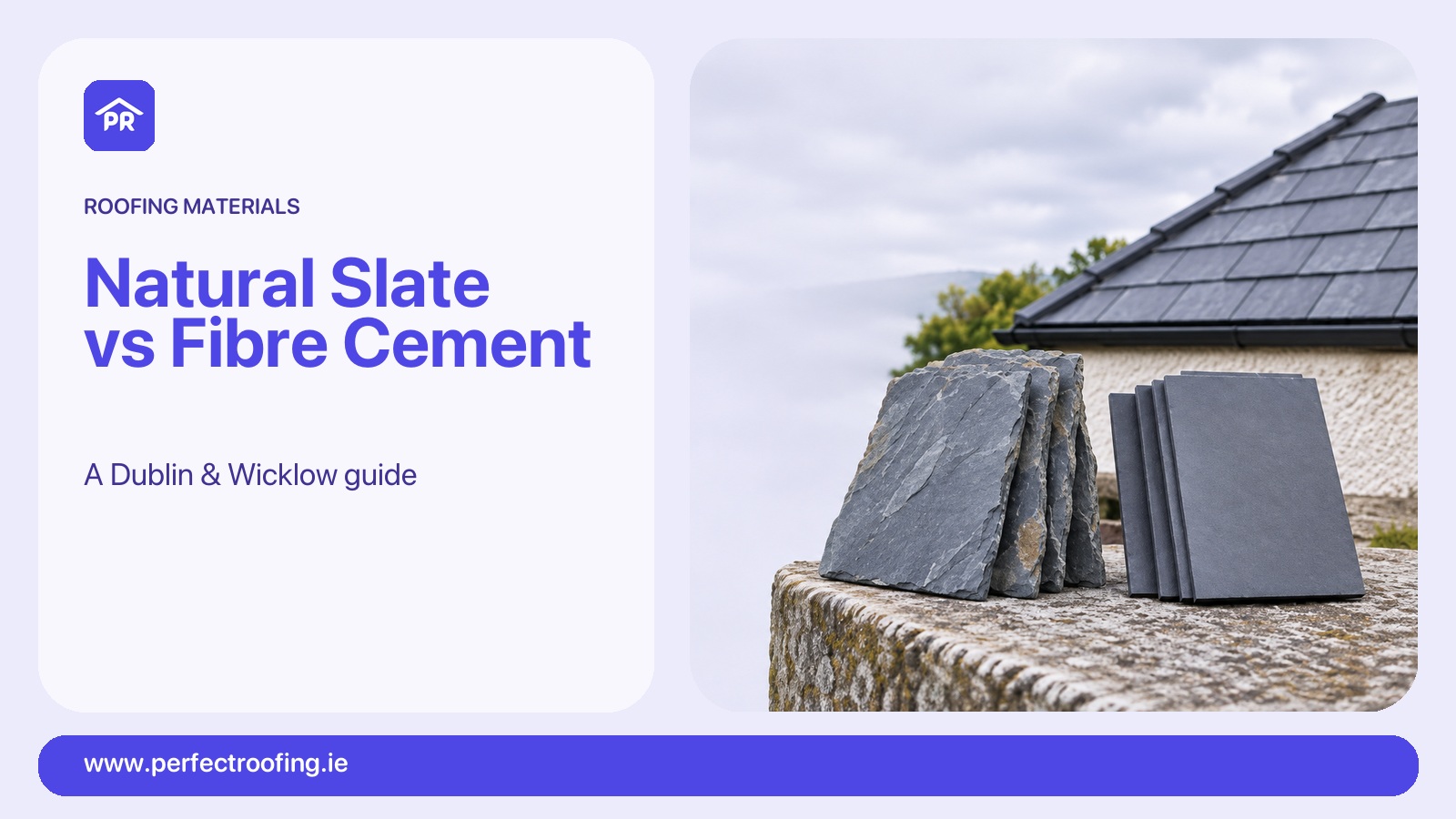
Natural slate and fibre-cement slate can both create a smart, weather-resistant pitched roof, but they are not interchangeable products. One is split from natural stone, with variation from piece to piece. The other is a manufactured roofing material designed to provide controlled dimensions, colour, and finish.
For a homeowner planning a roof replacement in Dublin, Bray, Wicklow, or a nearby area, the best choice depends on more than appearance. Roof pitch, structure, exposure, detailing, labour, neighbouring rooflines, maintenance expectations, and the total project budget all matter. This guide compares the two options so you can ask for a roof specification that suits the property rather than choosing from one small sample alone.
Natural slate and fibre-cement slate at a glance
| Question | Natural slate | Fibre-cement slate |
|---|---|---|
| What is it? | Natural stone quarried, selected, and split into roofing slates | A manufactured composite of cement, fibres, water, and other specified ingredients |
| Appearance | Individual tonal, texture, and edge variation | More uniform colour, thickness, shape, and coursing |
| Roof character | Often chosen for a traditional, distinctive, or premium natural finish | Often chosen for a tidy, consistent roofline and controlled finish |
| Weight | Varies by slate type, thickness, size, and fixing layout | Commonly promoted as a lightweight slate option, but product data must still be checked |
| Installation | Natural variation requires careful sorting, grading, setting out, and skilled fixing | Consistent dimensions can make setting out more predictable |
| Weathering | Natural colour and surface variation form part of the material | Coated colour and finish may change gradually with exposure, depending on the product |
| Budget position | Usually the higher initial-cost route once material and skilled labour are considered | Often the more accessible initial-cost route, depending on the range and roof design |
| Best comparison method | Check quarry, selection, format, thickness, technical data, and installed sample roofs | Check product range, finish, dimensions, fixing guide, accessories, and written terms |
These are broad differences, not a specification. Natural slates vary by quarry and selection, while fibre-cement ranges vary by manufacturer, format, finish, and technical requirements. Compare named products and a complete roof build-up before accepting a quotation.
What natural slate brings to a roof
Natural roofing slate is stone that has been extracted and split into individual units. Its small variations are part of its appeal. A finished roof can have subtle changes in tone, texture, thickness, and edge character while still looking balanced when the slates are selected and laid carefully.
Homeowners often consider natural slate when they want:
- A genuine stone roof with individual character
- A finish that suits a period house or traditional streetscape
- Subtle variation rather than a completely uniform surface
- A long-term roof covering where the full specification and workmanship justify the investment
- A material that can be assessed by quarry, selection, size, thickness, and test data
Natural does not automatically mean suitable. The slate still needs reliable technical documentation, correct selection, appropriate thickness and format, and a fixing design that suits the roof. Samples should be viewed together rather than judging one especially attractive piece.
Official manufacturer information illustrates how specific the choice can be. CUPA PIZARRAS, for example, publishes separate data for individual quarry products and describes CUPA 50 as a natural slate suited to the Irish market. The useful lesson is not that one product fits every home; it is that the quarry source, format, technical data, and intended market should be identifiable.
What fibre-cement slate brings to a roof
Fibre-cement slate is manufactured to consistent dimensions and finish. Current products can be smooth, textured, or formed with dressed-looking edges, giving homeowners a choice between a very even roof and a surface intended to echo some of natural slate's visual character.
Fibre-cement slate may suit a project where the priorities include:
- A neat, regular pattern across the roof slopes
- Consistent thickness and dimensions
- A lighter slate product, subject to the chosen product's technical data
- A controlled colour and finish
- A coordinated range of roof accessories and details
- A more accessible initial budget than many natural slate specifications
The product name matters. Do not accept “fibre slate” as the whole specification. Ask which range, colour, texture, size, fixing method, and accessories are proposed. Cedral's current Irish roofing range, for example, includes several fibre-cement slate finishes and supporting accessories, as well as separate natural slate options. That variety is a reminder to compare the exact proposed product rather than the category name alone.
Appearance: individual character or consistent lines?
Appearance is the easiest difference to notice, but it should be assessed across a roof area.
Natural slate has genuine mineral and surface variation. Careful grading allows the roofer to distribute that variation so the completed roof looks intentional. The finish can work particularly well on older Dublin terraces, traditional cottages, and homes where natural material character is central to the design.
Fibre-cement slate is more uniform. That can suit a contemporary extension, a simple new roof, or a homeowner who prefers clean, regular courses. Textured products can soften the manufactured look, while smooth products create a crisper finish.
Before deciding, ask to see:
- Several loose samples, not just one slate
- A larger sample panel where available
- Completed roofs using the same product and colour
- The roof in both dry and wet conditions if possible
- Ridge, hip, verge, valley, and ventilation accessories that will be visible
- How the new covering will meet an adjoining or neighbouring roof
On a semi-detached or terraced property, the junction with the next roof may influence the decision. A noticeably different colour, slate size, gauge, or thickness needs careful detailing so the transition is weathered properly and does not look accidental.
Weight and roof structure still need checking
Fibre-cement slate is commonly described as lightweight, but “lightweight” is not a structural assessment. Natural slate weight also varies with its dimensions and thickness. The relevant figure is the installed system for the selected product, including the number of slates per square metre and the required lap and fixing arrangement.
For a roof replacement, the inspection should consider:
- Existing rafters, trusses, battens, and visible timber condition
- The current roof covering and any proposed change in loading
- Roof pitch, rafter length, and exposure
- Underlay, counter-batten, batten, and ventilation strategy
- Solar panels, roof windows, tanks, or other existing loads and penetrations
- Dormers, valleys, lower roofs, and complex junctions
Do not assume that the lightest covering is automatically best or that a roof which previously carried slate can accept every new slate specification without review. The complete roof design should be checked before materials are ordered.
Irish weather performance depends on the whole system
Dublin and Wicklow roofs can face wind-driven rain, exposed elevations, shaded slopes, salt-laden coastal air around Bray and the Wicklow coast, and repeated wetting and drying. Both slate types can be specified for Irish conditions, but neither compensates for poor detailing.
Performance depends on factors such as:
- Roof pitch and the product's permitted use at that pitch
- Slate size, headlap, gauge, and fixing pattern
- Wind exposure and the fixing design
- Underlay, battens, ventilation, and eaves detailing
- Ridges, hips, valleys, verges, abutments, and penetrations
- Correct integration with chimneys, roof windows, vents, and gutters
- Careful handling and replacement of damaged pieces during installation
A useful quotation should identify the proposed slate and explain how the roof details form one compatible system. A premium covering installed with weak junction details is not a premium roof.
Installation and workmanship differences
Natural slate rewards experienced selection and setting out. Pieces may need to be graded for thickness and appearance before they are distributed across the roof. The roofer needs to maintain tidy courses while working with the material's natural variation.
Fibre-cement slate offers more consistent units, but accuracy remains essential. Correct lap, gauge, holes, nails, hooks or rivets where specified, and compatible fittings all matter. Slates should be handled and cut according to the product guidance, and the roof should be set out so narrow cuts or awkward edge details are avoided where practical.
For either option, ask the contractor:
- Which exact slate is included in the quotation?
- What fixing guidance will be followed?
- How have roof pitch and exposure influenced the specification?
- How will ridges, hips, verges, valleys, eaves, and abutments be formed?
- What ventilation and underlay strategy is proposed?
- How will colour or thickness variation be managed?
- Will you see a sample or agreed reference before ordering?
- How will spare matching slates be identified and left for future repairs?
Repairs, replacements, and future matching
Individual damaged slates can often be replaced, but a good repair is about more than finding a similar rectangle.
With natural slate, the replacement should be compatible in size, thickness, colour, texture, and fixing arrangement. A stone from a different source may weather differently or stand out. Keeping a small quantity of the installed slate, labelled with its product and source, can make future matching easier.
With fibre-cement slate, the range and colour should be recorded. A new slate from the same named range may still look different beside a roof that has weathered for years. Product ranges can also change, so leftover slates and the original paperwork are useful.
In both cases, the roofer should investigate why the slate failed. A cracked unit might have suffered impact, poor fixing, foot traffic, movement, or an unsuitable detail. Simply replacing the visible piece may not solve the underlying cause.
How to compare the real cost
Do not compare slate prices in isolation. The meaningful figure is the complete installed roof and what it includes.
Ask each quotation to state:
- Slate manufacturer, product, size, colour, and finish
- Removal and disposal of the existing covering
- Underlay, battens, fixings, ventilation, and accessories
- Ridge, hip, valley, verge, chimney, wall, and eaves work
- Scaffolding, access, protection, and waste handling
- Allowances for hidden timber or deck damage
- Gutters, fascia, soffits, roof windows, and penetrations
- Samples, handover information, spare slates, and written product terms
Natural slate may carry a higher initial material and labour allowance, while fibre cement may reduce the entry cost. Those broad positions can change with roof complexity, product range, access, and detailing. Compare like-for-like scopes and consider how long you plan to keep the property, how important the finish is, and what future matching or maintenance may involve.
Which slate may suit your home?
Natural slate may be the stronger fit when the homeowner values genuine stone, distinctive variation, and a traditional or premium finish, and is comfortable budgeting for careful selection and skilled installation.
Fibre-cement slate may be the stronger fit when the homeowner wants clean uniform lines, predictable dimensions, a lighter manufactured slate product, and a more accessible initial specification.
The final recommendation should also account for:
- The age, style, and roof shape of the property
- Existing structure and roof covering
- Roof pitch and weather exposure
- Shared or adjoining rooflines
- Chimneys, valleys, dormers, and roof windows
- Planning or conservation considerations where relevant
- Product availability and technical support
- Budget and long-term plans for the home
There is no universal winner. A well-specified fibre-cement roof can be a better decision than an unsuitable or poorly installed natural slate roof, and a carefully chosen natural slate can offer character that a uniform manufactured product is not intended to reproduce.
Ask Perfect Roofing for a slate roof recommendation
If you are planning a roof replacement in Dublin City, North Dublin, South Dublin, Lucan, Bray, Wicklow, Naas, or a nearby area, Perfect Roofing can inspect the existing roof and compare suitable slate options for the property.
Contact us by WhatsApp, phone, or email. We can discuss natural slate and fibre-cement slate in the context of your roof pitch, structure, exposure, access, adjoining roofs, appearance, budget, and long-term plans. Do not climb onto the roof to inspect or collect samples yourself; use ground-level photographs and leave close inspection to people with the proper access and safety equipment.
Need a roofer to take a look?
Send a few photos on WhatsApp, email us, or tap the number to call. We cover Dublin City, North Dublin, South Dublin, Lucan, Bray, Wicklow, Naas, and nearby locations.