Roof Replacement
How Much Does a New Roof Cost in Dublin?
A practical Dublin new roof cost guide covering roof types, material choices, pricing factors, warranties, known roofing brands, and what homeowners should check before accepting a quote.
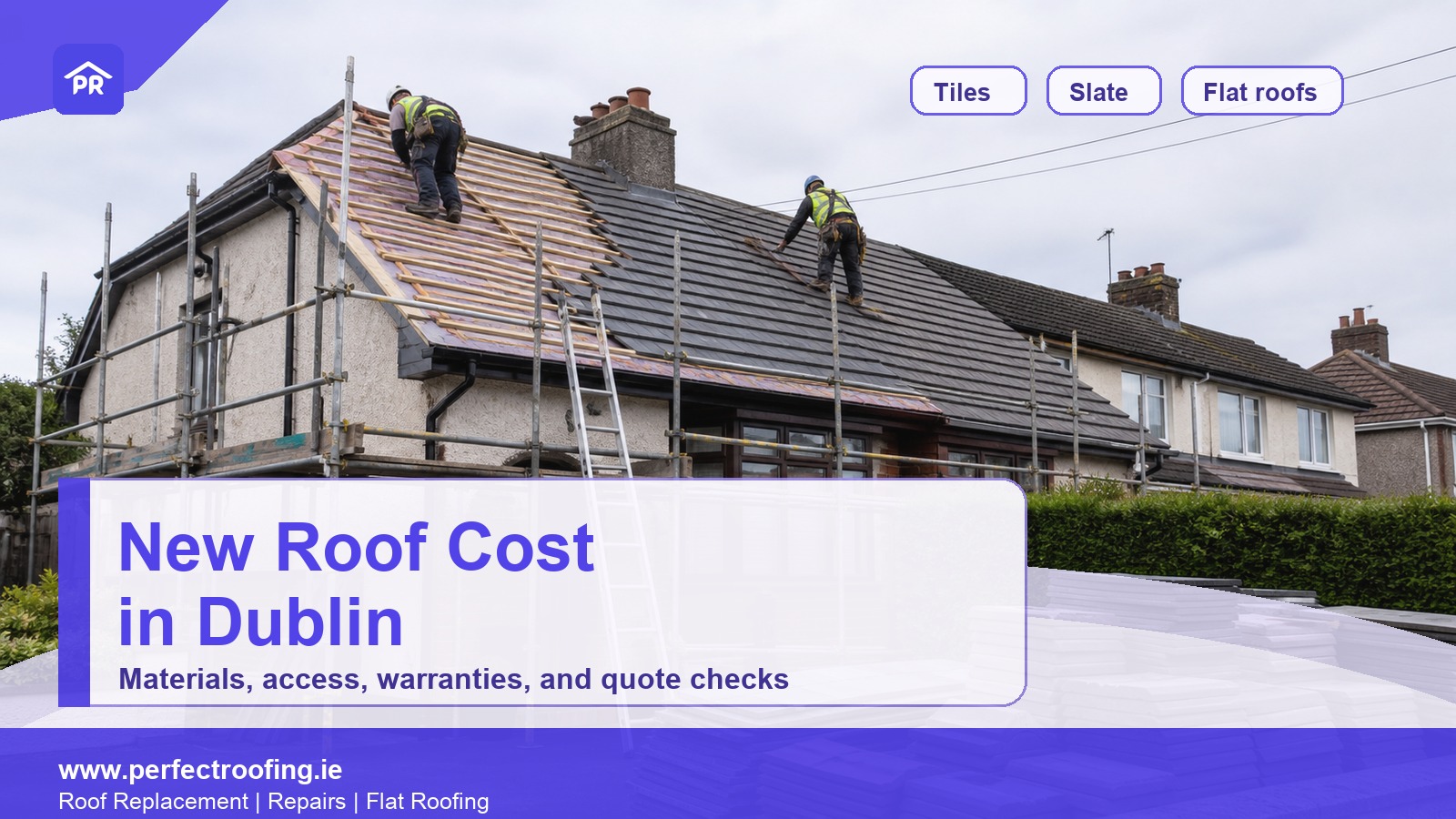
The cost of a new roof in Dublin can vary from a smaller five-figure job on a simple terraced or semi-detached home to a much larger investment on a detached, period, slate, or complicated roof. The frustrating part is that two houses on the same road can need very different budgets once scaffolding, access, roof pitch, old felt, battens, valleys, chimneys, gutters, and material choice are included.
This guide gives Dublin homeowners a practical way to think about roof replacement costs before asking for quotes. It covers common roof types, rough budget ranges, the factors that move the price up or down, and how to compare well-known material brands without getting distracted by a single headline warranty number.
The figures below are broad budgeting ranges, not a quotation. Perfect Roofing can give a site-specific recommendation after looking at the roof, access, existing covering, roofline details, and the homeowner's long-term plans.
Quick answer: what does a new roof cost in Dublin?
For a standard Dublin home, a full roof replacement is usually a significant five-figure project. Public Irish cost guides reviewed in August 2026 commonly place standard semi-detached roof replacements in the region of roughly €9,000 to €18,000, with Dublin often dearer than many other parts of Ireland because of labour, access, parking, traffic, scaffolding, and disposal costs.
As a rough homeowner guide:
| Roof type or material | Typical Dublin budgeting position | Notes |
|---|---|---|
| Concrete tile pitched roof | Usually the lower-cost full pitched roof option | Common on Dublin estates; good availability; sensible for many semi-detached and terraced homes |
| Clay tile pitched roof | Mid-range to premium, depending on tile | Often chosen for appearance, matching, and character |
| Fibre cement or synthetic slate | Mid-range | Slate look without the same weight or labour cost as natural slate |
| Natural slate | Premium | Often best for period homes, conservation-sensitive properties, or homeowners prioritising long service life |
| Zinc or metal roofing | Premium and specialist | More common on extensions, dormers, and modern roof details than standard estate re-roofs |
| EPDM flat roof | Mid-range flat roof option | Popular for extensions, garages, dormers, and porches |
| GRP fibreglass flat roof | Mid-range to premium flat roof option | Seamless finish when installed well; details matter |
| Torch-on felt flat roof | Usually lower-cost flat roof option | Still used widely, but quality depends heavily on system and workmanship |
One Irish 2026 pricing guide lists standard semi-detached concrete tile replacements around €9,000 to €14,000, artificial slate around €12,000 to €16,500, and natural slate around €16,000 to €24,000 before allowing for the way Dublin and commuter-belt jobs can price higher. Use those figures as a sense-check, then ask each roofer to break down the actual specification.
Why Dublin roof prices vary so much
A roof quote is not just a price for tiles or slates. Most of the cost is tied up in access, labour, safety, stripping, disposal, preparation, weatherproofing, detailing, and finishing.
The biggest cost factors are:
- Roof size in square metres.
- Whether the house is terraced, semi-detached, detached, bungalow, dormer, or period property.
- Roof pitch and height.
- Scaffold complexity, pavement access, lane access, parking, and skips.
- Existing roof covering and how difficult it is to strip.
- Whether old battens, felt, underlay, valleys, or timber need replacement.
- Number of chimneys, valleys, hips, ridges, dormers, roof windows, skylights, and abutments.
- Whether gutters, fascia, soffits, verges, or downpipes are included.
- Material choice: concrete tile, clay tile, fibre cement slate, natural slate, zinc, EPDM, GRP, or felt.
- Leadwork, flashings, ventilation, dry ridge, dry verge, and roofline upgrades.
- Whether insulation, attic ventilation, Velux windows, or skylights are being dealt with at the same time.
- Warranty requirements and whether the work uses a full manufacturer system.
This is why a cheap quote can be expensive later if it leaves out scaffolding, disposal, ventilation, valley replacement, leadwork, roofline repairs, or the condition of the deck underneath.
Pitched roof costs by material
Most Dublin roof replacements are pitched roofs with concrete tiles, clay tiles, fibre cement slates, or natural slates. The right choice depends on the house, the existing structure, nearby roofs, exposure, planning context, budget, and how long you want the roof to last.
Concrete roof tiles
Concrete tiles are often the practical benchmark for Dublin re-roofs. They are widely available, familiar to roofers, and usually more affordable than natural slate or specialist metal systems.
Concrete tiles may suit:
- 1970s to 2010s estate homes.
- Semi-detached and terraced houses where the existing roof was already concrete tile.
- Homeowners looking for a balanced cost and durability option.
- Roofs where matching neighbouring properties matters.
Well-known options include Marley concrete tile ranges and BMI Redland concrete tile ranges. Marley describes its concrete plain tile as compatible with its wider roof system, with fittings and accessories available, and notes a 15-year guarantee for a complete Marley Roof System. BMI Redland lists a 60-year concrete roof tiles guarantee for UK and ROI coverage, but its own guarantee table also makes clear that workmanship and many non-BMI components are not covered by that product guarantee.
The takeaway: ask what exact tile, underlay, battens, fixings, ridge, verge, valley, ventilation, and flashing specification is being used. A recognised tile brand is useful, but the full roof build-up matters more than the tile name alone.
Clay roof tiles
Clay tiles usually cost more than standard concrete tiles, but they can be a good choice where appearance, period character, colour stability, or matching an existing roofline matters.
Clay tiles may suit:
- Character homes where the roof appearance is important.
- Repairs or replacements that need to match nearby clay roofs.
- Homeowners who want a warmer, more traditional finish.
- Roofs where the structure and pitch suit the selected tile.
Clay tile costs vary because tile profile, colour, fittings, labour, and roof complexity all matter. If a clay tile is being proposed, ask whether the quote includes matching ridge tiles, hips, valleys, verge treatment, ventilation, and any specialist fittings.
Fibre cement and synthetic slate
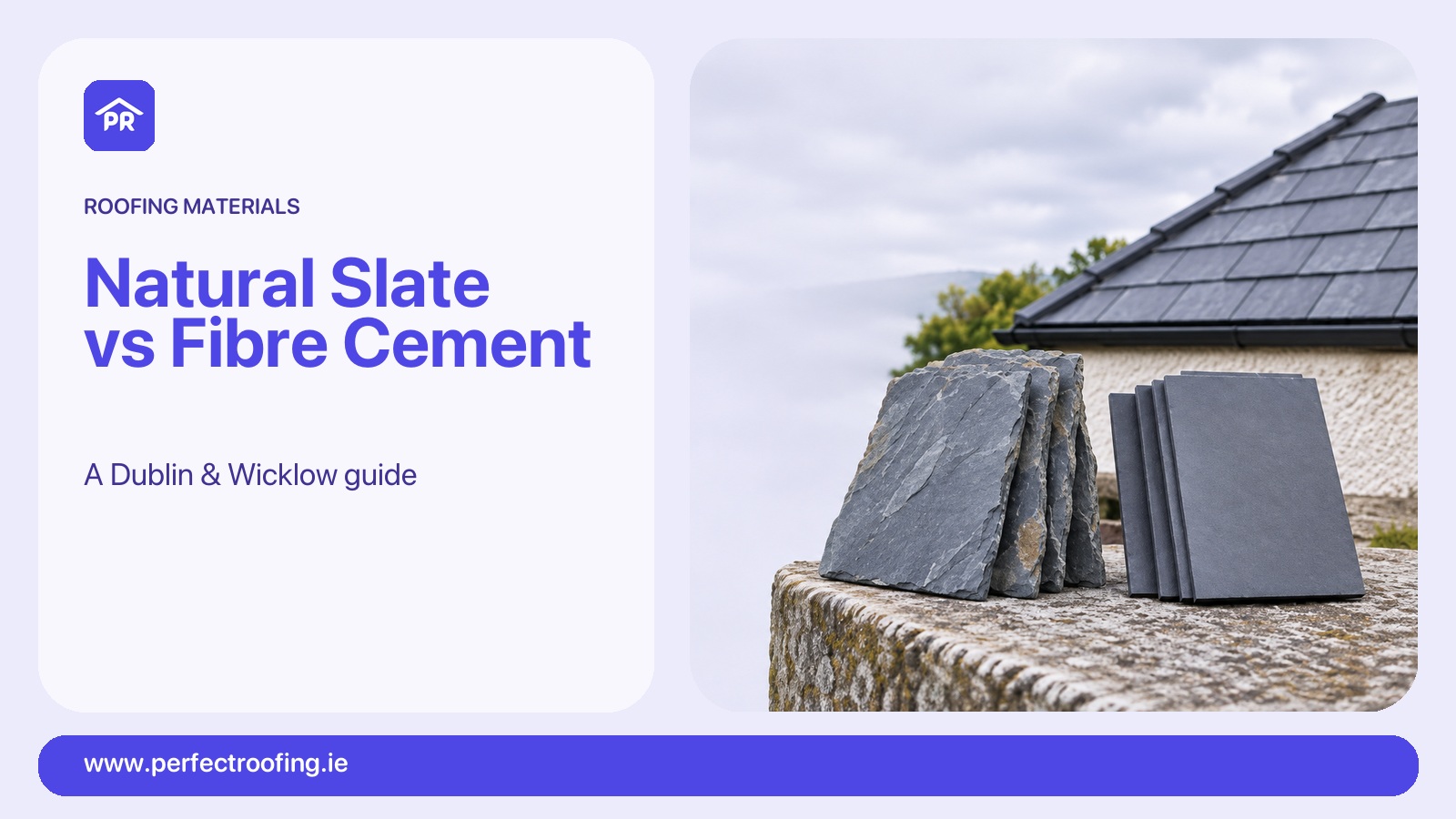
Fibre cement or synthetic slate is often chosen when homeowners want a slate-style look at a lower cost and lower weight than natural slate. It can be a practical middle ground for Dublin homes where natural slate would stretch the budget or require more structural consideration.
Cedral, formerly associated with Tegral in Ireland, is a well-known fibre cement slate name. Cedral states that its fibre cement slates are Irish-made for Irish weather and lists guarantees such as 20-year colour and 30-year structural cover for Thrutone Endurance and Rivendale, 10-year colour and 30-year structural cover for Supercem, and 50-year cover on Torres and Molina natural slates.
Fibre cement slates may suit:
- Homes that need a slate appearance without natural slate pricing.
- Renovations where weight is a consideration.
- Roofs where uniform size and appearance are helpful.
- Homeowners comparing concrete tile against a cleaner slate-style finish.
Ask to see samples in natural light. Some homeowners love the consistent finish; others prefer the variation of natural slate.
Natural slate
Natural slate is usually the premium pitched roof option. It can be the right answer for period Dublin homes, older terraces, properties where natural materials matter, or homeowners planning very long-term ownership.
Natural slate may suit:
- Victorian, Edwardian, and older Dublin properties.
- Homes where matching the original roof character matters.
- Premium re-roofs where appearance and longevity are high priorities.
- Exposed roofs where the roofer can specify suitable fixings and detailing.
Natural slate costs more because the material is dearer and installation is more skilled and time-consuming. The source and grade of slate also matter. Spanish slate, Welsh slate, and other natural slate options can sit at different price points, and not all "slate" quotes are equal.
Ask where the slate is from, what grade it is, what fixings are used, what guarantee applies, and whether the roofer has experience with natural slate roofs in Dublin weather.
Flat roof costs: EPDM, GRP, and felt
Many Dublin homes do not need a full pitched re-roof, but they do need a new flat roof on an extension, garage, dormer, porch, utility room, or bay roof. Flat roof prices are usually quoted separately because the area is smaller and the system is different.
EPDM rubber flat roofs
EPDM is a synthetic rubber membrane used on many residential flat roofs. Elevate describes RubberCover EPDM as a residential flat-roofing system for applications up to 150 square metres, with UV and ozone resistance, yearly inspection advice, and a 10-year material warranty.
EPDM may suit:
- Extensions, garages, porches, and dormers.
- Roofs where a large sheet can reduce seams.
- Homeowners who want a low-maintenance flat roof covering.
- Simple layouts without too many awkward penetrations.
The details still matter: deck condition, trims, outlets, upstands, rooflights, wall junctions, and drainage can decide whether the roof performs well.
GRP fibreglass flat roofs
GRP can create a hard, seamless flat roof surface when installed properly. Cure It, a known GRP system distributed in Ireland, lists a 20-year materials guarantee and notes that its system is designed for roofing applications.
GRP may suit:
- Flat roofs where a neat seamless finish is wanted.
- Balconies, walkways, or areas where the correct specification supports occasional access.
- Roofs with clean deck preparation and good detailing.
- Homeowners who want a crisp finished appearance.
GRP is sensitive to preparation, weather, detailing, and installer experience. A low price is not helpful if the deck, edge trims, or wall junctions are not handled properly.
Torch-on felt and bituminous systems
Torch-on felt and reinforced bituminous systems are still common on Irish flat roofs. They can be a cost-effective option, especially for simpler flat roof areas, but the quality of the system, layers, detailing, and installation method is important.
BMI Icopal is one of the well-known flat roofing system names in Ireland. BMI's Ireland site describes several guarantee levels, from product guarantees through to system and workmanship options, depending on the products and systems selected. Bauder is another recognised flat-roof manufacturer; it states that its guarantees can range from 10 to 25 years, with some systems at 30 years, and may cover materials, design advice, and approved-installer workmanship depending on the guarantee.
For a domestic flat roof, ask:
- Is the quote for a basic felt covering or a named system?
- How many layers are included?
- Is the deck being replaced?
- Are outlets, upstands, trims, and rooflights included?
- What maintenance is required?
- What does the warranty actually cover?
Which roof material is cheapest?
For a full pitched roof, concrete tile is usually the lower-cost mainstream option. Fibre cement or synthetic slate usually sits above concrete tile. Clay tile and natural slate generally move higher again, with natural slate often the premium choice.
For flat roofs, torch-on felt is often the lower-cost option, while EPDM and GRP sit higher depending on deck condition, details, and the system selected.
Cheapest is not always poor, and premium is not automatically best. A good concrete tile roof installed properly can be a better buy than a poorly detailed natural slate roof. A well-specified felt system can outperform a badly installed "premium" flat roof. The roof should match the house, exposure, access, and budget.
What should a Dublin new roof quote include?
When comparing quotes, try to compare like with like. A quote that looks cheaper may simply leave out important work.
Ask whether the quote includes:
- Scaffold and safe access.
- Removal of old tiles, slates, felt, battens, underlay, and waste.
- Skip hire and disposal.
- New breathable membrane or underlay.
- New treated battens.
- Tiles, slates, ridge tiles, hips, valleys, verge details, and fixings.
- Leadwork, soakers, flashings, chimney details, and wall junctions.
- Roof ventilation.
- Gutters, fascia, soffits, downpipes, and roofline repairs.
- Velux windows, skylights, or roof windows if part of the project.
- Flat roof sections, porches, bay roofs, garages, or dormers.
- Any timber repairs discovered after stripping.
- Clean-up, snagging, and final inspection.
- Workmanship warranty and manufacturer warranty paperwork.
If two quotes are far apart, ask both roofers to break down the specification. The difference may be material quality, scaffolding, disposal, leadwork, timber repairs, ventilation, or warranty cover.
Warranty: what really matters
Roof warranties can sound impressive, but a long number does not automatically mean the whole roof is covered for that long. Some guarantees cover the product only. Some exclude labour. Some require proof of purchase, registration, maintenance, approved installers, or full system installation. Some do not cover damage caused by poor installation, movement, storm damage, or other components.
Before choosing a material or roofer, ask:
- Is this a manufacturer product warranty or a contractor workmanship warranty?
- Does it cover materials only, or labour as well?
- Does it cover the whole roof system or just one product?
- Is registration required within a set time?
- Is maintenance required?
- Is the warranty transferable if the house is sold?
- What is excluded?
- Who handles a claim: the roofer, supplier, manufacturer, or approved contractor network?
This is especially important with well-known names. A Marley, BMI Redland, Cedral, Bauder, BMI Icopal, Elevate, or Cure It product can be a strong part of the specification, but the installer, roof design, accessories, and paperwork decide how useful the warranty is in real life.
How to judge brands without getting lost in reviews
Homeowners often ask which brand is "best" or which brand has complaints. Brand reputation matters, but roofing complaints are often about installation, poor detailing, mismatched components, bad ventilation, weak deck preparation, or unrealistic expectations rather than the tile, slate, or membrane alone.
A better way to judge a brand is to ask:
- Is the brand widely available through Irish or UK suppliers?
- Are replacement tiles, slates, trims, and accessories easy to source later?
- Does the manufacturer publish clear technical documents?
- Are compatible ridge, verge, valley, ventilation, and fixing products available?
- Is the warranty clear about what is and is not covered?
- Does the roofer have experience installing that system?
- Can the roofer show similar roofs completed with that material?
- Are online complaints about the product itself, or about poor installation and aftercare?
For many Dublin homeowners, the best choice is not the most famous name. It is the material and system that suits the roof, can be installed properly, can be maintained, and can be supported if a repair is needed years later.
When to spend more and when to keep it simple
Spending more may make sense when:
- The property is period, exposed, coastal, or visually sensitive.
- The current roof has repeated leaks in several areas.
- Natural slate or clay is needed to match neighbouring homes.
- The roof has many valleys, chimneys, dormers, or roof windows.
- The homeowner plans to stay long term.
- Scaffolding is already required, making wider roofline upgrades sensible.
Keeping the specification simpler may make sense when:
- The house suits standard concrete tiles.
- The roof shape is straightforward.
- The homeowner needs a practical weatherproof replacement without premium finishes.
- Matching surrounding estate roofs matters more than a distinctive look.
- The budget is better spent on good underlay, battens, ventilation, gutters, and flashings rather than a premium covering.
How Perfect Roofing can help with a new roof in Dublin
If you are planning a new roof in Dublin City, North Dublin, South Dublin, Lucan, Bray, Wicklow, Naas, or nearby areas, Perfect Roofing can inspect the roof and explain which options make sense for the property.
Send photos by WhatsApp, call to describe the roof, or email details of the house, location, roof type, visible defects, and any materials you are considering. Useful photos include wide shots of the front and rear roof, gutters, chimneys, valleys, roof windows, attic damp marks, flat roof areas, and any previous repairs.
Perfect Roofing can advise on roof replacement, roof repairs, flat roofing, gutters, Velux windows, skylights, ventilation, leadwork, and related roofline work. The goal is to give you a clear specification, a realistic budget, and a roof that suits the house rather than a one-size-fits-all quote.
Sources checked for pricing and product details
- RoofQuote.ie 2026 Irish new roof cost guide
- Marley concrete plain roof tile and roof system information
- BMI Redland guarantee information
- Cedral Ireland slate guarantee information
- Elevate RubberCover EPDM FAQ
- Cure It GRP roofing features from GRP Roofing Supplies Ireland
- BMI Icopal Ireland flat roof guarantees
- Bauder guarantee information
Need a roofer to take a look?
Send a few photos on WhatsApp, email us, or tap the number to call. We cover Dublin City, North Dublin, South Dublin, Lucan, Bray, Wicklow, Naas, and nearby locations.